America’s roadways, once symbols of progress and connectivity, are increasingly showing their age.
Potholes multiply, guardrails rust, and faded lane markings become silent hazards, contributing to a distressing rise in traffic fatalities across the nation.
As maintenance budgets strain and human inspection crews struggle to keep pace with the sheer scale of the problem, a new eye is emerging on the asphalt: artificial intelligence.
Cities and states are no longer just considering AI; they are actively deploying it, transforming it into an indispensable tool in the urgent quest for safer journeys.
The island state of Hawaii, grappling with a recent and alarming spike in traffic deaths—106 fatalities recorded by October 2025, surpassing all of the previous year—is at the forefront of this technological shift.
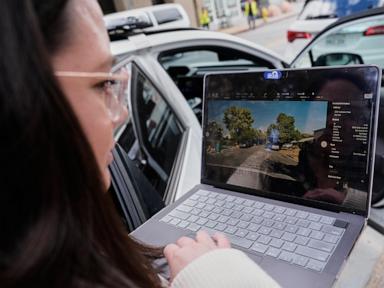
In a bold initiative dubbed “Eyes on the Road,” officials are distributing 1,000 free AI-powered dashcams to residents.
These aren’t just recording devices; they are intelligent inspectors, continuously scanning guardrails, road signs, and pavement markings.
“This is not something where it’s looked at once a month and then they sit down and figure out where they’re going to put their vans,” explains Richard Browning, chief commercial officer at Nextbase, the company behind the dashcams and imagery platform.
The system instantly differentiates between minor wear and critical emergencies, flagging issues that demand immediate attention from maintenance crews.
For a state like Hawaii, facing unique logistical challenges with equipment needing to be shipped and limited space, such real-time, automated vigilance is not merely convenient, but essential.
As Roger Chen, a University of Hawaii associate professor of engineering involved in the program, notes, “It’s not an easy problem.”
The focus on damaged guardrails is particularly poignant.
Mark Pittman, CEO of Blyncsy, which integrates dashcam feeds with mapping software, highlights their ability to analyze “all guardrails in their state, every single day.”
This constant surveillance is a direct response to the tragic consequences of neglect.
Last year, Hawaii settled a $3.9 million lawsuit with the family of a driver killed in 2020 after hitting a guardrail that had been damaged 18 months prior and never repaired.
This stark incident underscores the human cost of delayed maintenance and the critical role AI can play in preventing future tragedies.
Meanwhile, on the mainland, San Jose, California, has been quietly demonstrating AI’s efficacy in tackling a perennial urban menace: potholes.
By mounting cameras on street sweepers, the city’s system accurately identifies potholes 97% of the time.
The success has been so resounding that the effort is now expanding to parking enforcement vehicles, turning routine city operations into data-gathering missions.
Mayor Matt Mahan, a former tech entrepreneur, envisions an even more ambitious future.
He advocates for a shared AI database, arguing that collective intelligence amplifies impact.
“We could wait five years for that to happen here, or maybe we have it at our fingertips,” Mahan says, referring to AI’s ability to recognize a problem it has seen elsewhere.
This vision is taking shape through the GovAI Coalition, established in March 2024, where governments can share best practices and, eventually, critical road data.
Texas, a state with more roadway lane miles than the next two states combined, is embarking on an equally ambitious, multi-faceted AI plan.
Less than a year in, it leverages not only cameras but also anonymized cellphone data from enrolled drivers to pinpoint safety concerns.
Jim Markham of the Texas Department of Transportation marvels at the efficiency: “If something was installed 10 or 15 years ago and the work order was on paper, God help you trying to find that in the digits somewhere.”
AI, he explains, can screen 250,000 lane miles to identify old street signs long overdue for replacement, acting as a “force multiplier” that allows them to “look wider and further much faster.”
Not all AI solutions rely on the visual input of cameras.
Massachusetts-based Cambridge Mobile Telematics offers StreetVision, a system that analyzes cellphone data to identify risky driving behaviors.
Ryan McMahon, the company’s senior vice president, recalls an incident where the software flagged aggressive braking on a Washington, D.C., road.
The surprising culprit? A bush obscuring a stop sign.
“That brought me to an infrastructure problem, and the solution to the infrastructure problem was a pair of garden shears,” McMahon recounts.
This anecdote beautifully illustrates AI’s capacity to connect seemingly disparate data points to uncover root causes, leading to simple yet impactful solutions.
The current advancements, experts agree, are merely a stepping stone.
Mark Pittman of Blyncsy predicts that within eight years, nearly every new vehicle, whether human-driven or autonomous, will come equipped with a camera.
This future necessitates a fundamental shift in how transportation departments operate.
“How do we see our roadways today from the perspective of grandma in a Buick but also Elon and his Tesla?” Pittman asks, highlighting the growing imperative for infrastructure to cater to both human and automated drivers.
The road ahead, quite literally, is being paved by algorithms, offering a glimpse into a future where our journeys are not only smoother but demonstrably safer, guided by the omnipresent, tireless eyes of artificial intelligence.
-
Frank DiBernardo handles LNGFRM's Foodie and Miscellaneous writing tasks. He's always getting ideas from users, so don't be afraid to send an email to the editor.