Down the rabbit hole: Manon Gage as Marissa Marcel Photograph: Half Mermaid Productions
A new bar for elegance has been established by a computer game that examines how women are treated in Hollywood. We interview its star and creator.
You sometimes play a video game that you just cannot get out of your head. Your eyelashes may get colorful smudges while playing Candy Crush. Your dreams could include elements of The Legend of Zelda: Breath of the Wild. And every so often you come across a game that is so completely different from anything you’ve ever played that it becomes an addiction. One of them is Immortality, the most recent title from renowned game creator Sam Barlow and his firm Half Mermaid. A computer game that is also three full-length films, wrapped around a mystery that was so captivating that I couldn’t focus on anything else for days—this is something that has never been done before. It’s difficult to understand how it even functions since it’s so delicate and complicated.
Immortality opens with a talkshow footage from the late 1960s in which a young performer with brilliant eyes and red hair is being questioned about her most recent leading performance in the movie Ambrosio, which is an adaptation of a 1796 book about a diabolical temptress who leads a monk down the road of immorality. Marissa Marcel, who was at the time on the verge of success, stars in this movie with a renowned but dishonest director, but it is never published. Her subsequent film, an erotic suspenseful murder mystery about art, is similarly never released in theaters. She withdraws into obscurity for a while before making a reappearance in a Lynchian thriller about artifice and stardom in the 1990s. However, that movie is also lost, and after that she completely vanishes.
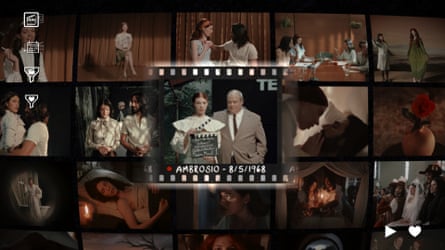
Freeze frame… players use a grid to organise their search. Photograph: Half Mermaid Productions
You, the player, now have access to a whole collection of clips, rushes, and behind-the-scenes video from Marissa’s career, adding to the intrigue around the issue of what happened to her. You can find the solution anywhere in these sections. Any feature, such as a plant, a cup, or a director’s slate, may be zoomed in on and frozen in the video to take you to a different film where the same object occurs. You move between all three movies as you go across the eras, observing themes or specific characters as you piece together not just what occurs in the movies but also what happens to the people who are producing them.
“In the history of cinema, the more extreme compromises and restraints would be landed on the women”
Together, these three movies convey a tale about filmmaking, the cost of creativity, and the mistreatment of women in Hollywood. However, the full tale of immortality is revealed via how you experience them: by reproducing them piecemeal using your intuition, paying attention to an actor’s expression or an off-camera remark, and going down rabbit holes only to find out that they are deep and branching. You must investigate these situations and look for hints as you try to solve this delicate and complex mystery. After about an hour or two of playing, you hit a turning point when you’ll be viewing a scenario and wonder, did I really see what I thought I saw? It will be wound back. Watch once again. Observe the thread. And in the center, a remarkable mystery begins to emerge.
Immortality’s director is Barlow, an unusual position in video games given that they are normally such massive, collaborative creative endeavors. However, this is not your typical video game, much like Barlow’s earlier works Her Story and Telling Lies, which are both smaller-scale puzzles that employ real actors in place of motion capture and computer graphics. “I reasoned, why don’t I genuinely develop an interactive movie if people keep calling my games interactive movies? Barlow says. “Why don’t I share my opinions on movies and explain why I find them to be so remarkable and interesting? When we break down movies and their making, it always comes down to the performers, and historically, women have been subjected to the most severe concessions and restrictions.
This game both honors and denigrates Hollywood and the film industry. Even while it may first seem to be a disturbing, heartbreaking tale of an actor who was used unfairly, it is not. Immortality is happily self-assured and sophisticated enough to handle all of these notions (and many more) at once, so there is empowerment in this. Early in the writing process, Barlow focused on the auteur director movement and the European New Wave, as well as the explosion of sensuality and sexuality represented on film, the golden era of cinema of the 1970s, the demise of the studio system, and the emergence of the auteur director.
According to Barlow, “We talked to a number of folks who were engaged in creating movies back then.” The femme fatale was a character archetype that was developed to titillate males, but women who play them are portraying a character that has greater agency, is driving the story, and has a degree of sexual expression that is denied to most female characters. Through the sexual thriller, a prism through which males could cope with their mounting concern about what a future in which everyone was equal looked like, we followed that thread into the 1980s and 1990s.
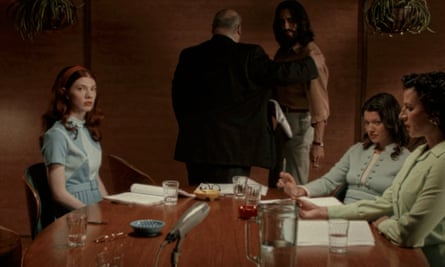
Looking for clues … behind-the-scenes footage for players to piece together. Photograph: Half Mermaid Productions
Over the course of three months in LA in the summer of 2021, Immortality was filmed (and was almost scuppered several times by Covid). Even though it was hard to imagine what Immortality might truly be, Manon Gage, the actress who portrays Marissa in the game, was immediately pulled to the character. She recalls that her first audition consisted of just a few scenes. “Marissa in each of the three films, and I wondered, “What are we doing here? This scope is extraordinary. How is this a game on a computer? The 400-page screenplay included some of the greatest writing I’d seen in a long time. Sincerely speaking, you don’t read writing this nice, particularly if you’re a relative beginner. I was immediately taken in.
The cast claims that Barlow spent hours talking with each of them one-on-one while describing how the game will operate. Hans Christopher, who portrays John Durick, the director of photography and one of the few constants in Marissa’s career, says, “I got into what he was saying, but I was still hard to get my brain around what was going on. But I got the impression that he was aware of it, so that was all we needed to be concerned about.
The performances are important because this is a multi-layered story in which each performer is an actor playing an actor playing a role. If the player doesn’t think they’re seeing real people and getting a peek behind the scenes of actual film projects, then the game’s central conceit starts to unravel. According to Gage, “We were always considering our connection to the viewer in an intriguing manner.” “If there is an off-camera look, you can be sure that the actor will notice it, wonder what it was, and take the hint. With that, I had fun playing. While breaking the fourth wall, you are also allowing others inside.
Although it was challenging to imagine how people would feel their work, Charlotta Mohlin, whose nameless but crucial role in Immortality, thinks it was. “At one point, I questioned if I would be discovered in the game. Will I be seen by other players? “, she chuckles. “We all understood it as a tale, but until I played it, I couldn’t get my mind around how people would locate items in scenes and navigate between them,” says the author.
Immortality is a technical achievement in both programming and filmmaking, requiring 10 hours of video and three separate films. Barlow and Half Mermaid had to sift through the film frame by frame after it had been taken, selecting doorknobs, plants, and various people to add to the game’s database so that the user could click on them and put the movie together. At first, the fragmented nature of these movies’ experiences is disconcerting, but that’s what makes Immortality unique: no two players (or spectators) will experience it in the same manner. How can you create a tale that makes sense regardless of the sequence in which you read it?
It surprises me that Barlow’s response is that you don’t really need to design it that way. He claims that when it comes to stories, “the present audience member is so much more sophisticated than someone from 50 years before.” “Storytelling is so prevalent in our culture that we have internalized all of the tropes and frameworks. It is thus extremely simple for people to fit the parts of a tale together when you give them bits and pieces. But even if we see the identical pieces, it’s still beneficial to engage the player’s mind and imagination more. It is by nature more engaging.
With Immortality, you will ultimately find a conclusion after more than five hours. No matter which film you have already located and which is still buried inside the collection, you will eventually uncover an answer. What it all really means, though, is up for interpretation since your approach to the game and how you go through it will give you a different set of solutions. Even the game’s performers don’t all agree on how to interpret its themes.
“The concept of film capturing a moment of truth – in a way that is immortal,” says Christopher. “That is something that will live on for ever. The game wants to capture that, bring you in and feel like you are now part of this grand, living moment – that you, too, are immortalised.”
Thanks to Keza MacDonald at The Guardian whose reporting provided the original basis for this story.
-
Frank DiBernardo handles LNGFRM's Foodie and Miscellaneous writing tasks. He's always getting ideas from users, so don't be afraid to send an email to the editor.


