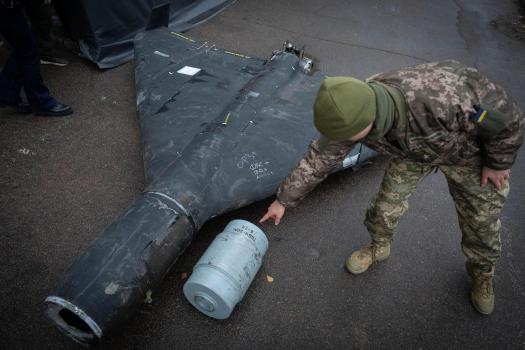
The relentless hum of countless drones has become the new soundtrack to Ukrainian nights, a chilling symphony of destruction that signals Moscow’s grim resolve.
What began as sporadic attacks has escalated into a nightly deluge, with Russia now unleashing more unmanned aerial vehicles in a single evening than it did during some entire months earlier this year.
The numbers are staggering, a testament to a shift in warfare that promises to redefine the conflict: over 700 drones on July 8 alone, a record that analysts warn could soon breach the 1,000-a-day mark.
This dramatic surge is no accident; it is the calculated outcome of a strategic pivot by the Kremlin.
Russia is not merely using drones; it is building a dedicated “drone force,” a separate military branch dubbed the Unmanned Systems Troops.
This commitment is underpinned by a burgeoning domestic production capability that has moved far beyond reliance on imported Iranian Shaheds.
The Russian “Geran” — a redesigned, more lethal replica — is now pouring out of factories, including the notorious Alabuga plant, which reportedly churns out these instruments of war on an industrial scale.
The imagery from Alabuga is stark: hundreds of black Geran drones stacked under Soviet-era propaganda posters, a chilling fusion of historical ambition and modern technological might.
The plant director, Timur Shagivaleyev, encapsulates the new reality with chilling clarity: “It’s a war of drones. We are ready for it.”
The evolution of the Geran is equally alarming.
Russian engineers have tweaked the original design, increasing its altitude and making it harder to intercept.
They’ve enhanced its resistance to jamming and equipped some variants with potent thermobaric warheads, capable of incinerating targets.
Most unsettlingly, some now boast artificial intelligence, allowing them to operate autonomously, making the decision-making process of destruction even more detached and efficient.
While the standard Geran still trundles along at 110 mph, a faster jet version is reportedly on the horizon, promising to shrink Ukraine’s already strained reaction windows.
This industrial-scale production and rapid innovation have, according to Ukrainian military intelligence, been facilitated by a critical lifeline: China.
Up to 65% of the components for Geran drones are allegedly sourced from Chinese suppliers, a claim Beijing denies but which, if true, underscores the porous nature of international sanctions and the complex web of global supply chains fueling this war.
Despite Ukrainian drone attacks on these production facilities, Moscow’s output remains undeterred, a testament to a resilient, perhaps even ruthless, industrial base.
Russia’s tactical playbook has also matured.
The sheer volume of drones is now complemented by cunning deception.
Decoy drones, aptly named “Gerbera” (for a type of daisy), are deployed to mimic their deadlier counterparts, confusing Ukrainian air defenses and drawing away precious, expensive missiles from the true targets.
This strategy allows more costly cruise and ballistic missiles to slip through, hitting critical infrastructure, air defense batteries, and air bases.
As military bloggers like Alexander Kots observe, Russia is no longer “spreading its fingers but hitting with a punching fist in one spot,” focusing massive strikes to maximize impact.
The drones, capable of roaming Ukrainian skies for hours, zigzagging past defenses, embody a relentless, attritional logic.
The financial calculus behind this strategy is stark.
While ballistic and cruise missiles cost millions, a Geran drone costs only tens of thousands of dollars.
This makes them, as the Center for Strategic and International International Studies (CSIS) notes, “the most cost-effective munition in Russia’s firepower strike arsenal.”
Despite international sanctions, Russia’s military spending has soared, rising 3.4% over 2024 to an estimated $200 billion this year.
President Putin boasts of over 1.5 million drones of various types delivered to the military last year, a figure that, even if partially inflated, speaks volumes about the scale of the commitment.
The Kremlin, it appears, can afford this brutal, high-volume approach.
For Ukraine, the challenge is existential.
Their defenses, while valiant, are stretched thin.
Mobile teams armed with machine guns offer a low-cost, desperate countermeasure, preserving invaluable Western-supplied air defense missiles.
Ukraine is also racing to scale up its own interceptor drone production, but the rising tide of Russian attacks threatens to overwhelm their capabilities.
The very nature of the conflict along the 600-mile front line has been transformed; short-range attack drones now swiftly identify and target troops within a tight 6-mile kill zone.
The advent of fiber optic drones, immune to jamming and boasting extended ranges, allows strikes deep into what were once considered safe rear areas, targeting supply lines, support structures, and command centers.
As Michael Kofman, a military expert, aptly puts it, these Russian advancements demand new defensive paradigms for Ukraine.
The rear must be protected, entrenchment must go deeper.
Ukrainian President Volodymyr Zelenskyy sees Moscow’s intention clearly: “to intimidate our society,” with aspirations of launching up to 2,000 drones in a single attack.
This isn’t just about destroying infrastructure; it’s about breaking spirit, grinding down resistance through sheer, relentless pressure.
The “war of drones” is no longer a futuristic concept; it is the grim, present reality, shaping battlefields and terrorizing populations, a chilling testament to how quickly modern warfare can evolve into a devastating, automated nightmare.
-
Frank DiBernardo handles LNGFRM's Foodie and Miscellaneous writing tasks. He's always getting ideas from users, so don't be afraid to send an email to the editor.