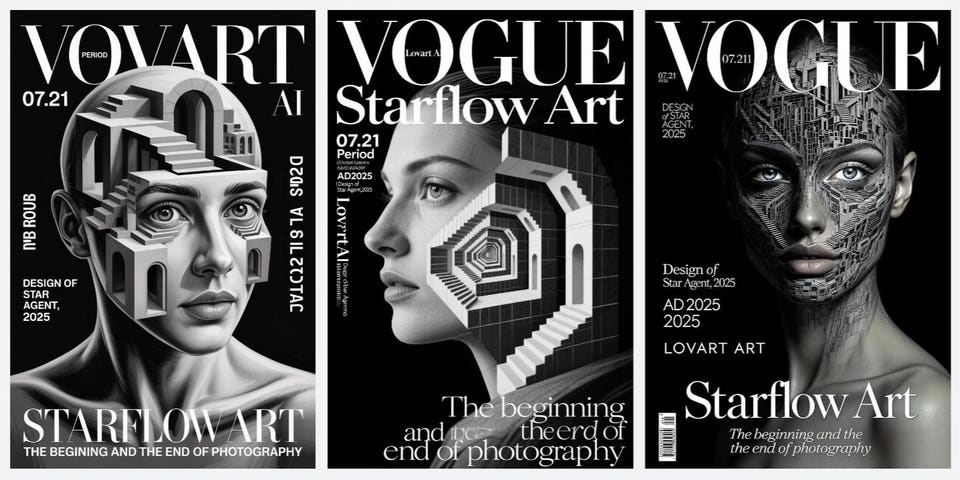
A quiet revolution in the creative world took a decisive step forward this week as San Francisco-based Lovart AI officially launched globally, promising to democratize agency-grade design work for a price point that could make established firms wince.
For less than $90 a month, Lovart AI claims to deliver the kind of visual assets that once required a six-figure branding agency, all within minutes and from a single text prompt.
It’s a bold declaration that signals a seismic shift in how design might be conceived, executed, and consumed.
Marketed as the world’s first “Design Agent,” Lovart AI isn’t merely another image generator.
Its core innovation lies in combining a proprietary reasoning engine with a sophisticated stack of leading generative models, enabling it to churn out everything from intricate logos and product packaging to dynamic video content and complex 3D assets.
The ambition is clear: to interpret creative briefs with the nuance of a human creative director, coordinating a veritable team of specialized AI agents through a unique system they’ve dubbed “Mind Chain of Thought.”
Users engage with this formidable engine via a natural-language interface within a collaborative workspace called ChatCanvas.
Imagine asking for “a coconut latte brand with a brown color scheme,” and receiving a complete visual system, including posters, product renders, social media graphics, and even a sample video ad.
This isn’t just generating an image; it’s generating an entire brand universe.
Having spent the past month interacting with Lovart AI, this journalist can attest to its surprising capabilities.
As an ideation tool, it is, frankly, a home run.
Its ability to surprise with unexpected creative interpretations and generate 40 polished assets simultaneously – from UI flows to 3D models – is a genuine differentiator.
The user experience, a critical factor in the adoption of any new technology, is remarkably smooth.
As one Reddit user aptly put it, “Compared to Midjourney or Leonardo, the UX here is just smooth. Everything feels like it’s made for creators, not engineers.” Another lauded its minimal prompt requirements, noting, “You can get hyper-detailed shots without endless tweaking.”
This ease of use, coupled with its broad output, makes it an incredibly powerful starting point for any creative endeavor.
However, the path from ideation to final execution still presents a familiar AI hurdle.
While Lovart AI excels at generating initial concepts and a wide array of visual assets, precision adjustments remain its Achilles’ heel.
Despite the presence of an inpainting tool, it often proved faster to export the Lovart design into Photoshop for the final, precise tweaks.
The client, it must be said, loved the outcome, but the distinction between AI as a powerful ideation partner and a complete, autonomous design solution remains.
Lovart AI’s closed beta attracted over 800,000 users from 70 countries, drawing interest not just from professional designers but also from solo founders, student creators, and marketers perpetually pressed for time and resources.
As a team member shared on Reddit, “A lot of early users are solo builders and startup teams who don’t have the time or team to start from scratch every time.” This speaks to the profound need Lovart AI aims to fill: democratizing access to high-quality design for those traditionally priced out of agency services or lacking the in-house expertise.
Lovart’s founders, CEO Melvin Chen, a Carnegie Mellon trained AI researcher, and Haofan Wang, envision a future where designers teach AI how to think.
“The canvas is the desk. The agent is your teammate,” Chen stated, articulating a vision of collaboration rather than replacement.
Yet, Lovart AI is stepping into an arena already dominated by titans.
Adobe, with an estimated 80% market share according to Statista, and Canva, holding 12.5%, are formidable competitors.
Canva has already integrated Leonardo AI, while Adobe’s Firefly AI image and video generator is deeply embedded within its Creative Suite, available to enterprise users.
Crucially, Adobe trains its models exclusively on licensed content from Getty Images and indemnifies users against copyright claims—a significant safeguard in a rapidly evolving legal landscape surrounding AI-generated content.
Lovart AI has not disclosed its content sourcing or copyright indemnification policies, a potential flashpoint in an industry increasingly concerned with intellectual property.
Lovart AI has not yet disclosed venture funding, though whispers of a $7.5 million seed raise are circulating.
For now, the focus is squarely on traction.
It topped Product Hunt on launch day, and enthusiasm on platforms like Discord and Reddit remains palpably high.
One user’s enthusiastic summation, “This is what happens when Figma and Midjourney have a baby. And it doesn’t sleep,” perfectly encapsulates the excitement and the relentless potential of this new tool.
The question looming over Lovart AI, and indeed the entire AI design sector, is profound: Is being really good, really good enough in this insanely crowded, rapidly evolving market?
Lovart AI offers free and paid tiers, inviting users to explore its capabilities.
Its success will hinge not just on its technological prowess, but on its ability to carve out a unique value proposition, navigate the complex legal and ethical terrain of AI-generated content, and convince a skeptical world that the future of design is indeed an agentic one, always on, always creating, and always ready to be a teammate.
The creative landscape is shifting beneath our feet, and Lovart AI is one of the most compelling new players on the field.
-
Frank DiBernardo handles LNGFRM's Foodie and Miscellaneous writing tasks. He's always getting ideas from users, so don't be afraid to send an email to the editor.