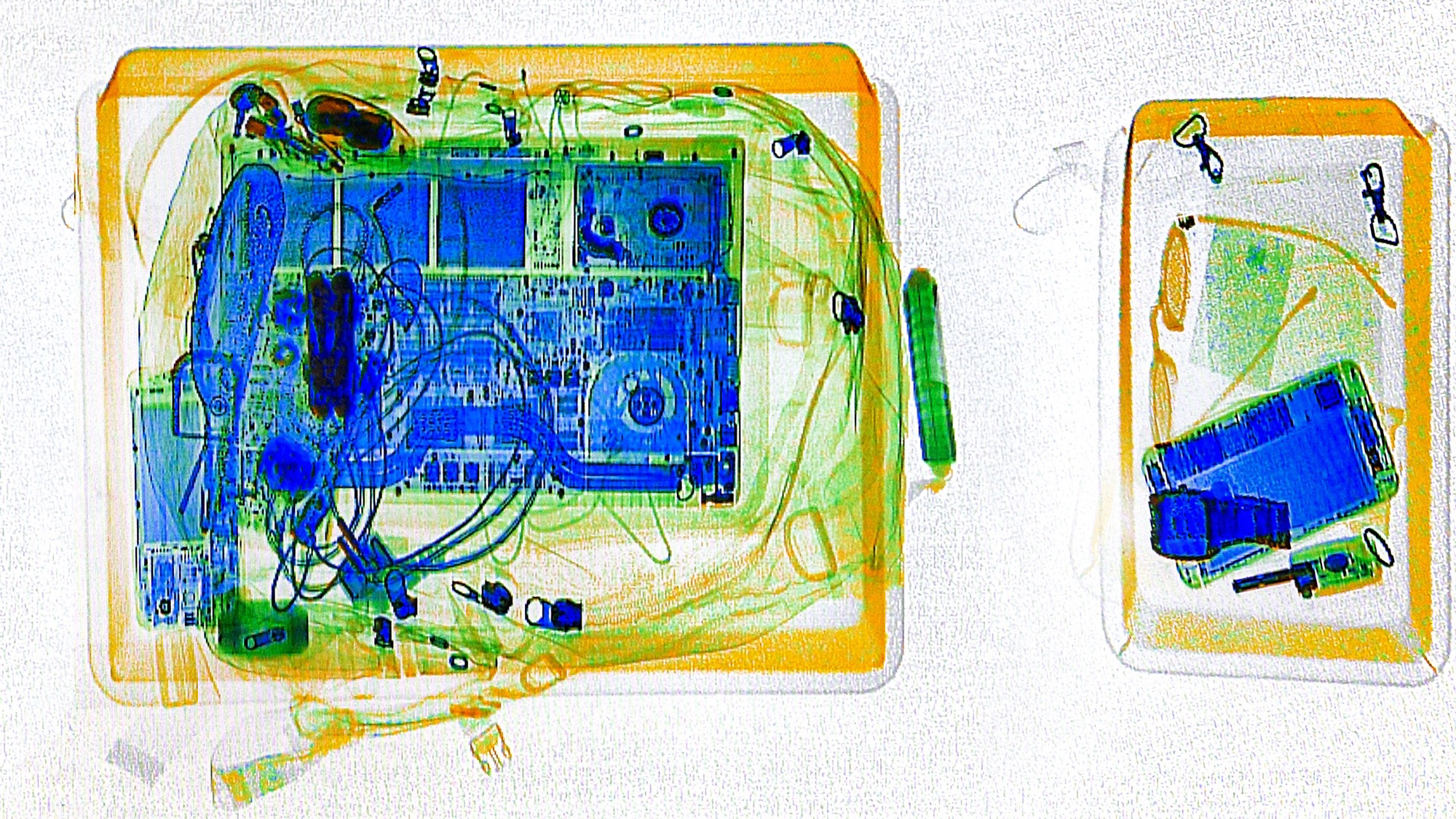
The airport security checkpoint: a universally recognized crucible of pre-flight anxiety.
We’ve all been there, fumbling with shoes, wrestling laptops from bags, and silently praying that forgotten water bottle won’t trigger a full-blown cavity search of our carry-on.
But as your meticulously packed luggage glides into the maw of the X-ray scanner, have you ever truly pondered what secrets it reveals?
What exactly does that squiggly, multicolored display tell the Transportation Security Officer (TSO) peering into your personal effects?
As it turns out, a whole lot more than you might imagine.
The transformation of airport security post-9/11 fundamentally reshaped our travel experience, and at its heart lies the sophisticated gaze of the Computed Tomography (CT) system.
Since 2002, these medical-grade marvels have become the silent sentinels of our skies.
Unlike the old, flat X-ray images, CT scanners employ a dazzling ballet of technology, sending low-dose X-rays through your bag while an X-ray camera spins around it, capturing hundreds of images.
These aren’t just pictures; they’re data points that, when processed by sophisticated algorithms, construct a three-dimensional, rotatable image of your bag’s contents.
Imagine the digital equivalent of an MRI for your suitcase.
This 360-degree view allows TSOs to differentiate between metals, liquids, and even organic materials with astonishing precision.
That forgotten bottle of sparkling water? Visible.
The pile of cash you hastily shoved in a side pocket? Absolutely.
A container of pills? Clear as day.
Even items cunningly concealed within electronics don’t escape this digital scrutiny.
It’s this level of detail that allows TSOs to spot the truly dangerous items—knives, guns, and explosives—before they ever make it onto a plane.
The statistics themselves are staggering.
Last year alone, the TSA screened over 2 billion carry-on bags and a staggering 494 million checked bags.
This monumental effort yields an equally monumental haul of prohibited items.
According to the TSA, smaller airports might see hundreds of pounds of confiscated goods annually, while the largest hubs can accumulate as much as 2,000 pounds, or a full ton, of prohibited items per month.
This isn’t just about catching the obvious threats; it’s about managing the sheer volume of human oversight and, at times, sheer absurdity.
What exactly do they find?
The list reads like a bizarre inventory from a lost and found at a supervillain convention.
Beyond the expected knives, martial arts items, and large tools, TSOs have encountered everything from fireworks and replica grenades to actual snakes and literal kitchen sinks.
The annual roundups on the TSA’s official YouTube channel are a testament to human ingenuity—and sometimes, outright foolishness.
Remember the passenger who tried to hide a vape in a tube of toothpaste?
Or the knife baked into a loaf of bread?
And then there are the more sinister attempts: a DIY explosive in a soda can, or drug mules attempting to conceal narcotics in hair scrunchies and fentanyl in candy.
It’s a stark reminder that while most travelers are simply trying to get from A to B, a determined few are always pushing the boundaries.
The evolution of this technology also hints at a future where airport security might feel less like an intrusive hurdle and more like a seamless transition.
The newer CT scanners are so adept that travelers can now, in many cases, leave their laptops nestled comfortably in their carry-ons, a small victory for convenience that once seemed impossible.
There’s even a tantalizing prospect on the horizon: scanners so advanced they can determine if the liquids in your luggage contain explosives, potentially paving the way for a glorious return to full-sized shampoo bottles in our carry-ons.
But what happens to all these oddities and forbidden treasures?
It’s a common urban myth that TSOs gleefully swipe that fancy bottle of Scotch or designer perfume you had to surrender.
The reality is far less glamorous, and perhaps a bit more fascinating.
The vast majority of items surrendered or forgotten at airport security checkpoints don’t end up in an agent’s personal stash.
Instead, they find a second life at state-sponsored auctions, often on platforms like GovDeals.com.
So, while you might still be miffed about losing your favorite skincare product, there’s a strange, almost poetic circle of life at play.
Someone, somewhere, might be bidding on a collection of kitchen knives or even a MacBook, all thanks to the daily churn of airport security.
Ultimately, the sophisticated digital eye of the TSA scanner is a critical layer in the complex tapestry of modern air travel security.
It’s a constant, silent battle between technology and human ingenuity, vigilance and forgetfulness.
It serves as a reminder that behind the quick flash of the X-ray, there’s a world of hidden details, from the mundane to the malicious, all under the watchful gaze of an evolving system designed to keep us safe in the skies.
-
Frank DiBernardo handles LNGFRM's Foodie and Miscellaneous writing tasks. He's always getting ideas from users, so don't be afraid to send an email to the editor.