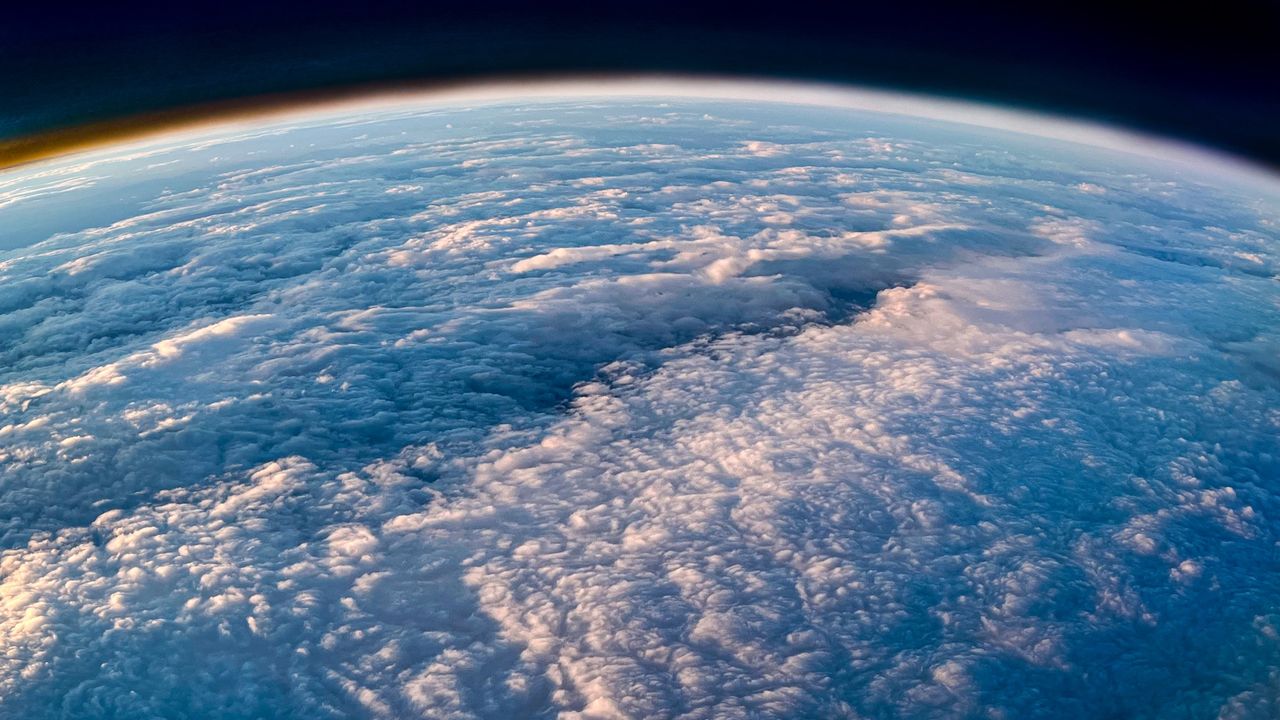
For decades, a crucial segment of Earth’s atmosphere has remained stubbornly out of reach, a scientific blind spot aptly dubbed the “ignorosphere.”
Too high for conventional aircraft, too low for the persistent gaze of low-Earth-orbiting satellites, this enigmatic region, stretching from roughly 30 to 100 miles above our planet, has held its secrets close.
Yet, a recent breakthrough promises to finally illuminate this uncharted territory, thanks to a remarkably elegant solution: tiny, sunlight-propelled devices that could revolutionize our understanding of everything from climate change to space weather.
The innovation, detailed in a paper published in Nature, centers on the phenomenon of photophoresis.
Imagine a minuscule, ultra-thin membrane, no larger than a button, made of aluminum oxide and a whisper-thin layer of chromium.
When sunlight strikes one side, it warms slightly more than the other.
As gas molecules in the surrounding low-pressure environment bounce off this warmer surface, they impart a subtle but continuous push, gently nudging the membrane upward.
This effect, though incredibly weak, becomes significant in the near-vacuum conditions found at the edge of space, allowing these “self-lofting” devices to defy gravity.
Ben Schafer, lead author of the paper and a researcher at the Harvard John A. Paulson School of Engineering and Applied Sciences (SEAS), describes the recent successful tests in a vacuum chamber as a pivotal moment.
“That’s a big result showing that this would actually work in the same conditions that you have in the upper atmosphere,” Schafer explained to Space.com.
The team successfully floated 0.4-inch (1 centimeter) specks using light only 55% as intense as natural sunlight, a clear demonstration of the technology’s viability.
The significance cannot be overstated for a region that has long vexed atmospheric scientists precisely because, as Schafer notes, “there is nothing that can fly there.”
The ignorosphere, encompassing the mesosphere and a portion of the thermosphere, is far more than just a void.
It serves as a critical boundary, the very interface where Earth’s protective gaseous shroud meets the vastness of outer space.
It is here that the colossal energy from solar events, such as coronal mass ejections (CMEs), is largely absorbed, triggering the mesmerizing auroral displays that dance across polar skies.
It is also the crucible where energetic exchanges lead to geomagnetic storms, phenomena capable of disrupting power grids and knocking satellites off their carefully plotted orbits.
Furthermore, this is the final resting place for countless re-entering satellites, their fiery demise leaving behind a lingering, poorly understood atmospheric pollution.
The lack of continuous, precise data from this region has created a significant gap in our knowledge, hindering everything from accurate space weather predictions to the refinement of global climate models.
“Getting accurate data from this region about winds, temperatures, pressures, etc. would really up the accuracy of existing global climate models,” Schafer asserts.
“It would fill that gap that we have.”
The vision extends beyond mere scientific curiosity.
Schafer and his colleague Angela Feldhaus have already spun out a company from Harvard SEAS, aptly named Rarefied Technologies, with the aim of commercializing these innovative devices.
The practical application envisions slightly larger membranes, around 2.4 inches (6 cm) wide, capable of lifting miniature sensors and antennae weighing about 10 milligrams.
These tiny scouts would be released from stratospheric balloons at altitudes of approximately 30 miles (50 km).
From there, they would passively ascend to up to 60 miles (100 km) during the day, riding the solar winds.
At night, without the solar propulsion, they would gently descend, but if light enough, would remain suspended in the upper atmosphere, ready to rise again with the dawn.
The immediate focus for Rarefied Technologies is refining the material and structure to further reduce weight, enabling even larger and more capable devices.
What makes this breakthrough particularly compelling is its lineage.
Photophoresis itself is not a new discovery; it was first observed in the 19th century.
Yet, for over a century, it remained largely a scientific curiosity, awaiting the advent of advanced material science and nanofabrication technologies that could finally harness its potential.
The current work, in a fascinating twist, draws inspiration from a theoretical paper by David Keith, then a professor at Harvard SEAS and now at the University of Chicago.
Keith had proposed using reflective photophoretic membranes as a radical geoengineering intervention – a way to reflect sunlight and cool Earth if climate change mitigation efforts failed.
This high-stakes, ambitious concept provided the intellectual foundation for Schafer’s more immediate, practical application.
As Keith himself noted, this research “opens up an entirely new class of device: one that’s passive, sunlight-powered, and uniquely suited to explore our upper atmosphere.”
The implications of this technology stretch far beyond Earth’s ignorosphere.
Schafer envisions these passive, solar-powered gliders exploring the thin atmosphere of Mars, offering a new paradigm for planetary atmospheric science.
Perhaps even more audacious is the prospect of these devices one day competing with the likes of SpaceX’s Starlink satellite broadband constellations.
While currently requiring significant advancements in payload capacity and navigation, the idea of a network of sunlight-powered communication nodes floating in the mesosphere, offering data rates comparable to low-Earth-orbit satellites, presents a truly disruptive vision for global connectivity.
From a 19th-century scientific oddity to a potential geoengineering solution, and now to a tangible tool for unlocking the secrets of our planet’s atmospheric frontier, the journey of photophoresis is a testament to the enduring power of scientific inquiry and the unexpected paths of innovation.
The ignorosphere, it seems, may not be ignored for much longer.
-
Frank DiBernardo handles LNGFRM's Foodie and Miscellaneous writing tasks. He's always getting ideas from users, so don't be afraid to send an email to the editor.