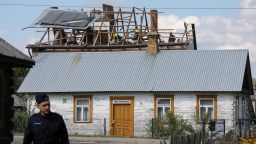
The unsettling wail of air-raid sirens, quickly followed by the thunderous roar of NATO fighter jets, shattered a peaceful late-summer night over eastern Poland.
It was a stark, jarring symphony of modern warfare, prompted not by incoming missiles, but by a swarm of nearly two dozen Russian drones violating alliance airspace.
The incident, which Poland believes was a deliberate probe of its defenses, has ignited a critical debate across Europe: can NATO innovate fast enough to counter a threat that is cheap, ubiquitous, and rapidly evolving? importance of NATO
The immediate response was undeniably robust.
Multimillion-dollar F-16s and F-35s scrambled to avert the perceived danger, an effective show of force that likely cost tens of thousands of dollars in fuel and maintenance. role of NATO fighter jets
Yet, the fragments recovered on Polish soil told a different story – remnants of Gerbera drones, crafted from plywood and Styrofoam, often used as decoys, with an estimated production cost of just $10,000 each. evolution of drone technology
This stark contrast exposes the core dilemma facing NATO: a crippling cost asymmetry. cost asymmetry in defense spending
“The cost asymmetry doesn’t work,” observed Robert Tollast, a researcher at the London-based Royal United Services Institute (RUSI), highlighting a fundamental flaw in current defensive strategies.
While NATO demonstrated its capability in averting a massive Iranian drone and missile attack on Israel last April, the estimated billion-dollar price tag for that defense effort renders such an approach unsustainable in the long run.
The uncomfortable truth, Tollast argues, is that “before Ukraine, a lot of Western defense technology just didn’t consider this… asymmetric threat of drones.”
Yet, the consensus among the burgeoning military tech sector is less about a lack of foresight and more about a glacial pace of adoption within NATO’s defense ministries.
“The tech is there,” asserted Johannes Pinl, CEO of MARSS, a UK-based company specializing in threat-detection software and now producing its own interceptor drones.
Speaking at the DSEI defense forum, Pinl painted a vivid picture: “Probably a good part of the Polish border could have been covered now with a nice drone wall.”
This “drone wall” concept – a layered network of detection and interception – is gaining traction, particularly among Baltic countries and European Union officials.
But the bottleneck, Pinl laments, lies in NATO’s procurement systems, which he describes as “still in the 80s.” procurement systems in military
He cited MARSS’s AI-enabled interceptor, a reusable titanium-framed drone designed to “basically cut through the incoming drone at speed,” which has been operational for years but is only now awaiting evaluation by a NATO country.
The traditional process, where defense ministries laboriously draft detailed technical specifications before companies can even bid, is simply too slow for the current pace of innovation.
The war in Ukraine, however, has inadvertently created a fascinating, if frustrating, two-speed procurement process in Europe.
Siete Hamminga, CEO of Netherlands-based Robin Radar Systems, whose technology is already widely deployed in Ukraine to detect Shahed drones at a 12-kilometer range, illustrates this perfectly. Ukraine’s defense technology advancements
“If a country wants to buy equipment for Ukraine, they have a highway route to do so,” he explained, with a mandate to procure “XYZ ASAP.”
But for their own national defense, they must navigate a labyrinthine bureaucratic procedure.
Despite these systemic hurdles, Ukraine has become a real-time crucible for new defense technology, forcing a reckoning within Western capitals.
Portuguese-founded defense tech startup Tekever, for instance, has seen the UK government purchase over $350 million worth of its AR3 surveillance drones for Ukraine since 2022.
The Royal Air Force (RAF) has now adopted the AR3 for its new electronic warfare system, StormShroud, a testament to the accelerated learning curve.
Tekever is scaling rapidly, opening a new 1,000-job drone factory west of London, its fourth UK site.
Karl Brew, head of Tekever’s defense unit, credits a shared risk model between government and industry, allowing the RAF to integrate their technology within six months by leveraging “all the experience in Ukraine” and adding “special sauce of Western technology.”
This newfound urgency is echoed at the highest levels.
Richard Knighton, the new Chief of the UK Defence Staff, recently emphasized the need to “change our relationship with industry to innovate at a wartime pace.”
In Latvia, proximity to Russia is driving even greater urgency.
Agris Kipurs, CEO of drone startup Origin Robotics, whose BEAK attack and surveillance drone is now used by Latvian and UK armed forces, revealed his country is “developing new mechanisms for how to work with the new industry.”
Origin’s new interceptor drone, BLAZE, is funded by a Latvian government R&D grant, a clear signal that small nations recognize they “will never be able to afford sufficient air defense capability if we are limited to the options that we currently have in the markets.”
Even the US Department of War (recently renamed to reflect the shifting global landscape) is now racing to get ahead of this drone and counter-drone arms race.
A July memo from Secretary Pete Hegseth warned that “US units are not outfitted with the lethal small drones the modern battlefield requires,” outlining measures to cut red tape and delegate procurement authority directly to warfighters.
“One of the key lessons people are taking from Ukraine is, just experiment,” Tollast noted, advocating a “high-low mix of very expensive capabilities” like F-35s and Patriot batteries, alongside “things that might be a little bit less reliable, like Ukraine’s drone interceptors.”
But even if Europe can accelerate the adoption of experimental, lower-cost tech, the sheer volume of the threat remains daunting.
Russia, according to Ukrainian intelligence, is now churning out 5,500 units per month of its updated Shahed-equivalent, the Geran, and the cheaper Gerbera variant, from its rapidly expanding factory in Tatarstan.
This month, Ukraine endured a single night where Russia launched over 800 drones.
Morten Brandtzaeg, CEO of Norwegian ammunition and missile producer Nammo, articulated the stark reality.
His company is working on “higher volumes of low-cost missiles” to “match the price of the missile with the target that we’re shooting down.”
Nammo, now one of Europe’s largest ammunition producers, has already scaled artillery ammunition production from a few thousand shells annually to 80,000 last year.
Yet, his message to policymakers is unequivocal: “We are just in the beginning of the beginning of ramping up the capacity. Don’t believe that we have done enough.”
The drone threat is not merely a tactical challenge; it is a strategic inflection point for NATO.
The alliance’s ability to adapt, to shed the inertia of peacetime procurement, and to embrace innovation at a wartime pace will define its relevance and security in an increasingly complex and dangerous world.
The sirens over Poland were a warning, and the clock is ticking.
-
Frank DiBernardo handles LNGFRM's Foodie and Miscellaneous writing tasks. He's always getting ideas from users, so don't be afraid to send an email to the editor.