The unsettling quiet of a late Danish night was shattered not by the roar of fighter jets, but by the silent, almost imperceptible hum of drones.
These weren’t hobbyist toys or delivery vehicles gone astray; they were, according to Danish authorities, instruments of a sophisticated “hybrid attack”, deliberately probing the nation’s critical infrastructure and, most alarmingly, its most sensitive military installations.
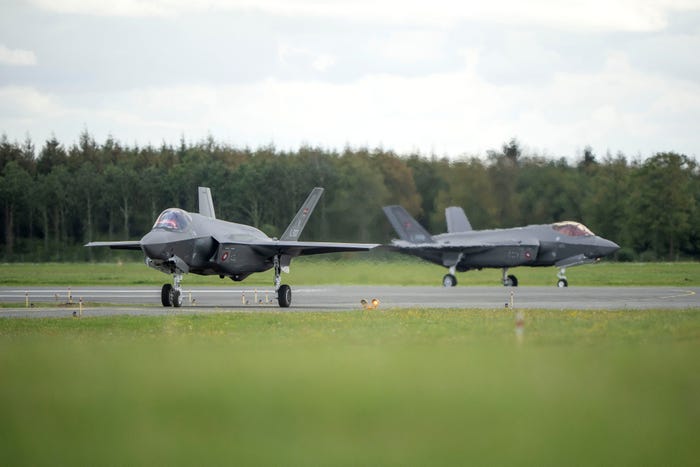
The sightings near multiple airports, including Copenhagen, caused temporary shutdowns, but the real jolt came with reports of drones hovering near the Skrydstrup airbase – home to Denmark’s cutting-edge F-35 stealth fighters.
This wasn’t merely a nuisance; it was a carefully orchestrated act, a chilling demonstration of a new front in an undeclared conflict.
Defense Minister Troels Lund Poulsen minced no words, stating that “everything points to this being the work of a professional actor,” defining it as a “hybrid attack using different types of drones.”
Justice Minister Peter Hummelgaard echoed the sentiment, identifying the motivation as a desire “to create fear” and sow division, leaving no options off the table regarding who might be responsible.
While no specific nation was publicly blamed, the shadow of Russia looms large over these incidents, a persistent specter in the European security landscape.
The timing of these Danish disruptions is no coincidence.
They arrive amidst a period of heightened tension across NATO’s eastern flank, where Russian belligerence has become a distressingly frequent occurrence.
Just weeks prior, Russian drones violated Polish airspace, leading to their interception by NATO jets and the temporary closure of an airport.
Moscow predictably denied intent, a claim swiftly rejected by Warsaw.
Days later, three Russian MiG-31 interceptors lingered for 12 minutes in Estonian airspace, another incident dismissed by Russia as a non-event.
These aren’t isolated errors; they are part of a discernible pattern, a relentless “shadow war” designed to test alliance defenses, gauge response times, and ultimately, destabilize.
The deployment of cheap, commercially available drones against high-value military assets like the F-35 base at Skrydstrup highlights a profound asymmetry in modern warfare.
Here stand some of the world’s most advanced, multi-million-dollar combat aircraft, designed to dominate the skies in conventional conflicts.
Yet, their security is challenged by objects costing a mere fraction, easily procured, and difficult to detect and counter.
This scenario underscores a critical vulnerability that NATO, accustomed to Cold War-era threats, is still grappling with.
The sophisticated electronic warfare systems and expensive air-to-air missiles designed for fighter jets are often ill-suited or economically unviable for neutralizing swarms of small, low-flying drones, especially in civilian areas where kinetic solutions pose unacceptable risks to the population.
The dilemma for NATO members is palpable: how to respond to these provocations without inadvertently escalating an already precarious situation?
Denmark, in its recent incidents, chose not to shoot down the drones, citing public safety concerns.
This restraint, while understandable, stands in contrast to the more assertive stances taken by other allies.
Lithuania’s parliament, for instance, has authorized its armed forces to shoot down any unlawfully entering drones, irrespective of an immediate threat.
Poland has similarly vowed to neutralize threatening aerial objects.
And NATO Secretary General Mark Rutte has indicated that alliance members could target any Russian combat aircraft violating their airspace.
This divergence in response highlights the complex tightrope walk between demonstrating strength and avoiding a miscalculation that could trigger wider conflict.
These “hybrid attacks” are the quintessential manifestation of “gray zone aggression” – actions that fall below the traditional threshold of war, yet are undeniably hostile.
They aim to achieve strategic objectives through non-military means, exploiting vulnerabilities in critical infrastructure, sowing discord, and eroding public trust, all while maintaining plausible deniability.
From cyberattacks and disinformation campaigns to signal jamming and, now, drone intrusions, the frequency and sophistication of these incidents are on an upward trajectory.
As Justice Minister Hummelgaard grimly observed, these hybrid threats are “here to stay,” demanding a fundamentally new approach to national and collective security.
The Ukraine war has served as a stark, bloody lesson on the imperative for robust ground-based air defenses, a capability that atrophied in many NATO nations after the Cold War.
But the drone incursions in Denmark and elsewhere underscore an even more insidious challenge: defending against an adversary that seeks to wage war not with tanks and fighter jets, but with fear, disruption, and the quiet hum of a professional drone, testing the limits of patience and resolve in an increasingly unpredictable world.
The F-35s at Skrydstrup represent the pinnacle of conventional air power, but the battles of tomorrow may be fought and won in the silent, contested spaces below the radar, where the enemy is often unseen, and the rules of engagement are still being written.
-
Frank DiBernardo handles LNGFRM's Foodie and Miscellaneous writing tasks. He's always getting ideas from users, so don't be afraid to send an email to the editor.