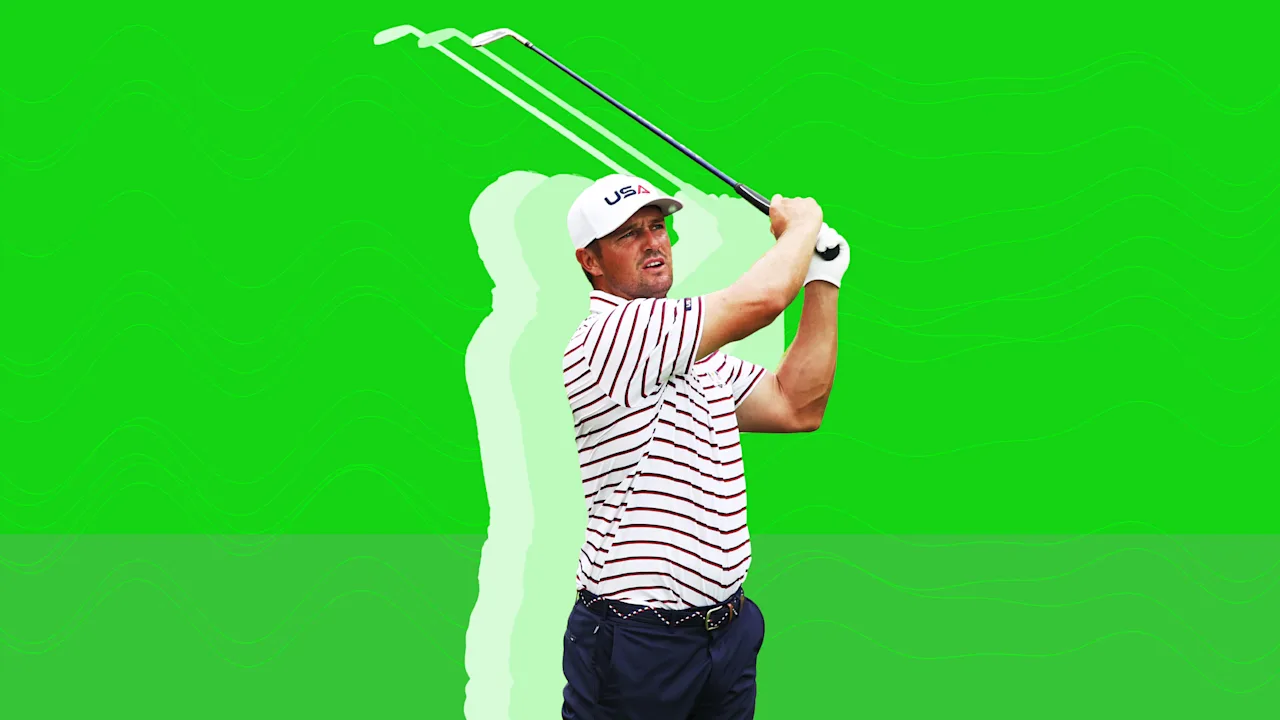
In the rarefied world of professional golf, where tradition often dictates methodology, Bryson DeChambeau has long been an anomaly.
Dubbed the sport’s “mad scientist,” he has consistently pushed the boundaries of equipment, technique, and physical conditioning.
Now, DeChambeau is once again ahead of the curve, embracing artificial intelligence not merely as a tool, but as his primary swing coach – a move that signals a seismic shift in how elite athletes might hone their craft.
The notion of a digital mentor guiding the nuanced movements of a golf swing might sound like science fiction, but for DeChambeau, it’s a tangible reality, deployed even moments before he steps onto the tee.
“We’re building an AI golf coach,” DeChambeau explains, his voice betraying a hint of the revolutionary excitement that often accompanies his pronouncements.
“Essentially, it will be a golf coach that, based on data, will be able to tell you exactly what you’re doing, how to practice, and how to improve your game.”
This isn’t just about minor tweaks; it’s about a fundamental re-evaluation of human performance, driven by objective, relentless data.
The setup is deceptively simple, yet its capabilities are profoundly complex.
A smartphone perched on a tripod captures video of DeChambeau’s swing, feeding raw visual data into a sophisticated ecosystem.
At its core lies SportsBox, an AI-powered 3D biomechanical analysis application.
This digital maestro dissects over 30 critical points on the body, club, and ball with each swing, meticulously measuring everything from rotational range of motion to the intricate dance of kinematic sequencing – the precise, sequential acceleration and deceleration of body parts during the swing.
This torrent of granular information then flows into Google’s Gemini AI, the true brains of the operation, which translates these raw measurements into actionable, personalized coaching insights.
Think of SportsBox as the hyper-accurate sensor array, Gemini as the intelligent interpreter, and Google Cloud as the robust platform that hosts this entire digital symphony.
What sets this system apart is its ability to establish and maintain a “gold standard” – a dynamic database of DeChambeau’s optimal swings from his best performances.
When a shot goes awry, the AI instantly measures the deviant swing against this gold standard, pinpointing and ranking the factors most likely contributing to the miss.
“We can take a golf swing, then upload it, and within a minute, it will give me what’s different from my gold standard set of swings,” DeChambeau marvels.
“It will give me a rundown list of the top [deviations] that are correlating to whatever’s causing me to miss.”
This immediacy is revolutionary.
In an era where athletes often wait hours, or even days, for human coaches to manually pore over data, DeChambeau receives feedback in less than 60 seconds.
This allows for real-time adjustments, a luxury previously unimaginable.
“We were going through [the data] by hand in an Excel spreadsheet,” he recalls, painting a picture of a bygone, laborious era.
“It was a manual process, very difficult. So you’re talking about months and months of trying to study the golf swing, now done in minutes.”
The precision is astounding.
DeChambeau cites an example: “Let’s say it’s a radial deviation at P6. That’s too much, meaning I’ve got too much wrist hinge, which makes the club come more outside in. So it’s very specific.”
For most of us, such technical jargon would be a bewildering jumble.
This is where Gemini’s multimodal capabilities truly shine.
Granville Valentine, managing director of AI go-to-market at Google Cloud, highlights Gemini’s ability to ingest and process a combination of video, audio, text, and voice.
Crucially, it can adapt its communication style, explaining complex biomechanical concepts in terms appropriate for any skill level.
As a golfer’s understanding deepens, the AI can evolve, offering increasingly granular and technical data, meeting each user precisely where they are.
Perhaps the most compelling testament to the AI’s power came when it challenged one of DeChambeau’s long-held beliefs.
For years, he believed he needed to stay centered, “on top of the ball,” with his driver.
The AI, however, consistently contradicted him, urging him to sway his chest back slightly on the backstroke to position his center mass more behind the ball, allowing for a fuller release through impact.
“That just blew my mind at how precise this assistant is,” he admits, acknowledging a pivotal “kick-in-the-butt moment” that forced him to trust the machine over his own ingrained intuition.
The AI’s greatest strength, he realized, is its unflinching objectivity.
“It’s unbiased,” he says.
“It doesn’t tell you what it thinks you should do. It’s literally based on what you do when you’re doing your best, and keeps you in check with that.”
This objectivity, untainted by human emotion or preconceived notions, fosters a profound sense of confidence, which DeChambeau admits has always been a struggle.
The implications extend far beyond a single golfer’s quest for a major championship.
Valentine sees this technology democratizing access to elite-level instruction, a vision that resonates deeply in a sport often perceived as exclusive.
“I don’t think the objective is to get rid of coaches,” he clarifies, “I think it’s to deliver access to those folks who don’t have access to coaches.”
This isn’t about replacing the human element, but augmenting it, making world-class insights available to a broader audience.
DeChambeau, ever the visionary, believes widespread adoption on the PGA Tour is inevitable.
“When these [other golfers] see what the capabilities are, they’ll immediately latch onto it,” he asserts.
The transformation, he suggests, is just beginning.
From an AI coach to a full-fledged club fitter and beyond, the future of golf, and indeed professional sports, is being rewritten in lines of code, one precise swing at a time.
The era of the digital caddy, coach, and confidante is not just approaching; it has already arrived, and Bryson DeChambeau is leading the charge.
-
Frank DiBernardo handles LNGFRM's Foodie and Miscellaneous writing tasks. He's always getting ideas from users, so don't be afraid to send an email to the editor.