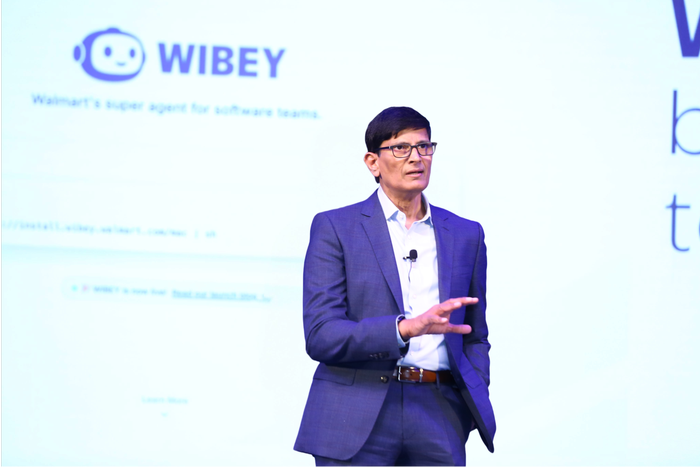
In the relentless churn of the modern technological landscape, where programming languages emerge and recede with the speed of fleeting trends and artificial intelligence promises to redefine every facet of work, the search for enduring talent has never been more critical.
Amidst this flux, one of the world’s largest employers, Walmart, offers a surprisingly clear vision for what truly matters.
It’s a perspective that cuts through the noise of specific skillsets and buzzwords, championed by Sravana Karnati, the Executive Vice President of Global Tech platforms.
With a quarter-century of leadership experience spanning giants like Amazon, Disney, and Oracle, Karnati’s insights aren’t merely hiring preferences; they are a blueprint for resilience and relevance in an ever-accelerating industry.
Karnati distills the essence of engineering excellence into two fundamental qualities: deep domain expertise in computer science fundamentals and an insatiable capacity for learning.
This isn’t just about finding individuals who can perform a task today; it’s about identifying those who can build the future and adapt to its inevitable shifts.
The first pillar, domain expertise, often gets conflated with proficiency in a particular coding language.
Yet, Karnati emphatically clarifies that mastering Java or C++ is secondary to grasping the bedrock principles of computer science. “It is not about whether you know Java, whether you know C++, or some other language,” he explains.
“What we look for is, does a person understand the fundamentals of computer science?” This distinction is profound.
A programming language is merely a tool, a syntax for expressing logic.
The true power lies in understanding the underlying logic itself – the architecture of systems, the intricacies of algorithms, the dependencies that bind complex software together, and the inherent risks in their design.
This emphasis on fundamentals echoes a timeless truth: while tools evolve, core principles remain.
An engineer who understands data structures, operating systems, and network protocols can pivot to any new language or framework with relative ease.
They possess the cognitive scaffolding upon which new knowledge can be built.
This is particularly salient in an era where Large Language Models (LLMs) like those Walmart leverages in its internal AI tool, Wibey, are becoming ubiquitous.
Karnati sees these as powerful productivity enhancers, capable of automating repetitive coding tasks and streamlining workflows.
But he is unequivocal: LLMs cannot substitute for a human engineer’s deep understanding of systems, algorithms, and architecture.
They are copilots, not pilots.
The human capacity to write “good algorithms and long-term sustainable code” remains paramount.
While a strong computer science background is crucial for software development and engineering roles, Karnati acknowledges that the depth of technical knowledge varies by function.
A UX designer, for instance, might not need to delve into the mathematical rigor of algorithms but would benefit immensely from basic technical literacy and, crucially, a mastery of design tools like Figma and an effective utilization of LLMs in their creative process.
This nuanced view underscores that expertise is context-dependent, but foundational understanding, in some form, is always valuable.
The second, equally vital trait Karnati seeks is the ability to learn – quickly, continuously, and broadly.
The tech industry doesn’t just evolve; it undergoes periodic revolutions.
Those who have thrived for decades, he observes, are the ones who have consistently “kept up with the business and continued to learn.”
This isn’t merely about attending a workshop; it’s a fundamental mindset of intellectual curiosity and adaptability, a willingness to retrain oneself repeatedly throughout a career.
This trait is not just about keeping pace; it’s about anticipating and shaping the future.
In a world increasingly dominated by AI, as Waze cofounder Uri Levine noted, the “most important learning today is the ability to adapt.” Cloudflare CEO Matthew Prince similarly champions a “broad set of skills.”
Karnati’s own career trajectory exemplifies this adaptability: holding a doctorate in chemical engineering, he seamlessly transitioned to becoming a computer scientist, demonstrating that formal degrees, while valuable, are not the sole arbiters of capability.
An industrial-engineering background, paired with a computer-science orientation and operational rigor, can be exceptionally potent in technology operations roles, he points out.
For aspiring engineers, or indeed anyone looking to thrive in the tech sector, Karnati offers practical guidance on demonstrating this learnability.
A “wide palette of learning” through diverse internships and varied coursework speaks volumes more than a narrow, hyper-specialized focus.
It signals a curious mind, a willingness to experiment, and an inherent drive to tackle new challenges.
Ultimately, Walmart’s approach to hiring, articulated by Sravana Karnati, serves as a powerful reminder that in an age of accelerating technological change, the most valuable assets are not static skills, but dynamic capabilities.
It’s a call to prioritize foundational understanding over transient proficiencies, and to cultivate a relentless pursuit of knowledge.
For individuals, this means investing in lifelong learning and intellectual breadth.
For organizations, it means fostering environments where curiosity is celebrated, and adaptability is the ultimate currency.
In the grand scheme of the tech ecosystem, these aren’t just good hiring practices; they are survival strategies.
-
Frank DiBernardo handles LNGFRM's Foodie and Miscellaneous writing tasks. He's always getting ideas from users, so don't be afraid to send an email to the editor.