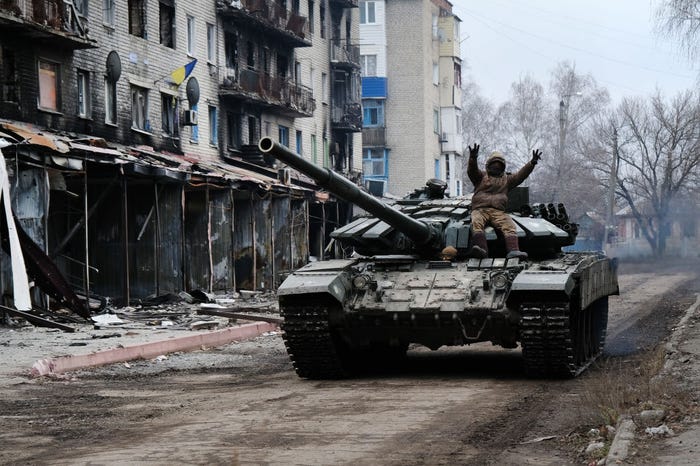
In the scarred landscapes of Ukraine, a stark, often brutal reality has unfolded: the venerable tank, once the undisputed king of the battlefield, finds itself increasingly vulnerable. Tanks are not obsolete, but they are indeed vulnerable.
Footage from the front lines, grim and inescapable, shows advanced armored vehicles, some costing millions, being turned into burning wrecks by cheap, commercially available drones, often priced in the hundreds. Drones vs tanks is a trending discussion, defining modern warfare.
These FPV quadcopters, buzzing like angry wasps, exploit the tanks’ Achilles’ heel – their less armored top hatches – delivering explosive payloads that rip through steel and flesh.
Open-source trackers confirm thousands of such losses, a testament to a new era of warfare where air superiority can be bought for pocket change.
Yet, despite this sobering demonstration of vulnerability, a fascinating paradox grips the North Atlantic Treaty Organization. NATO’s military strategies show they are committed to investment in tanks.
Far from abandoning the heavy metal beasts, NATO allies are doubling down, investing billions in new tank purchases, advanced upgrades, and even entirely new designs.
Sweden, the Czech Republic, and the Netherlands are acquiring dozens of German-made Leopard 2A8s, while Poland is opting for South Korean K2 Black Panthers.
Lithuania, a NATO frontline state bordering Russia, is buying tanks for the first time in its history, a direct response to the perceived threat emanating from the east.
Germany, in a significant strategic move, is deploying a full brigade equipped with Leopard 2A8s to Lithuania, its first major permanent stationing of troops abroad since World War II.
The message is clear: the tank, it seems, is not dead; it’s merely evolving.
This strategic divergence begs the question: are NATO’s generals and defense planners suffering from a collective delusion, or do they see something the immediate, visceral images from Ukraine obscure?
The answer lies in a nuanced understanding of warfare’s eternal dance between innovation and adaptation, and a firm belief that the next war will not simply be a carbon copy of the current one.
In Ukraine, tanks have struggled precisely because the conflict has devolved into a grinding, static war of attrition.
Front lines are heavily fortified with trenches, concrete barriers, and extensive minefields, while the skies swarm with drones.
As Colonel Hamish de Bretton-Gordon, a former British Army tank regiment officer, points out, a tank’s most potent asset is its mobility.
“Always has been,” he adds.
In a landscape where movement is perilous and every inch of ground is contested, tanks are often relegated to supporting roles, operating from concealed positions as mobile artillery, or used sparingly in carefully coordinated assaults, often supported by their own drones and electronic warfare.
The grand armored thrusts that characterized conflicts like the 1991 Gulf War, where tanks spearheaded dramatic advances, are conspicuously absent.
The image of a $500 drone destroying a $5 million tank is, as de Bretton-Gordon aptly puts it, “pretty incongruous.” The disparity in cost highlights the challenge.
But NATO’s strategists argue that the conditions in Ukraine are unique, driven by specific geographical, political, and technological factors.
Jeffrey Edmonds, a Russia analyst at the Center for Naval Analyses, cautions against drawing overly simplistic conclusions.
“Everybody prepares for the last war and is never ready for the next war,” he observes. The role of tanks remains a contentious issue, constantly evolving.
Crucially, NATO possesses capabilities far beyond those currently available to Ukraine.
The alliance commands overwhelming air superiority, including cutting-edge stealth fighters like the F-35, which could theoretically provide the critical air cover necessary to employ tanks effectively and in much larger numbers.
This air dominance, a stark contrast to Ukraine’s contested skies, could prevent a future conflict from ever devolving into the kind of attritional, drone-dominated stalemate seen today.
Furthermore, NATO is actively incorporating lessons learned from Ukraine into its next generation of armored vehicles. Future armored vehicles are being developed with enhanced drone protection in mind.
The ambition extends to a dozen European countries collaborating on a Main Armored Tank of Europe, a next-generation battle tank designed for future challenges.
Ultimately, the argument for the tank’s enduring relevance boils down to a fundamental truth of land warfare: you cannot win a war purely on the defensive.
To seize or retake ground, to achieve decisive victory, an army needs the ability to attack, and for that, tanks remain indispensable.
“Tanks provide shock effect, long-range fire,” Edmonds explains.
If the drone threat can be mitigated, and a more fluid battlefield maintained, their role remains critical.
As Boston succinctly puts it, “You can’t actually achieve your aims, almost ever, without some kind of ability to either attack or counterattack or retake ground.” Military technology trends indicate this will be a key focus moving forward.
So, while drones have undoubtedly reshaped the battlefield, forcing a re-evaluation of tactics and design, NATO’s continued faith in the tank is not blind.
It is a calculated gamble, a strategic bet on a future conflict where superior combined arms, advanced technology, and a proactive approach to evolving threats will, they hope, restore the tank to its rightful, if redefined, place as a cornerstone of offensive power.
The era of the tank as an invincible behemoth may be over, but its utility as a powerful instrument of war, adapted and integrated into a modern fighting force, is far from extinguished.
Firepower, mobility, and protection, as de Bretton-Gordon reminds us, are still fundamental on the battlefield.
And for now, NATO is betting on heavy armor to deliver them.
-
Frank DiBernardo handles LNGFRM's Foodie and Miscellaneous writing tasks. He's always getting ideas from users, so don't be afraid to send an email to the editor.