In the high-octane world of artificial intelligence, where technological breakthroughs are announced with breathless anticipation and corporate valuations soar on the promise of the next big model, an unexpected voice from the East is urging a fundamental rethink.
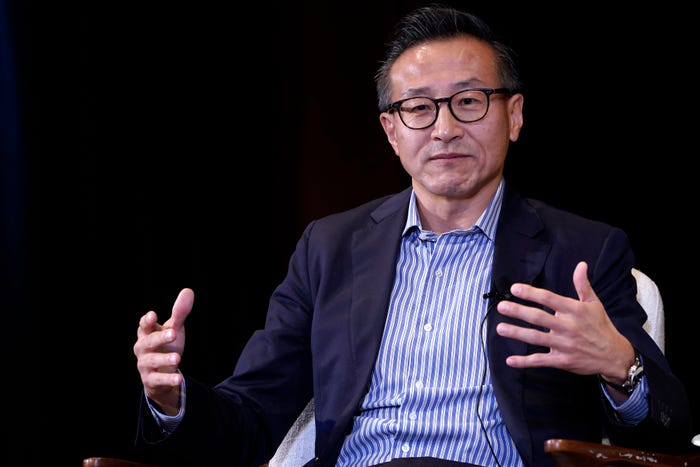
Joe Tsai, the chairman of Alibaba, one of China’s most formidable tech giants, has thrown a curveball into the prevailing narrative, suggesting that the much-hyped AI race isn’t about who crosses the finish line first with the most powerful algorithm, but rather a grueling “long marathon” where speed of adoption, not raw computational muscle, dictates true success.
His provocative assertion: the US, despite its colossal investments, might do well to take a leaf out of China’s playbook.
Tsai, speaking at the All-In Summit 2025 in a recording recently made public, dismantled the popular notion of a winner-takes-all contest.
“When it comes to AI, there’s no such thing as winning the race,” he declared, painting a picture of an ever-shifting landscape where model leadership is fleeting.
One week, a particular AI model might reign supreme, only to be eclipsed by another the next.
For Tsai, this constant flux renders the pursuit of the “strongest AI model” a Sisyphean task.
Instead, he posits, the real victory lies in the swift and widespread integration of AI into everyday life, making it a ubiquitous tool rather than an exclusive technological marvel.
This perspective stands in stark contrast to the prevailing strategy in the West, particularly in the United States.
Here, the AI race has largely been defined by an arms race for computational supremacy.
Tech titans are pouring unprecedented billions into developing ever-larger, more sophisticated foundational models and the gargantuan infrastructure needed to support them.
Meta, for instance, anticipates spending an eye-watering $600 billion on AI infrastructure, including massive data centers, through 2028.
Not to be outdone, OpenAI and Oracle have reportedly earmarked $500 billion for a colossal data center project dubbed “Stargate.”
The underlying belief seems to be that sheer scale and raw processing power will ultimately yield a decisive, unassailable lead.
China, however, appears to be charting a different course, one that Tsai champions as a model for global AI proliferation.
While not claiming technological superiority in the “model war,” Tsai argues that China has made significant strides in terms of practical application and ensuring people benefit from AI.
The strategy is less about building the biggest brain and more about democratizing intelligence.
Chinese companies are embracing open-source and smaller, highly optimized models designed for real-world deployment on common devices like mobile phones and laptops.
This lean, efficient approach translates to cheaper, lighter, and far easier-to-deploy AI solutions, fostering rapid integration across a vast user base.
Consider DeepSeek’s R1 model, which, according to its developers, rivals top competitors while being built at a mere fraction of the cost.
This is not an isolated incident but indicative of a broader strategic pivot.
As Ray Wang, research director for semiconductors and emerging technology at Futurum Group, observed, China is less focused on outbuilding OpenAI and more on embedding AI into everyday technology at breakneck speed.
This grassroots approach, prioritizing widespread utility over ultimate power, could be a silent but potent force shaping the future of AI competitiveness.
The implications of these divergent strategies are profound.
While the US gambles on monumental investments to create AI systems of unparalleled capability, China is fostering an environment where AI becomes an intrinsic part of the digital fabric for millions.
One could argue that the American approach aims for a ‘moonshot,’ a singular, revolutionary leap, while the Chinese strategy is akin to laying down a vast, interconnected network of smaller, highly functional satellites.
The question then becomes: which path leads to greater long-term competitive advantage and, more importantly, broader societal benefit?
Tsai’s commentary serves as a critical reminder that technological prowess, while vital, is only one piece of the puzzle.
The true measure of AI’s success might not be found in benchmark scores or the number of parameters in a model, but in its ability to seamlessly integrate into and enhance human lives.
If AI remains largely confined to massive data centers and the exclusive domain of tech giants, its transformative potential will be limited.
If, however, it proliferates through open-source initiatives and optimized models, becoming a readily accessible tool for innovation and problem-solving, its impact could be truly revolutionary.
The “long marathon” of AI, it seems, is less about winning a sprint and more about endurance, adaptability, and the strategic deployment of intelligence where it matters most: in the hands of the many.
The West, with its eyes fixed on the horizon of ultimate power, might do well to glance sideways at the rapid, pervasive advancements taking root in the East.
-
Frank DiBernardo handles LNGFRM's Foodie and Miscellaneous writing tasks. He's always getting ideas from users, so don't be afraid to send an email to the editor.