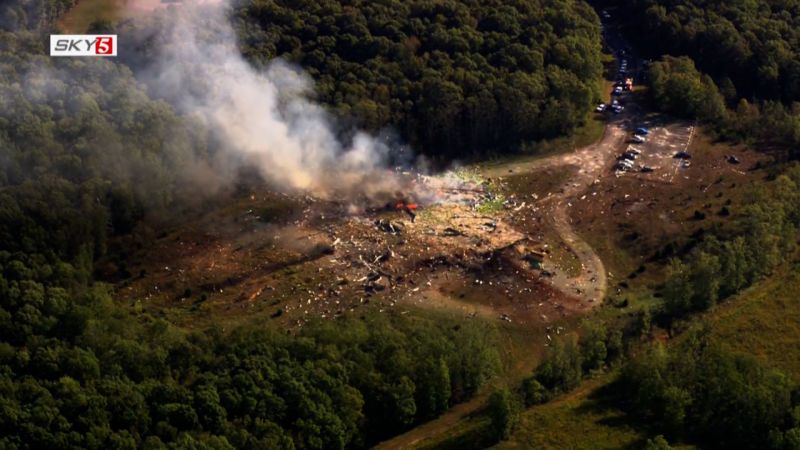
In the scarred landscape of Humphreys County, Tennessee, where a mighty blast ripped through an explosives plant, reducing buildings to dust and lives to memory, a fragile but potent light has emerged.
Amidst the grim task of sifting through the remains of what was once Accurate Energetic Systems, a technological marvel known as Rapid DNA analysis has offered a glimmer of solace, identifying 14 of the 16 souls lost in the catastrophic explosion.
It is a stark juxtaposition: the raw, untamed power of an industrial disaster met by the quiet precision of science, delivering a measure of peace to families plunged into unimaginable grief.
The explosion, which occurred at the manufacturing plant for military and demolition explosives, registered as a 1.6 magnitude earthquake, a testament to its terrifying force.
It was a blast so complete, so devastating, that it left no survivors within the facility, silencing potential eyewitnesses to the moments leading up to the catastrophe.
This absence of human testimony has amplified the challenge for investigators, forcing them to piece together a narrative from a scene of widespread destruction, where debris, some as small as a fingernail, was flung miles away.
In the immediate aftermath, the emotional toll on families was immense, compounded by the harrowing wait for news of their loved ones.
Humphreys County Sheriff Chris Davis articulated this profound need for certainty, describing the DNA identifications as “that one little piece of light that’s made it through it in efforts to give [families] the hope of having closure.”
This isn’t merely about naming the dead; it’s about acknowledging their existence, offering a tangible link to a life violently severed, and providing a foundation upon which the arduous process of grieving can begin.
The speed of this identification process is largely thanks to Rapid DNA technology.
Unlike traditional lab-based DNA analysis, which can take days or weeks, this automated, portable system can develop a DNA profile from a mouth swab in under two hours.
Authorities expedited the process by collecting samples directly from the families of the missing, allowing for swift comparisons with recovered remains.
This cutting-edge capability has transformed the agonizing wait into a slightly less protracted ordeal, a testament to how scientific advancement can humanize even the most brutal of tragedies.
The names of the 16 victims – Jason Adams, Erick Anderson, Billy Baker, Adam Boatman, Christopher Clark, Mindy Clifton, James Cook, Reyna Gillahan, LeTeisha Mays, Jeremy Moore, Melinda Rainey, Melissa Stanford, Trenton Stewart, Rachel Woodall, Steven Wright, and Donald Yowell – now stand as a solemn roll call, each name a universe of personal stories and shattered futures.
Yet, even as closure begins for some, the larger questions surrounding the blast remain.
The investigation, led by the ATF, is a painstaking, forensic reconstruction akin to assembling a colossal, shattered puzzle.
Special Agent Brice McCracken, of the ATF’s National Center for Explosives Training and Research, noted that the post-blast investigation into cause and origin can only truly begin once the entire half-square-mile impact area is cleared of hazards and remains.
This is a process measured not in days, but potentially in weeks or months, a testament to the complexity of the scene and the meticulous nature of the inquiry.
Beyond the immediate cause, a more troubling narrative emerges from the plant’s history.
Accurate Energetic Systems, a key supplier to the military with a recent $120 million contract for TNT, has faced scrutiny over safety in the past.
Federal records show that the Occupational Safety and Health Administration (OSHA) fined the company $7,200 after a 2019 inspection revealed violations related to personal protective equipment, employee exposure to contaminants, and inadequate safety training.
While the company contested and eventually settled these findings, they paint a concerning picture of workplace practices.
Adding to the unease is the plant’s prior history of fatal incidents.
In 2014, an explosion at the same facility, then operated by Rio Ammunition on Accurate Energetic Systems property, claimed one life and injured four others.
For families like Ernest Mays, father of victim LeTeisha Mays, these past events cast a long shadow over the current tragedy.
Ernest Mays expressed a desperate need to know if the explosion was accidental or intentional, a sentiment echoed by his daughter’s own premonitions.
LeTeisha had reportedly voiced safety concerns about her job, experiencing nosebleeds at work and dreading her shifts, yet felt compelled to stay until she could pay off her car.
Her story, and others like it, serve as a poignant reminder that behind every statistic of injury and death are real people, often caught between economic necessity and deeply felt anxieties about their workplace safety.
As the ATF’s National Response Team meticulously sifts through the fragments, guided by blueprints and the silent testimony of scattered debris, the promise is clear: “If criminal activity is involved, those responsible will be held accountable, and if it was accidental, that lessons have been learned to prevent a tragedy like this from ever happening again,” stated Tyra Cunningham, assistant special agent in charge at the agency’s Nashville division.
This tragedy in Humphreys County is more than just an industrial accident; it is a stark examination of corporate responsibility, regulatory oversight, and the enduring human quest for answers, justice, and ultimately, a measure of peace in the wake of unimaginable destruction.
-
Frank DiBernardo handles LNGFRM's Foodie and Miscellaneous writing tasks. He's always getting ideas from users, so don't be afraid to send an email to the editor.