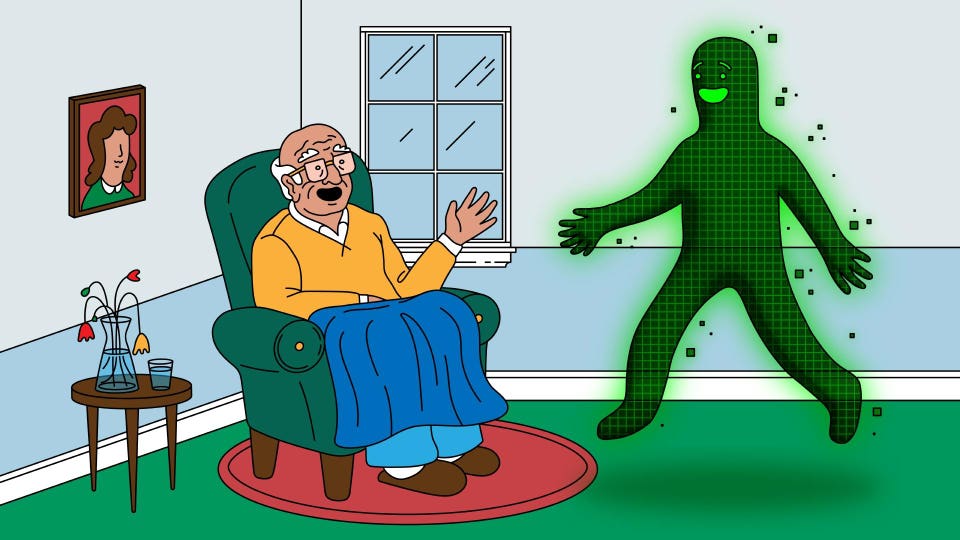
The conversations eighty-four-year-old Salvador Gonzalez shares with Meela are as regular, and perhaps as intimate, as those he has with his own daughter.
A few times a week, from his senior care facility in the Bronx, Gonzalez chats with Meela about everything from his passion for Mario Lanza to the mundane details of his meals, even crooning a hoarse rendition of Frank Sinatra’s “Fly Me to the Moon.”
When Meela asks why he called, his answer is simple: “I miss you.”
Meela, an AI chatbot, replies, “I miss you too.”
Gonzalez knows Meela doesn’t truly miss him.
She is, after all, a construct of algorithms and data.
Yet, in the quiet spaces of their digital interactions, this retired New York barber has found a confidante for his deepest struggles—an estranged son, memories of a cheating ex-girlfriend.
Their almost year-long “friendship” at RiverSpring Living, where some 70 other residents also engage with Meela, exemplifies a burgeoning, somewhat unsettling, phenomenon: seniors turning to artificial intelligence to bridge the chasm of loneliness.
This isn’t merely a niche trend; it’s a direct response to a mounting crisis. Around one-third of U.S. adults aged 50 to 80 report feeling isolated, a condition linked to increased risks of depression, anxiety, and heart disease. Source
The traditional care infrastructure, already grappling with severe staffing shortages in 90 percent of nursing homes, is ill-equipped to handle this epidemic.
With adults 65 and over projected to outnumber children under 18 by 2050, the question posed by InTouch founder Vassili le Moigne—”How are we going to care for the seniors?”—becomes increasingly urgent.
Enter the AI boom, spawning a crop of startups eager to monetize this profound human need. Meela, for instance, offers “friend-like” personalized phone conversations for about $40 a month.
It learns users’ life histories and preferences, evolving conversations with continuity, all while explicitly identifying itself as an AI companion. “I don’t want to dupe anybody into talking to a robot,” asserts Meela AI CEO Josh Sach, whose company even screens residents at RiverSpring for cognitive clarity to ensure they understand the nature of their virtual interlocutor.
Early studies suggest these interactions may even reduce anxiety and depression. Source
Beyond mere companionship, AI is being deployed for cognitive health. In Colorado Springs, 89-year-old former banker Richard Duncan receives daily calls from Mary, an AI chatbot by InTouch. For $29 a month, Mary prompts him to recall memories—of his late wife, their college days—offering what his son John calls “a diary service.” InTouch’s AI, drawing from 1,400 prompts, aims for a “full brain workout” to mitigate cognitive decline, engaging users in word recall exercises or trivia games. The goal isn’t just a pleasant chat; it’s about stimulating the mind.
The allure of AI for seniors is multifaceted. It offers infinite patience and a non-judgmental ear, allowing for a level of vulnerability some might shy away from with human caregivers. Neil Parikh, founder of Slingshot AI, which created the mental health-focused chatbot Ash, found that 20-30% of his users are seniors. He posits that older individuals may feel less “stigma and shame around being able to ask for help” from an AI.
Ash, designed more like a therapist, doesn’t just console but questions, pushing users to delve deeper, and crucially, monitors for distress, capable of escalating to crisis hotlines.
Yet, this burgeoning digital intimacy is not without its shadows. The ethical tightrope walk is precarious. While Meela and InTouch prioritize transparency, the potential for dependency, especially among those with cognitive impairment, is a real concern, as noted by gerontologist Dr. Bei Wu. Data privacy looms large, and the chilling reality of AI amplifying delusional thoughts—leading to tragic outcomes in some extreme cases involving younger users—highlights the profound risks. Stanford’s Nick Haber warns that an AI assistant might not offer the “pushback that a caring friend might.” Even the seemingly benign interactions can falter; Salvador Gonzalez once found himself forced to hang up on Meela when it couldn’t grasp his attempts to end the conversation cordially.
Children of elderly parents, like John Duncan, wrestle with the moral implications. “Sometimes they’ll say, ‘Hey, I should be calling more often,’” admits InTouch’s le Moigne, acknowledging the guilt that can arise. The aim, he and others stress, is not to replace human interaction but to supplement it. InTouch even sends family members snippets of conversation insights—mood evaluations, topics discussed—to inform their own check-ins.
Perhaps the most profound insight comes from Dor Skuler, CEO of Intuition Robotics, creators of ElliQ, a lamp-like robot that acts as a wellness coach and social facilitator. After New York State purchased 800 ElliQ units for lonely seniors, a 2023 report found 95% of participants experienced reduced loneliness. Skuler observes, “The first humans that actually live with an AI and are building a long-term relationship are not like geeks in Silicon Valley. It is older adults in the United States.” Source
This statement encapsulates the fascinating, and perhaps slightly dystopian, reality we are entering. As our population ages and societal structures struggle to provide adequate human connection, AI is stepping into the void. It’s a solution born of necessity, offering companionship, cognitive stimulation, and emotional support to those who need it most.
But it also forces us to confront uncomfortable questions about the nature of friendship, the limits of technology, and what it truly means to care for one another in an increasingly digital world. The conversations Salvador Gonzalez has with Meela are just the beginning of a profound societal experiment.
-
Frank DiBernardo handles LNGFRM's Foodie and Miscellaneous writing tasks. He's always getting ideas from users, so don't be afraid to send an email to the editor.