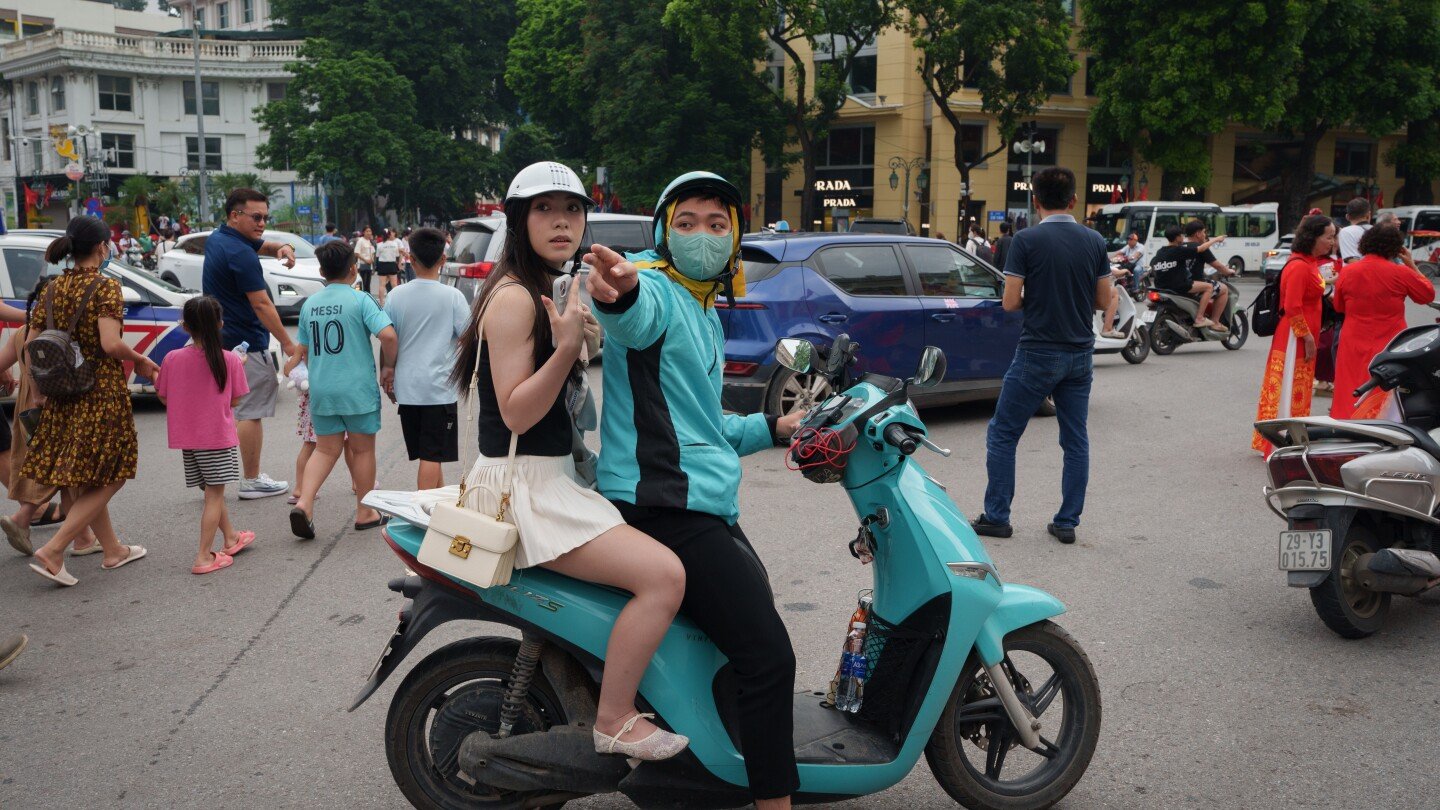
HANOI, Vietnam — For decades, the ubiquitous motorbike has been more than just transport in Vietnam; it’s the pulsating heart of daily life, a symbol of independence, and the tireless workhorse of a nation on the move.
From families of four navigating bustling streets to delivery drivers expertly balancing impossible loads, the roar of millions of gasoline engines has been the soundtrack to Vietnam’s economic ascent.
But that soundtrack is about to change, perhaps dramatically, as the country embarks on an ambitious, some say breakneck, race towards an electric future.
The government, eyeing the choking smog that hangs heavy over its metropolises and the alarming statistic of 70,000 annual deaths linked to air pollution, is determined to silence the internal combustion engine.
Hanoi, the capital, has fired the starting gun, announcing a ban on gasoline-powered motorcycles from its city center by July 2026.
Ho Chi Minh City is contemplating a similar move, and the national vision is bold: by 2030, a third of cars and more than a fifth of all motorbikes are slated to run on electricity.
It’s a seismic shift, one that pits deeply ingrained tradition against the urgent demands of environmental sustainability.
At the heart of this impending revolution lies a profound dilemma for millions.
Vietnam boasts a staggering 77 million two-wheelers, with 7 million in Hanoi and 8.5 million in Ho Chi Minh City alone.
These aren’t luxury items; they are essential tools.
Ta Manh Cuong, a 45-year-old ride-hailing driver, affectionately calls his battered gasoline bike his “iron horse,” a faithful companion earning him about $20 on a good day.
Cuong would welcome an electric alternative if it were cheaper, but the reality bites: “But right now I can’t afford to buy an electric bike.”
Cuong’s sentiment echoes a widespread concern.
Gas-powered bikes are currently far cheaper, renowned for their rugged durability, and easily repaired by a myriad of roadside mechanics.
The electric models, while sleek and silent, come with a higher upfront cost and lingering anxieties about range, charging convenience, and long-term reliability.
Established giants like Honda, which commands over 80% of Vietnam’s motorcycle market, and Yamaha, with a 17% share, have voiced strong reservations, arguing that the 2026 timeline is simply too aggressive.
Having only recently begun selling e-bikes, they warn of the immense strain on consumers tasked with replacing millions of vehicles in a mere few years.
Yet, where there are challenges, there are also immense opportunities.
Vietnamese electric vehicle makers, from nimble startups like Dat Bike to the formidable VinFast, backed by the nation’s largest conglomerate VinGroup, are betting big on this electric future.
Chinese electric bikemaker Yadea is also keen to capitalize.
They see not just a market, but a national imperative.
Zifei Yang of the International Council on Clean Transportation points out a crucial advantage: unlike the car market, motorbikes sold in Vietnam are predominantly manufactured domestically.
This shift to electric could therefore be a boon for local producers, fostering innovation, creating jobs, and attracting new investment, potentially positioning Vietnam as a leader for other developing nations eyeing similar transitions.
Indeed, the market is already responding.
Since the ban was announced, electric motorbike sales have surged, with purchases of smaller bikes up 89% and full-sized models a remarkable 197% in the first eight months of 2025.
VinFast has led this charge, its sales more than quadrupling, outpacing rivals.
The company is not just selling bikes; it’s building an ecosystem, with plans for 150,000 battery-swapping stations nationwide within three years, offering a practical solution to range anxiety.
VinFast is also partnering with banks to provide low-interest loans and subsidies, covering up to 90% of costs and waiving registration fees.
The government, too, is sweetening the deal.
In Hanoi, eligible residents can receive $120-$200 in subsidies for electric bikes costing at least $590, alongside exemptions from new registration and license plate fees until 2030.
Ho Chi Minh City plans low-interest loans, tax breaks, and low-emission zones, aiming to replace 400,000 gasoline motorbikes by 2028, starting with a ban on ride-hailing and delivery services using gas bikes in 2026.
Yang suggests that targeted subsidies for scrapping old bikes and improved public transport could further accelerate the transition, especially for high-mileage ride-hailing fleets that stand to save significantly on fuel costs.
For businesses like Bao Ngoc Cao’s motorbike rental service, the ban initially sparked “terror.”
Her livelihood depends on cheap, reliable gasoline bikes rented to expats and tourists.
Losing access to tourist-heavy areas of Hanoi would be devastating, and current subsidies don’t nearly cover replacing her fleet.
Yet, even Cao, despite her immediate concerns, concedes she supports the ban in principle, recognizing the promise of cleaner air and healthier streets for her community.
“We are just waiting to get more clarity and see what happens,” she says, embodying the cautious optimism and pragmatic uncertainty gripping many Vietnamese.
Dat Bike CEO Son Nguyen emphasizes that while incentives add momentum, long-term success hinges on building electric bikes that win on their own merits—high performance, long ranges, and fast charging at competitive prices.
His company’s recent $22 million capital raise underscores the confidence investors have in this vision.
Vietnam’s journey towards an electric future is more than an environmental policy; it’s a cultural reckoning.
It’s the story of a nation grappling with the inherent tension between a cherished past and a necessary, albeit challenging, future.
The rumble of the “iron horse” may soon fade from the city centers, replaced by the silent hum of electric motors.
Whether this transition proves to be a smooth glide or a bumpy ride will depend on how effectively the government, innovators, and the resilient Vietnamese people navigate the complexities of cost, convenience, and a deep-seated love affair with two wheels.
-
Frank DiBernardo handles LNGFRM's Foodie and Miscellaneous writing tasks. He's always getting ideas from users, so don't be afraid to send an email to the editor.