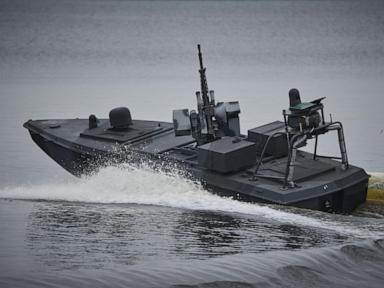
In the shifting currents of the Black Sea, a new chapter of naval warfare is being written, not by mighty battleships, but by agile, autonomous drones.
Ukraine’s state security service (SBU) has pulled back the curtain on an upgraded iteration of its “Sea Baby” sea drone, a vessel that epitomizes ingenious adaptation and asymmetric strategy.
This isn’t merely an incremental improvement; it signals a profound reimagining of maritime conflict, one where a nation without a traditional navy is challenging a formidable naval power on its own terms.
The latest “Sea Baby” is a technological leap, boasting an extended operational range that now covers the entire Black Sea, stretching from 1,000 to an impressive 1,500 kilometers.
Its payload capacity has been dramatically increased to a formidable 2,000 kilograms, allowing it to carry heavier and more diverse weaponry.
During a recent demonstration, variants were showcased equipped with multi-rocket launchers and stabilized machine-gun turrets, transforming what was once primarily a single-use strike craft into a versatile, multi-purpose platform.
But the true game-changer lies beneath its sleek surface.
The upgraded drones are now imbued with artificial intelligence, featuring AI-assisted friend-or-foe targeting systems that promise enhanced precision and reduced collateral damage in the heat of battle.
Furthermore, these autonomous vessels can launch small aerial attack drones, adding another layer of offensive capability, and incorporate multilayered self-destruct systems to prevent capture and exploitation by enemy forces.
Brigadier General Ivan Lukashevych of the SBU proudly declared that Ukraine has become the world’s pioneer in this new form of naval warfare and continues to push its boundaries.
The impact of these evolving sea drones has already been acutely felt by Russia.
The SBU credits the “Sea Baby” with successful attacks on 11 Russian vessels, including frigates and missile carriers, a string of losses that has forced a strategic and psychologically significant relocation of Russia’s main Black Sea Fleet base from Sevastopol in occupied Crimea to Novorossiysk on Russia’s mainland coast.
This is more than just a logistical shift; it’s a clear admission of vulnerability, a powerful testament to the disruptive potential of these unmanned craft.
Ukraine, outmatched in conventional naval assets, has effectively created a credible deterrent and offensive capability against a much larger adversary, redefining what naval power means in the 21st century.
The operational reality behind these high-tech weapons reveals a human element, too.
These craft are controlled remotely from discreet, mobile command centers, often vans, where operators like “Scout” (identified by his call sign, adhering to Ukrainian military protocol) manage a bank of screens and controls.
“Cohesion of the crew members is probably the most important thing. We are constantly working on that,” Scout emphasized, highlighting the critical blend of advanced technology and human skill required to wield these tools effectively.
It’s a stark reminder that even in the age of AI, human ingenuity, coordination, and resilience remain paramount.
Beyond direct naval engagements, the “Sea Baby” has also played a role in other high-profile operations, including repeated attacks on the Kerch Bridge, most recently targeting its underwater supports in a relentless effort to disrupt a vital supply artery for Russian forces.
This sustained pressure underscores Ukraine’s strategic intent to undermine Russia’s logistical and military capabilities in the Black Sea region.
Perhaps one of the most compelling aspects of this program is its funding model.
The “Sea Baby” initiative is partially supported by public donations through a state-run program, a powerful symbol of national unity and popular resolve.
Every contribution, no matter how small, directly translates into advanced capabilities on the front lines, allowing Ukraine to showcase “the most effective use of the money they have donated to us,” as Lukashevych put it.
This collective effort transforms the fight into a shared national endeavor, where citizens directly empower their defenders with cutting-edge tools.
The evolution from expendable strike boats to reusable, networked, and increasingly intelligent drones marks a significant advance in asymmetric naval warfare.
It demonstrates that innovation, driven by necessity and coupled with strategic vision, can effectively counter overwhelming conventional might.
Ukraine’s “Sea Baby” isn’t just a weapon; it’s a statement about the future of conflict, a testament to the enduring power of ingenuity, and a harbinger of a new era where smaller, smarter, and more agile platforms can indeed challenge the titans of the sea.
The Black Sea has become a crucible for this transformation, and the ripple effects are likely to be felt across the globe.
-
Frank DiBernardo handles LNGFRM's Foodie and Miscellaneous writing tasks. He's always getting ideas from users, so don't be afraid to send an email to the editor.