The modern world is increasingly powered by a silent, unseen force: artificial intelligence.
Yet, this burgeoning intelligence carries a heavy secret – a colossal appetite for energy and water, threatening to exacerbate the very environmental crises it often claims to address.
Data centers, the vast digital factories fueling AI’s rise, consumed an estimated 1.5% of the world’s electricity last year.
The International Energy Agency predicts this figure could more than double by 2030, a trajectory that raises alarm bells about increased reliance on fossil fuels, accelerating greenhouse gas emissions, and intensifying climate change.
The paradox is stark: a technology promising to revolutionize human efficiency also demands an ever-growing share of Earth’s finite resources.
But what if AI, in its burgeoning sophistication, could become the architect of its own redemption?
A growing chorus of scientists and innovators believes that the same immense computing power that consumes so much could also be harnessed to engineer a greener, more sustainable future, effectively offsetting its own environmental footprint.
Alexis Abramson, dean of the Columbia University Climate School, expresses a cautious yet firm optimism.
“I am pretty optimistic that while more and more AI use is going to continue to increase,” she notes, “we’re going to see our ability to process be much more efficient and as a result, the energy consumption won’t go up as much as some are predicting.”
This sentiment underpins a burgeoning movement to deploy AI as a potent weapon in the climate fight, transforming everything from how we heat our homes to how we generate power and manage urban sprawl.
One of the most immediate and impactful applications of AI lies within the very structures we inhabit.
Buildings and homes account for roughly one-third of U.S. greenhouse gas pollution, a staggering statistic that represents a “super low-hanging fruit” for energy savings, according to Zoltan Nagy, a professor of building services at Eindhoven University of Technology.
AI-powered building automation systems are proving to be game-changers.
Companies like 75F are deploying AI to intelligently adjust lighting, ventilation, heating, and cooling based on a myriad of factors, from real-time weather data to occupancy patterns and electricity usage.
Imagine a system that learns your office’s rhythm, pre-cooling only when staff are due to arrive, rather than relying on a manual blast of air conditioning that wastes energy.
These smart systems can even predict maintenance needs for HVAC equipment, preventing costly failures and ensuring optimal performance.
Experts suggest these automations can slash a building’s energy consumption by 10% to 30%, a significant cut that demands little human intervention.
Beyond static structures, AI is bringing intelligence to our mobile lives.
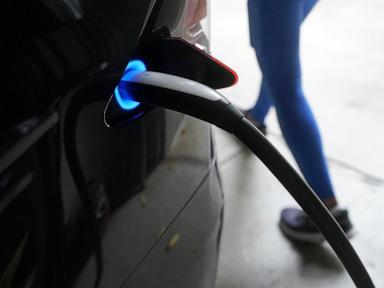
The proliferation of electric vehicles (EVs) is a crucial step towards decarbonization, but their charging habits can still strain the grid, especially during peak demand.
AI offers a smart solution: optimal charging schedules.
By analyzing grid demand, electricity rates, and the availability of renewable energy, AI can instruct EVs and other devices to charge during off-peak hours or when green energy is abundant.
As Abramson illustrates, an AI-enabled home could automatically delay charging your EV until overnight, when demand is lower and fossil fuel burning is less likely.
A pilot program in California demonstrated this potential, shifting charging to times with higher renewable energy availability, simultaneously saving customers money and reducing carbon intensity.
For homeowners with solar panels, AI can further optimize battery storage, ensuring excess energy is captured and deployed most efficiently.
Perhaps one of the most surprising and impactful applications of AI is its role in greening the very industries often blamed for climate change.
The oil and gas sector, a major emitter of methane – a greenhouse gas 80 times more potent than carbon dioxide over a 20-year period – is finding an unlikely ally in AI.
Boston-based Geminus AI leverages deep learning to help companies reduce methane flaring and venting, and to optimize energy use in extraction and refining.
Methane release, often a byproduct of pressure buildup in pipelines, is both an environmental hazard and a wasted resource.
Geminus CEO Greg Fallon explains that their AI-driven simulations can analyze complex networks of wells and pipes in seconds, recommending precise adjustments to compressor and pump settings that eliminate the need for venting or flaring.
This process traditionally takes engineers 36 hours; AI does it in a blink.
Fallon sees a “massive opportunity to reduce greenhouse gas emissions” as this technology scales across the industry.
Meanwhile, a less conventional energy source, geothermal, is also being unlocked by AI.
Salt Lake City startup Zanskar is using AI models to map the Earth’s subsurface, identifying previously overlooked geothermal hot spots.
Geothermal energy, which harnesses the planet’s natural heat to generate clean electricity, has immense potential.
Zanskar co-founders Carl Hoiland and Joel Edwards describe how their AI simulates countless subsurface scenarios to pinpoint optimal drilling locations and directions.
Hoiland boldly states, “AI is becoming the solution to its own energy problem.
It’s showing us a way to unlock resources that weren’t possible without it.”
Their success speaks volumes: AI modeling revitalized an underperforming plant in New Mexico and led to a new discovery in Nevada, defying conventional expert wisdom.
Finally, even our daily commutes are becoming smarter and cleaner thanks to AI.
Google’s Project Green Light, launched in 2023, employs artificial intelligence and Google Maps data to optimize traffic light timings.
Passenger cars and small trucks contribute approximately 16% of U.S. greenhouse gas emissions, making urban traffic a significant environmental concern.
Now active in 20 cities across four continents, including notoriously congested Boston, Project Green Light provides AI-generated recommendations to city engineers.
The results are promising: Google reports reductions in stop-and-go traffic by up to 30%, which translates to a 10% cut in emissions and improved air quality.
“We’re just scratching the surface of what AI can do,” remarks Juliet Rothenberg, Google’s product director of Earth and resilience AI, hinting at the vast, untapped potential.
The narrative of AI and the environment is clearly one of profound duality.
The technology’s insatiable hunger for power is undeniable, a challenge that demands urgent attention.
Yet, the ingenuity now being deployed to mitigate that very impact, and indeed to tackle broader climate issues, offers a compelling counter-narrative.
From intelligent buildings to smart grids, optimized industrial processes, and cleaner commutes, AI is demonstrating a remarkable capacity to enhance efficiency and reduce pollution.
The hope, championed by experts like Abramson and Hoiland, is that these intelligent solutions will not just alleviate AI’s own footprint, but ultimately accelerate humanity’s transition to a truly sustainable existence.
The race is on, and AI, for all its complexities, appears to be both the problem and a critical part of the solution.
-
Frank DiBernardo handles LNGFRM's Foodie and Miscellaneous writing tasks. He's always getting ideas from users, so don't be afraid to send an email to the editor.