The relentless march of technology often feels like a series of incremental improvements, each innovation building quietly upon the last.
Yet, every so often, a breakthrough emerges that doesn’t just refine what came before, but fundamentally alters our trajectory, hinting at a future that once belonged solely to the realm of science fiction.
We are now standing at such a precipice, staring into the profound implications of biohybrid brain-machine interfaces – a technology that promises not merely to augment human capabilities, but to redefine what it means to be human.
For many, the mention of brain-machine interfaces immediately conjures images of Elon Musk’s Neuralink.
And for good reason: Musk’s marketing prowess has ensured its visibility, but the technology itself is genuinely cutting-edge.
Neuralink’s approach, involving a robotic surgeon precisely implanting ultra-thin threads into the brain through a coin-sized skull opening, represents a significant leap from earlier devices like the Utah Array.
It minimises tissue damage and integrates seamlessly, becoming virtually invisible beneath the skin.
It is, without question, a testament to human ingenuity and the rapid acceleration of neurotechnology.
But what lies beyond this frontier?
While Neuralink captures headlines, another company, born from the same ambition, is quietly pursuing a path that could prove even more revolutionary.
Enter Science, founded by Max Hodak, Neuralink’s co-founder and former CEO.
Science is exploring multiple avenues, but two, in particular, demand attention: the PRIMA visual prosthesis and, more profoundly, the biohybrid brain-computer interface.
The PRIMA device offers a glimpse into the immediate impact of such innovation.
It’s a minuscule 2×2 mm chip, implanted directly into the eye, designed to restore partial sight to the blind.
This ingenious system bypasses damaged photoreceptor cells, stimulating bipolar cells instead.
What makes it particularly elegant is its self-sufficiency: microscopic solar cells on the chip are powered by a laser embedded in a pair of glasses, which also projects images captured by an integrated camera.
This light information is then converted into electrical impulses, offering thousands of individuals the potential to regain the ability to read and navigate their world with newfound clarity.
PRIMA is already in clinical trials, with promising results, and could soon become a commercial cornerstone, funding even bolder research.
Yet, it is Science’s biohybrid brain-computer interface that truly represents the next evolutionary leap.
The human brain is an incredibly dense, intricate network, a finely tuned biological marvel with virtually no “spare” space.
Traditional BMIs, relying on metallic electrodes or wires, inevitably risk tissue damage, severely limiting their potential bandwidth and integration.
This is where the biohybrid chip diverges dramatically.
Instead of inert hardware, it leverages biology itself.
Manufactured using standard semiconductor technology, the chip contains numerous microscopic cells, each housing a light-emitting micro-LED and a capacitive electrode.
The genius lies in the next step: genetically modified neurons are placed into these cells.
Once implanted, these engineered neurons begin to grow, forming synaptic connections and integrating naturally with the surrounding brain tissue.
Rather than an external intrusion, this approach allows biology to do the heavy lifting, weaving artificial neurons directly into the brain’s existing neural network.
The light-sensitive engineered neurons are then activated by the micro-LEDs, and their states are read by the capacitive electrodes, promising a level of bandwidth and seamless communication between brain and machine far beyond anything currently imaginable.
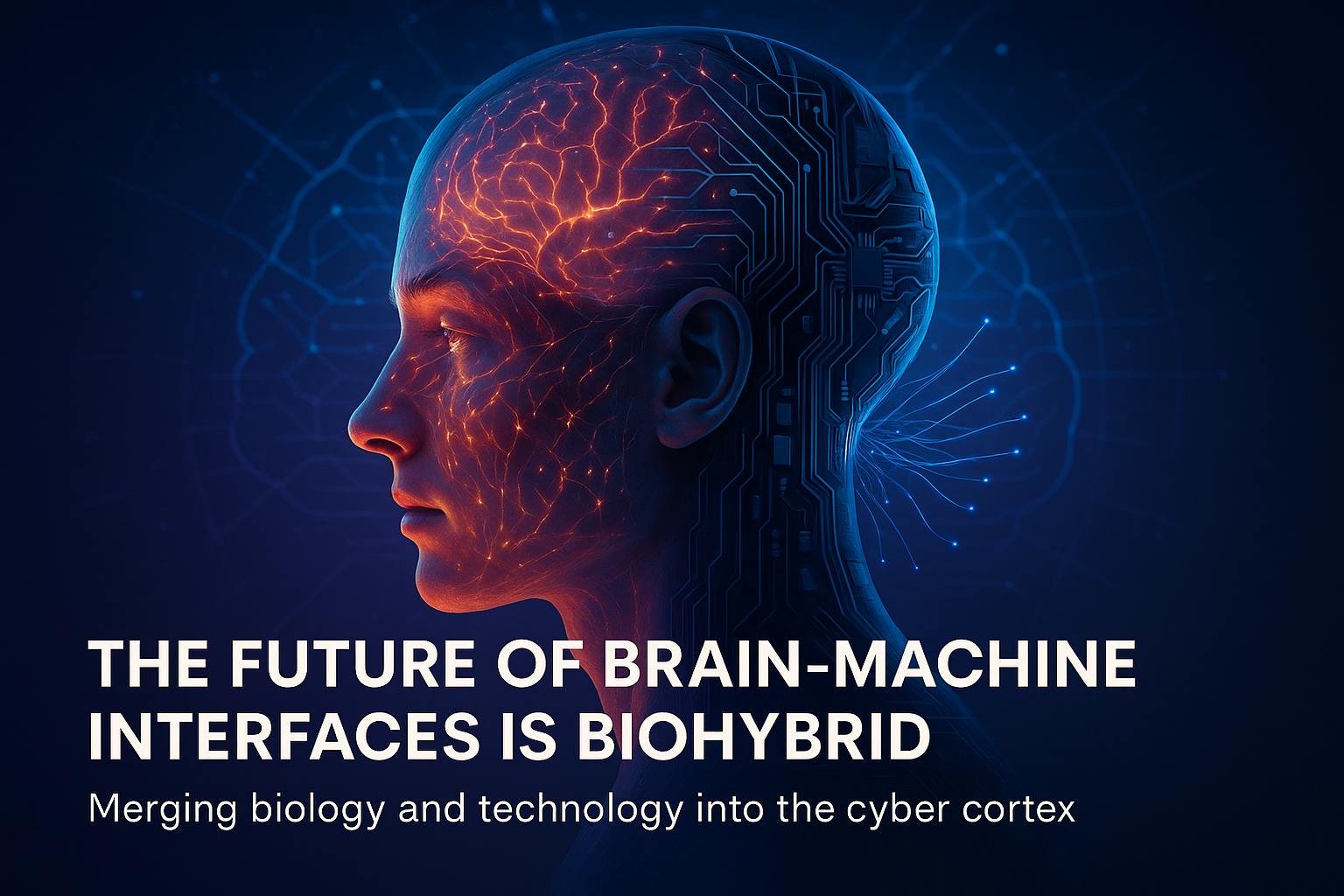
In essence, this technology introduces an entirely new, artificial layer of neurons to the human brain.
We can conceptualise this as a “cyber cortex” – a synthetic neural extension that merges biological and technological intelligence.
Just as the neocortex, evolutionarily the newest layer of our brain, allowed humanity to develop abstract thought, reasoning, and civilisation, this cyber cortex could usher in the next great evolutionary epoch.
It promises to blur the lines between organic and artificial, enabling us to transcend the limitations of our natural form.
The implications of a cyber cortex are staggering, pushing the boundaries of what we conceive as reality.
Max Hodak often speaks of direct brain-to-brain communication, a concept that immediately ignites the imagination.
Imagine a world where minds could be interconnected, not just sharing thoughts and emotions, but creating shared virtual realities that demand minimal external computing resources.
The prospect of an experience indistinguishable from physical reality – a true Matrix-like environment – strikes me as the holy grail of technological achievement.
If such a reality were to materialise, many of the technological challenges that consume our present efforts might simply become obsolete.
The relentless pursuit of energy production, storage, or material extraction could diminish in importance if the majority of our resources exist in a virtual realm.
Instead of perpetually solving problems within physical reality, we could, in effect, reshape reality itself, designing a framework where those problems cease to exist.
In a truly immersive virtual world, scarcity could vanish.
Resources could be optimally distributed, eradicating deprivation, hunger, and even the root causes of conflict.
A digitally augmented humanity might finally achieve a sustainable, balanced existence, not by altering human nature, but by transforming the very fabric of our perceived reality.
Of course, such visions belong, for now, to the realm of speculative fiction.
It is a future that feels impossibly distant, yet the scientific groundwork is being laid today.
Humanity stands at a critical juncture; our current civilisation grapples with unsustainable practices, and our capacity for self-destruction is undeniable.
Brain-machine interfaces, particularly the biohybrid frontier, offer not just a technological upgrade, but a potential escape hatch, a pathway towards something profoundly greater.
They hold the promise of nothing less than a new stage in human evolution, where the merging of biology and technology could allow us to design not just our tools, but our very existence.
-
Frank DiBernardo handles LNGFRM's Foodie and Miscellaneous writing tasks. He's always getting ideas from users, so don't be afraid to send an email to the editor.