In a world where businesses increasingly rely on swift and cost-effective transactions, the banking industry is at a crossroads.
The traditional banking system, often burdened with high fees and slow processing times for cross-border payments, faces mounting pressure to adapt or risk losing customers to nimble fintech competitors.
According to Deloitte’s 2025 Banking and Capital Markets Predictions report, the solution may lie in the burgeoning field of tokenization.
As businesses expand their global reach, they encounter a maze of challenges when transferring money across borders.
High transaction costs, prolonged payment speeds, and opaque settlement timelines can create friction in banking relationships.
Companies are understandably frustrated, clamoring for banks to enhance their cross-border payment capabilities.
In response, financial institutions are exploring tokenized currencies as a means of revolutionizing transactions, offering the promise of instant, 24/7 payment processing that could radically cut costs.
Deloitte’s report indicates that tokenization could be the key to revitalizing trust between banks and their corporate clientele.
By converting regulated assets such as commercial bank deposits and central bank deposits into tokenized formats, banks can enable instantaneous transactions that settle on a unified ledger.
This approach not only simplifies the payment process but also reduces the number of intermediaries involved, thereby slashing transaction costs significantly.
The prediction is bold: by 2030, one in four large-value international money transfers could be processed through these tokenized currency networks.
The potential economic impact is staggering.
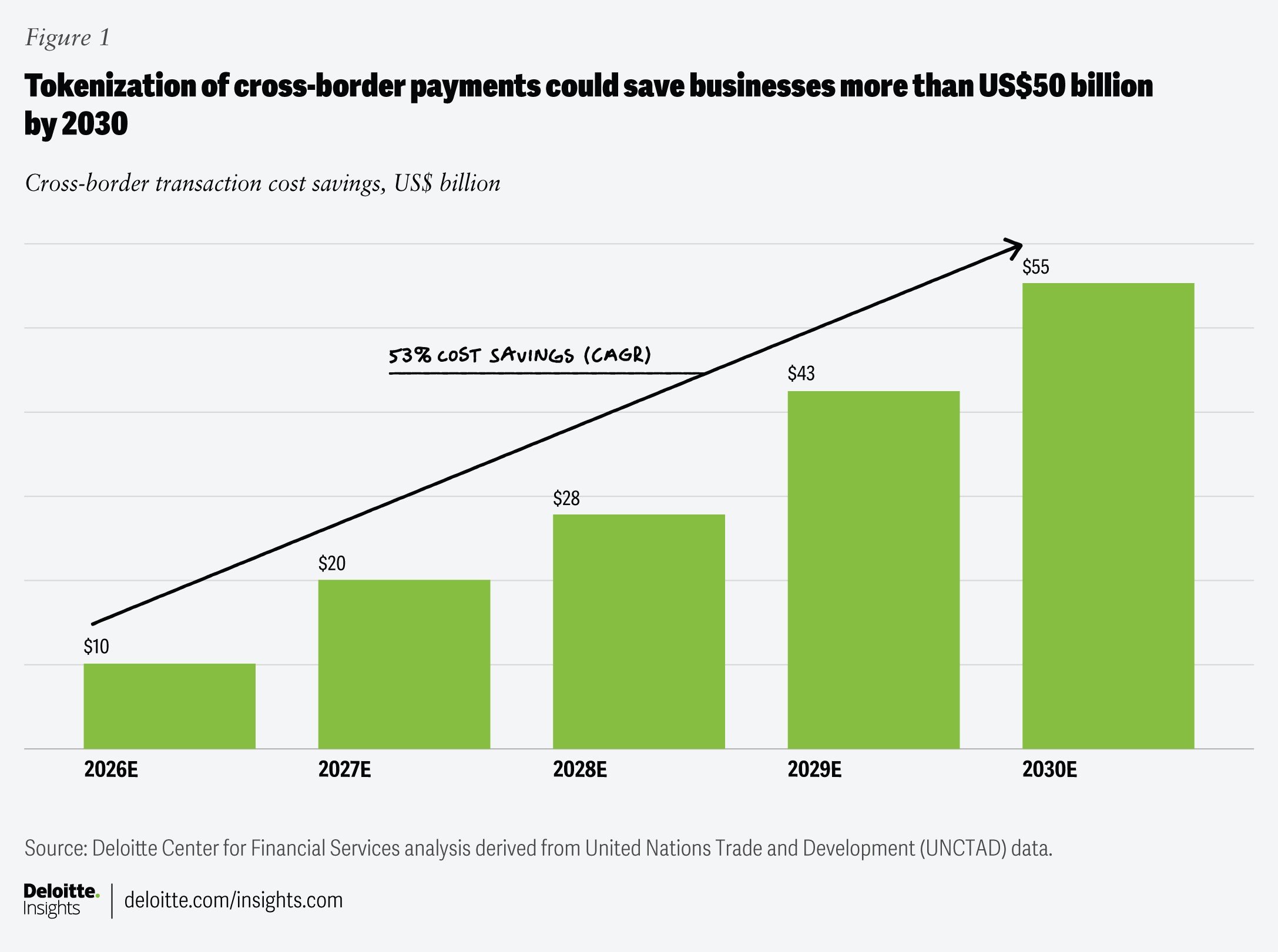
Deloitte estimates that advancements in tokenized payment infrastructure could lower corporate cross-border transaction costs by 12.5%, saving businesses over $50 billion by the end of the decade.
This is a game changer for companies that often find themselves bogged down by the inefficiencies of traditional banking systems.
However, the road to widespread adoption of tokenized currencies is fraught with challenges.
The current landscape of cross-border payments relies heavily on a network of correspondent banks that facilitate the flow of funds across international borders.
These transactions often involve multiple intermediaries and can be subject to long delays, particularly when time zone differences come into play.
As it stands, a significant portion of wholesale payments—those exceeding $100,000—travel through this cumbersome web of banks, leading to increased costs and extended settlement times.
Recent initiatives aimed at modernizing payment systems, such as enhancements to Swift’s payment tracking and pilot programs for instant payments between the U.S. and Europe, have made strides toward alleviating some of these pain points.
Yet, the need for multiple correspondent relationships continues to complicate the process, resulting in transaction costs that can be prohibitively high.
The introduction of tokenization could mitigate these issues by incorporating compliance checks directly into transaction flows, enabling banks to pre-validate details of both senders and recipients.
Unlike traditional transactions, where payment instructions are sent separately from the funds, tokenized transfers could seamlessly integrate messaging with money movement.
This innovation has the potential to streamline operations and eliminate many of the bottlenecks that currently plague cross-border payments.
Stablecoins, a type of digital currency pegged to stable assets like the U.S. dollar, are emerging as a frontrunner in this revolution.
With bipartisan support for federal legislation on stablecoins in the United States, there is a growing consensus that these digital cash instruments could pave the way for the future of wholesale cross-border payments.
The concept of a “stablecoin sandwich,” where a bank converts local currency into a stablecoin for instant transfer before crediting the recipient in their domestic currency, is gaining traction.
As banks and fintechs collaborate with regulators to define technical specifications and governance standards for these new digital assets, the prospects for tokenized currencies look increasingly promising.
The establishment of shared networks for the exchange of proprietary tokens is on the horizon, with multiple banks already piloting new settlement systems.
Despite the optimism surrounding tokenization, significant hurdles remain.
Regulatory frameworks for tokenized assets are still evolving, and the need to synchronize new digital ledgers with legacy banking systems presents a daunting challenge.
Many settlement systems are rooted in outdated technology, which can hinder the exchange of data and assets.
As the race to real-time payments accelerates, banks must not linger on the sidelines.
Those that act swiftly to embrace innovative payment solutions and forge strategic partnerships will not only strengthen their relationships with corporate clients but also secure their position in a rapidly changing financial landscape.
The future of banking may very well depend on the successful implementation of tokenized payment systems, and the time for action is now.
-
Frank DiBernardo handles LNGFRM's Foodie and Miscellaneous writing tasks. He's always getting ideas from users, so don't be afraid to send an email to the editor.