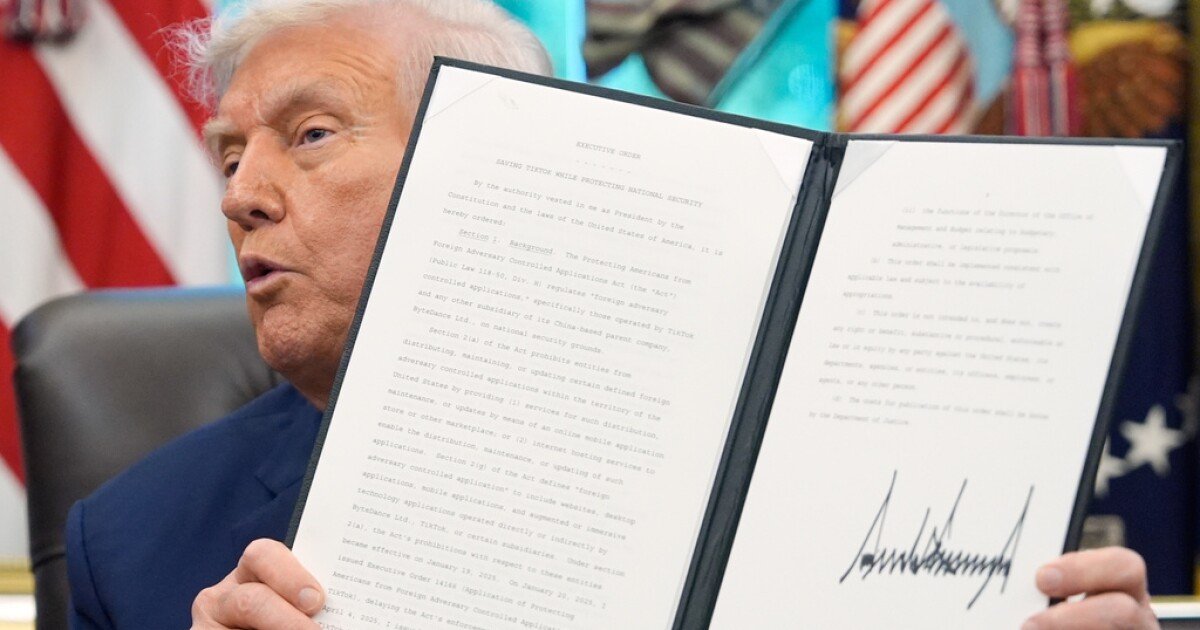
In a dramatic pivot that underscores the intricate dance between geopolitics, national security, and the powerful sway of social media, President Donald Trump has announced a proposed deal to place TikTok’s U.S. operations under American ownership.
The executive order signed by Trump, he claims, has received the crucial nod from Chinese leader Xi Jinping, setting the stage for a new chapter for the wildly popular video platform that has become a digital lifeline for millions of young Americans.
This latest development marks a significant turn in a saga that has seen TikTok repeatedly caught in the crosshairs of U.S.-China tensions.
Just last year, President Joe Biden signed legislation demanding ByteDance, TikTok’s Chinese parent company, sell its U.S. assets or face a nationwide ban.
Yet, a consistent thread of executive orders from the Trump administration has kept the app operational, reflecting a complex, evolving strategy to resolve the national security concerns without alienating a vast user base. Source.
The proposed framework, while still shrouded in some mystery, suggests a delicate balance has been struck, at least for now.
The stakes are undeniably high.
A recent Pew Research Center report revealed that a staggering 43% of U.S. adults under 30 regularly get their news from TikTok, surpassing every other social media app.
Any substantial alteration to the platform could fundamentally reshape how a generation consumes information and interacts online, making the details of this deal far more than just a corporate transaction.
Under the terms revealed by the White House, TikTok’s U.S. operations would be spun off into a new joint venture, predominantly controlled by American investors.
A consortium including tech giant Oracle and investment firm Silver Lake Partners is poised to hold roughly an 80% stake, with ByteDance retaining a minority 20% or smaller share. Source.
Crucially, the board overseeing this new entity would be controlled by U.S. investors, with ByteDance’s single representative excluded from any security-related discussions.
The list of potential American owners, however, immediately raises questions about the intersection of business, politics, and media influence.
Oracle co-founder Larry Ellison, a prominent figure with deep ties to the Trump administration, is positioned to be a significant player. Source.
Ellison, despite stepping down as Oracle’s CEO years ago, remains heavily involved as chairman and CTO, and his recent financial backing of Skydance’s Paramount merger hints at a broader ambition in media.
The mention of Rupert Murdoch, another figure whose interests often align with Trump’s, and Dell founder Michael Dell as potential investors further fuels speculation about the political leanings that might subtly, or overtly, shape the platform’s future.
At the heart of the national security debate lies TikTok’s recommendation algorithm – the sophisticated system that curates the endless stream of personalized video shorts.
China previously insisted this algorithm remain under its control, citing national laws. Source.
However, a U.S. regulation, passed with bipartisan support, mandated a complete severance of ties with ByteDance for any divestment to be valid.
The proposed solution is a licensed copy of the ByteDance-created algorithm, retrained exclusively with U.S. data.
Administration officials argue this retraining will effectively nullify any risk of Chinese interference, although U.S. officials have yet to present concrete evidence of past manipulation by Beijing. Source.
This technological workaround, in essence, attempts to create a digital firewall, but whether it truly assuages all concerns remains an open question, particularly given the opaque nature of algorithmic influence.
President Trump’s journey with TikTok has been a fascinating political tightrope walk.
His first term saw him attempting to ban the app outright, warning that its data collection threatened to give the Chinese Communist Party access to Americans’ personal information.
Yet, as the 2024 presidential election looms, his rhetoric has softened considerably, often citing TikTok’s indispensable role in reaching young voters.
Vice President J.D. Vance echoed this sentiment, emphasizing the desire to keep TikTok operating while bolstering security. Source.
This pragmatic shift underscores how the platform, once a symbol of geopolitical contention, has also become a valuable political tool.
But what will the “new” American TikTok feel like?
Any noticeable changes to a social media platform carry the inherent risk of alienating its audience, a lesson starkly illustrated by Elon Musk’s tumultuous takeover of Twitter, now X.
Analyst Jasmine Enberg of eMarketer cautions that while Musk’s changes were highly visible, the alterations to TikTok’s algorithm, driven by different data inputs, could be far more subtle, perhaps even unnoticeable to most users.
“Social media is just as much about the culture as it is the technology, and how users will take to new ownership and potentially a new version of the app is still an open question,” Enberg noted, highlighting the delicate balance between technical security and user experience.
Perhaps the most intriguing aspect of this deal is China’s apparent acquiescence.
Beijing once condemned the demand for TikTok’s divestment as an act of “robbery.” The shift in tone suggests a recalculation of priorities.
Some observers speculate that China extracted concessions from the U.S. on trade restrictions in exchange for the TikTok deal, or that it sought to pave the way for a high-level meeting between Xi and Trump.
Sun Yun, director of the China program at the Stimson Center, posits that for Beijing, “TikTok alone does not compare with the importance of an amicable U.S.-China relations and the positive momentum that prevents many negative developments from happening.”
Dimitar Gueorguiev, an associate professor of political science at Syracuse University, offers a more strategic interpretation.
He argues that TikTok, once a disruptive newcomer, has become an “expendable concession” for Beijing.
Five years ago, its “For You” feed was groundbreaking; today, rivals like Instagram offer similar experiences.
Beijing, Gueorguiev suggests, is more keenly focused on retaining access to U.S. technology and services in the short term, aiming to bolster its self-sufficiency in critical areas like semiconductors, artificial intelligence, and advanced manufacturing.
“That is the front line of technological competition,” Gueorguiev said.
“TikTok, by contrast, is a maturing consumer app with diminishing strategic weight.”
The proposed deal, therefore, is more than just a corporate acquisition; it’s a complex tapestry woven from national security anxieties, political expediency, technological innovation, and a shifting global power dynamic.
While the immediate crisis may be averted, the long-term implications for data sovereignty, the future of social media, and the delicate U.S.-China relationship remain profoundly uncertain.
-
Frank DiBernardo handles LNGFRM's Foodie and Miscellaneous writing tasks. He's always getting ideas from users, so don't be afraid to send an email to the editor.