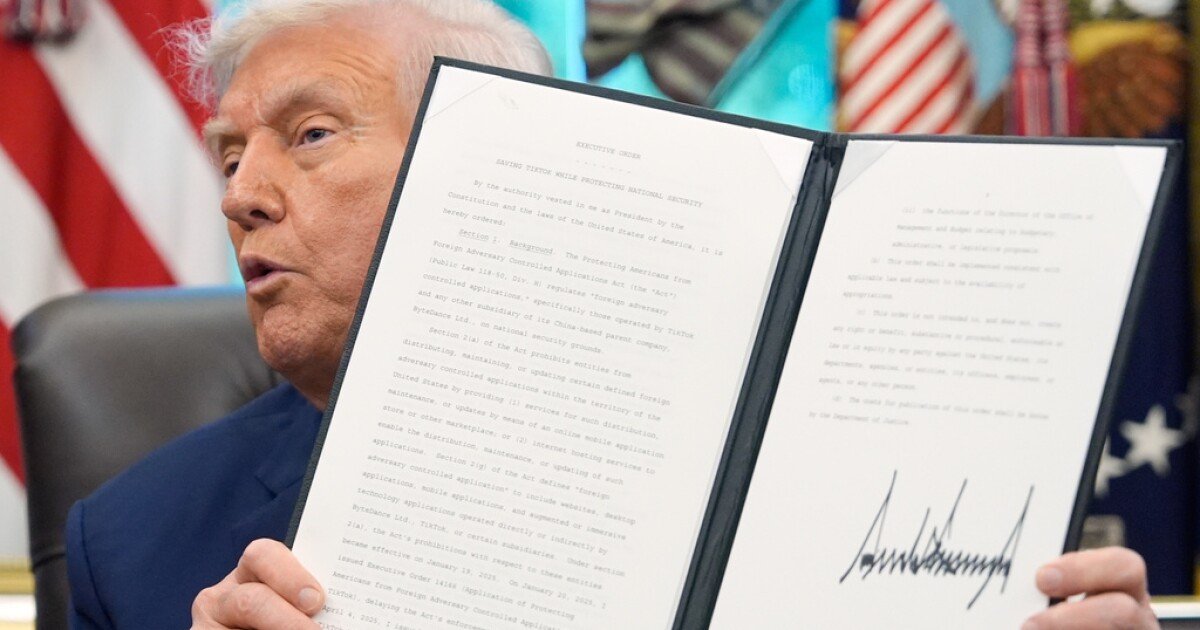
The White House, a stage often set for pronouncements of global consequence, recently became the backdrop for President Donald Trump’s declaration of a breakthrough in the protracted saga of TikTok.
With a stroke of a pen, Trump signed an executive order, asserting that it would allow the ubiquitous video-sharing app to continue its operations in the United States, now under American ownership, and crucially, with the blessing of Chinese leader Xi Jinping.
This announcement, delivered with characteristic confidence, aims to put a capstone on years of escalating tensions and legislative wrangling over national security concerns.
For many, the news might come as a surprise, given the tumultuous history of the app’s presence in the U.S.
Just last year, President Joe Biden signed legislation demanding that TikTok’s parent company, ByteDance, divest its American assets by early this year or face a nationwide ban. This situation has raised questions about ByteDance TikTok divestment.
Yet, a pattern has emerged, with presidential orders repeatedly granting TikTok reprieves as administrations grappled with the complexities of a forced sale.
The proposed deal, still shrouded in a fair degree of ambiguity, marks a significant turn, particularly with Trump’s claim of Chinese approval – a detail the Chinese embassy in Washington has yet to confirm, leaving an intriguing silence in its wake.
The stakes are undeniably high.
TikTok is not merely another social media platform; it’s a cultural phenomenon, a digital heartbeat for a significant segment of the American populace.
A recent Pew Research Center report underscored its pervasive influence, revealing that a staggering 43% of U.S. adults under 30 regularly turn to TikTok for news – a figure that outstrips even YouTube, Facebook, and Instagram.
Any fundamental alteration to this digital cornerstone could ripple through the information consumption habits of millions, especially the younger generations.
Under the framework sketched out by the White House, the app is slated to be spun off into a new U.S. joint venture.
This entity would be predominantly owned by a consortium of American investors, including tech giant Oracle and investment firm Silver Lake Partners.
While the precise figures await finalization, the American group is projected to hold an approximate 80% stake, leaving ByteDance with a minority share of 20% or less.
The crucial element of control, we are told, will reside with a U.S.-led board, with ByteDance’s single representative explicitly excluded from any deliberations concerning security matters.
A closer look at the proposed ownership group immediately raises questions about potential political influence.
Among the names floated are Oracle co-founder Larry Ellison and media magnate Rupert Murdoch, both figures whose business and political interests are notably intertwined with President Trump.
Ellison, despite stepping down as Oracle’s CEO years ago, remains deeply involved as chairman and CTO, and has recently expanded his media footprint through his son David’s role in the Paramount-Skydance merger.
Trump also indicated that Dell founder Michael Dell would join the investor roster.
The concentration of individuals with such pronounced political leanings within the new TikTok venture naturally sparks speculation about the platform’s future editorial independence and content moderation policies.
Will this new ownership usher in an era where political affiliations subtly, or not so subtly, shape the digital discourse of millions?
Central to the security debate has always been TikTok’s recommendation algorithm – the sophisticated engine that crafts the endlessly engaging “For You” feed.
China, historically, has fiercely protected this intellectual property, asserting its control by law.
However, U.S. legislation, passed with bipartisan support, mandated a complete severance of ties with ByteDance, including the algorithm.
American officials have long voiced concerns that this algorithm could be exploited by Chinese authorities to covertly manipulate messaging on the platform, though, notably, no concrete evidence of such attempts has ever been publicly presented.
The proposed solution to this algorithmic quandary is intriguing: a licensed copy of the ByteDance-created algorithm, meticulously retrained solely with U.S. data, will power the new American version of the app.
This “retraining effort,” according to administration officials, is designed to nullify any lingering risks of Chinese interference.
Vice President J.D. Vance echoed the sentiment, stating the desire to keep TikTok operational while bolstering confidence in its security.
President Trump himself remarked on the enthusiasm of young people for this outcome, acknowledging TikTok’s newfound utility in his 2024 presidential campaign strategy – a stark pivot from his initial stance of attempting to ban the app outright due to “data collection threatening access to Americans’ personal and proprietary information.”
Yet, the question looms: will the U.S. version of TikTok feel different?
Jasmine Enberg, an analyst for eMarketer, cautions that any noticeable changes to a social media platform’s service carry the inherent risk of alienating its audience.
She points to Elon Musk’s tumultuous takeover of Twitter, now X, as a prime example of how radical, visible changes can provoke immediate backlash.
However, the changes to TikTok’s algorithm, driven by different data inputs, could be far more subtle, perhaps imperceptible to the average user.
“Social media is just as much about the culture as it is the technology,” Enberg wisely observes, “and how users will take to new ownership and potentially a new version of the app is still an open question.”
From Beijing’s perspective, this deal represents a significant strategic shift.
What was once denounced as an act of “robbery” has now seemingly become an “expendable concession,” as Dimitar Gueorguiev, an associate professor of political science at Syracuse University, suggests.
Initial speculation following U.S.-China trade talks pointed to possible concessions from the U.S. on trade restrictions or even paving the way for a Xi-Trump meeting.
Sun Yun, director of the China program at the Stimson Center, emphasizes that “TikTok alone does not compare with the importance of amicable U.S.-China relations and the positive momentum that prevents many negative development from happening.”
Gueorguiev further argues that TikTok, once a disruptive newcomer five years ago with its “secret sauce” algorithm, has matured.
Rivals like Instagram have largely caught up, replicating its personalized video feed.
Beijing, he posits, is now prioritizing access to U.S. technology and services in the short term, aiming to bolster its self-sufficiency in critical sectors like semiconductors, artificial intelligence, and advanced manufacturing.
“That is the front line of technological competition,” Gueorguiev asserts.
“TikTok, by contrast, is a maturing consumer app with diminishing strategic weight.”
Ultimately, this proposed deal is more than a corporate transaction; it’s a microcosm of the intricate, often contradictory, dance between two global superpowers.
It’s a testament to the evolving nature of geopolitical leverage, where a popular consumer app can transform from a national security threat to a bargaining chip, and where political expediency can recalibrate national policy.
The future of TikTok, now tethered to a new set of American interests, remains a fascinating experiment in the intersection of technology, politics, and culture, with millions of young users watching, perhaps unknowingly, as the algorithmic gears of their digital world are subtly, but fundamentally, re-tuned.
-
Frank DiBernardo handles LNGFRM's Foodie and Miscellaneous writing tasks. He's always getting ideas from users, so don't be afraid to send an email to the editor.