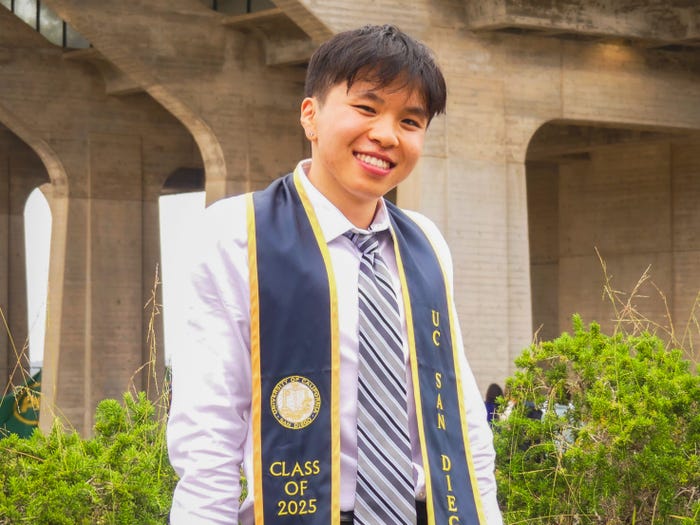
The clock was ticking, not just on Andrew Chen’s impending graduation from the University of California San Diego, but on a year-long quest that had, until a sudden email from Amazon, felt increasingly futile.
At 22, with a computer science degree almost in hand, Chen found himself staring down the barrel of unemployment.
This predicament has become an unsettling reality for many recent graduates navigating a tumultuous job market.
His situation, however, was far from unique.
As of June, unemployment rates for Americans aged 22 to 27 with at least a bachelor’s degree stood at 4.8%.
This figure, for the first time in recent memory, surpasses the jobless rate of the broader working-age population.
This isn’t merely a statistical anomaly; it’s a stark indicator of a hiring slowdown exacerbated by economic uncertainties, the nascent impacts of AI, and a wave of tech layoffs that have shaken industry giants from Amazon to Google.
Software development job postings on Indeed, once a beacon of opportunity, have plummeted by over 70% from their 2022 peak.
This has left aspiring engineers like Chen in a desolate landscape.
For Chen, the struggle had been a prolonged, disheartening marathon.
Since the summer of 2024, he had cast a wide net, applying to over 400 positions.
His initial ambition was firmly rooted in software engineering.
As rejection after rejection piled up, and silence became the loudest response, he began to pivot, exploring product management and design roles, almost conceding defeat in his preferred field.
The emotional toll of this relentless pursuit is often underestimated.
It includes constant validation-seeking, self-doubt, and the quiet despair of feeling unqualified despite years of rigorous study.
It’s a common narrative among Gen Z job seekers, who, despite their digital fluency and academic achievements, find themselves caught in an unprecedented bottleneck.
Then, in May, a glimmer of hope pierced the gloom: an email from Amazon, inviting him to interview for a software engineering role in just 10 days.
The timing was both a blessing and a curse.
While it offered a lifeline back to his dream, it also meant a frantic scramble to re-hone coding skills that had atrophied while he focused on other disciplines.
This was his chance, a rare opportunity in a market that felt increasingly like a closed shop.
He knew he couldn’t squander it.
Faced with this immense pressure, Chen devised an unconventional strategy: he would document his intense preparation on TikTok.
In an era often criticized for its superficiality, Chen discovered a profound utility in public vulnerability.
He envisioned TikTok not just as a platform for entertainment, but as a digital confessional, a public commitment device that would hold him accountable.
“I canceled all my social obligations, locked myself in my room, and basically only left the house to have lunch,” he recounted, the desperation palpable.
“I was thinking, if I don’t get this job, this is all for nothing.”
His days became a rigid regimen: blocks dedicated to LeetCode coding challenges, rigorous behavioral question prep, deep dives into Amazon’s revered leadership principles, and the meticulous crafting of STAR-format personal stories.
He scoured Reddit and Blind for insights, absorbing every scrap of wisdom from past candidates.
His TikTok videos, charting his progress, his anxieties, and his caffeine intake, quickly resonated, racking up millions of views.
The comments section was a microcosm of the internet itself: a mix of skepticism, doubt, but crucially, also an outpouring of advice and encouragement that fueled his resolve.
It was a testament to the power of collective experience, a modern form of mentorship forged in the digital ether.
When the interview day arrived in late May, Chen was, predictably, a bundle of nerves and sleep deprivation.
Amazon’s “loop” interview process—three back-to-back virtual sessions—tested not only his technical acumen but also his alignment with the company’s deeply ingrained leadership principles.
This emphasis on behavioral questions, on demonstrating values beyond mere coding ability, proved to be a critical insight.
“I think I’m a better talker than a coder, so I was very excited for that,” Chen admitted, highlighting a crucial shift in modern hiring where soft skills and cultural fit often stand alongside technical prowess.
On June 3, the email arrived.
It was a six-figure job offer from Amazon.
The relief, after 298 days of relentless searching, was immense.
He shared the news on TikTok, his final video in the series garnering nearly a million views, a triumphant conclusion to his public journey.
He graduated in mid-June and, shortly thereafter, moved to New York City to begin his new role in July.
Chen’s journey isn’t just a feel-good story of individual success; it’s a vital case study in resilience, adaptability, and the evolving landscape of career entry.
His advice, born from the crucible of a brutal job market, is simple yet profound: while application quality is important, sheer volume is often a “numbers game.”
More importantly, perhaps, his story underscores the unexpected ways digital platforms can be leveraged not just for personal branding, but for genuine accountability and community support in the often-lonely pursuit of employment.
In a world increasingly defined by digital interaction, Andrew Chen found his breakthrough by turning a personal struggle into a public, inspiring quest.
-
Frank DiBernardo handles LNGFRM's Foodie and Miscellaneous writing tasks. He's always getting ideas from users, so don't be afraid to send an email to the editor.