The annual Snapdragon Summit in Maui has long served as a crucial barometer for the trajectory of mobile and, increasingly, PC silicon.
This year, however, the barometer didn’t just point to incremental improvements; it heralded a seismic shift, a bold declaration from Qualcomm that the age of agentic AI has not merely arrived, but is poised to redefine our digital lives.
The company isn’t just building faster chips; it’s architecting the very foundation for intelligent entities designed to understand, anticipate, and act on our behalf.
At the heart of this transformative vision are two new flagship processors: the Snapdragon 8 Elite Gen 5 for smartphones and the Snapdragon X2 Elite for personal computers.
These aren’t simply powerhouses of raw computational might, though they certainly deliver on that front.
Instead, Qualcomm has positioned them as the neural networks for a new class of personal agents, platforms so deeply rooted in context-awareness, multimodality, and proactive intelligence that they promise to elevate our interaction with technology from mere instruction-giving to genuine partnership.
It’s a theme echoed by other industry giants like Google and Samsung, but Qualcomm’s deep dive into silicon-level execution lends a tangible weight to their ambitious narrative, underscoring where the company’s significant investments are flowing.
Consider the Snapdragon 8 Elite Gen 5, crafted on a cutting-edge 3nm process and powered by Qualcomm’s third-generation Oryon CPU architecture.
The performance claims are impressive: a 20% CPU uplift and 35% better efficiency over its predecessor, with prime cores clocking in at a blistering 4.6GHz.
The new Adreno GPU delivers a 23% graphics boost and 25% improved ray tracing, while the Hexagon NPU, the dedicated engine for AI workloads, is a formidable 37% faster.
My own hands-on benchmarking at the Summit confirmed these aren’t just marketing figures; this new mobile platform truly sets a new standard, outperforming anything currently available on both Android and Apple iOS.
But to focus solely on raw horsepower would be to miss the forest for the trees.
The real narrative here is what this power enables.
The Snapdragon 8 Elite Gen 5 is the first mobile platform to support Advanced Professional Video (APV), a new royalty-free video compression standard developed by Samsung, promising near-lossless, professional-grade video capture.
For gamers, the GPU’s innovative memory optimizations, including a shared HPM cache, translate into not just higher frame rates but also more efficient rendering, extending those immersive gaming sessions.
Crucially, the Snapdragon 8 Elite Gen 5 is engineered from the ground up for agentic AI.
Demos at the Summit were genuinely compelling, showcasing AI agents that could “see what you see, hear what you hear, and think with you in real time.”
These aren’t passive assistants waiting for a prompt; they proactively offer recommendations, summarize complex conversations, and even adjust camera settings on the fly.
And critically, all this intelligence processing happens on-device, a significant boon for privacy-conscious users.
The Snapdragon Seamless Agent, for instance, was presented as a cross-device orchestrator, seamlessly managing context and continuity across phones, PCs, earbuds, and wearables – a tangible manifestation of Qualcomm CEO Cristiano Amon’s vision for an ecosystem of you.
While some of these functionalities are still in development and will require robust OEM and developer support, the underlying blueprint for truly useful, day-to-day AI was undeniably clear.
Moving to the PC landscape, Qualcomm unveiled the Snapdragon X2 Elite, a successor to last year’s groundbreaking Snapdragon X Elite.
Built on an enhanced Oryon CPU architecture, the X2 Elite promises nothing less than desktop-class performance with laptop-class efficiency.
Early benchmark numbers, presented from prototype reference laptops, were, to put it mildly, exceptional.
We saw multi-threaded throughput that didn’t just compete with, but “took platforms from Intel, AMD and even Apple to task for a solid beating,” with single-threaded performance reportedly surpassing even Apple’s M4.
Graphics performance, demonstrated via 3DMark Solar Bay, also showed a significant lead over integrated solutions from Intel’s Core Ultra 200 series Lunar Lake and AMD’s Ryzen AI 9 series.
Now, a journalist’s duty requires a note of caution: these are early, Qualcomm-provided numbers, and a certain degree of “chest-thumping” is to be expected.
The real-world performance, especially where emulation might be required for specific applications like gaming, will be the ultimate test.
However, the potential is undeniable.
A cornerstone of Qualcomm’s PC vision is the seamless integration of local and cloud AI models.
This hybrid approach means AI agents can handle lightweight, immediate tasks on-device, while intelligently offloading more complex reasoning to larger cloud models when necessary.
The benefits are manifold: reduced latency, optimized power consumption, and enhanced privacy.
This strategy also strategically positions Qualcomm as a central, indispensable player in the broader AI ecosystem, with its chips serving as the crucial connective tissue across an expanding array of devices – smartphones, PCs, cars, wearables, and IoT.
The PC demos were equally compelling: an AI agent capable of distilling a day’s worth of emails into a concise digest, generating real-time graphs from Excel spreadsheets, and even acting as a research assistant, pulling context from both local files and online sources.
The key differentiator here is latency.
By performing much of the inference workload locally, the Snapdragon X2 Elite makes these experiences feel incredibly responsive and fluid, a significant advantage over purely cloud-based solutions.
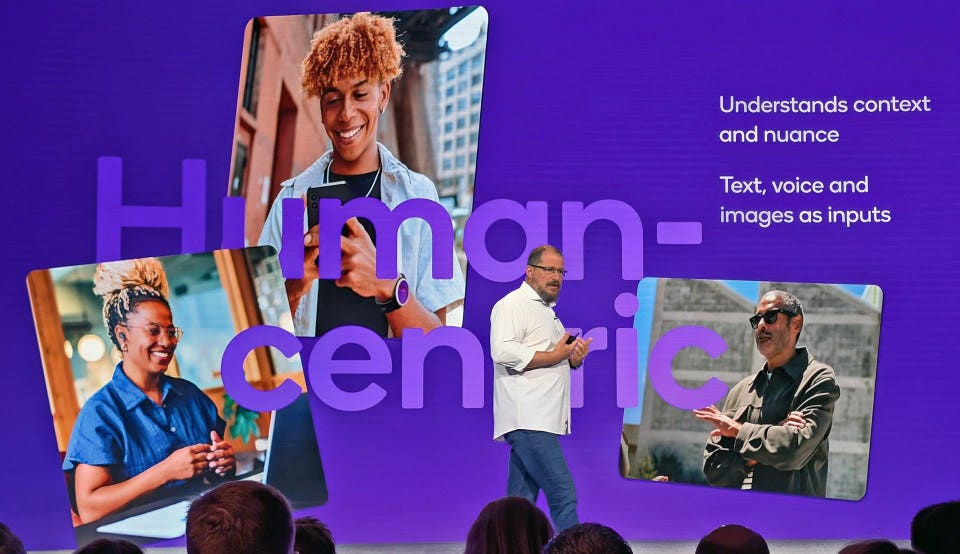
“Agentic AI” was the omnipresent phrase throughout the Summit, a mantra for a future where AI agents transcend their current role as passive assistants to become active, intuitive partners.
These agents are designed to be multimodal, capable of processing text, voice, images, and even environmental context simultaneously.
The personalization aspect was particularly striking.
By continuously learning on-device, these agents will adapt to individual users, all while keeping sensitive data private.
Qualcomm articulates this as “AI that knows you but doesn’t own you,” a crucial distinction in an era increasingly concerned with data sovereignty.
However, the ultimate proof will emerge when laptops and smartphones powered by this new technology hit the market, backed by a robust software and app ecosystem.
Qualcomm’s Snapdragon Summit 2025 painted a vivid, ambitious picture for the future of computing – one powered by intelligent, personalized AI agents running directly on our devices.
The Snapdragon 8 Elite Gen 5 isn’t just a mobile performance leap; it’s a foundational platform for AI that truly sees, hears, and responds in real time.
Similarly, the Snapdragon X2 Elite for PCs promises to bring hybrid AI to life, seamlessly blending local inference with cloud capabilities to deliver proactive, context-aware experiences and critical task automation.
I, for one, am genuinely excited for the first wave of Snapdragon X2 Elite series PCs to arrive in the first half of 2026.
This platform could well redefine performance-per-watt metrics for Windows PCs, injecting fresh competitive pressure into the market for Intel and AMD.
Ultimately, Qualcomm is making a profound wager: the future of computing isn’t merely about faster chips, but fundamentally smarter ones.
It’s about silicon solutions that not only execute instructions but intimately understand context, anticipate our needs, and act decisively on our behalf.
Snapdragon Summit made one thing abundantly clear: the personal AI era isn’t just on the horizon; it’s already here, and Qualcomm is determined to be its silicon superpower.
-
Frank DiBernardo handles LNGFRM's Foodie and Miscellaneous writing tasks. He's always getting ideas from users, so don't be afraid to send an email to the editor.