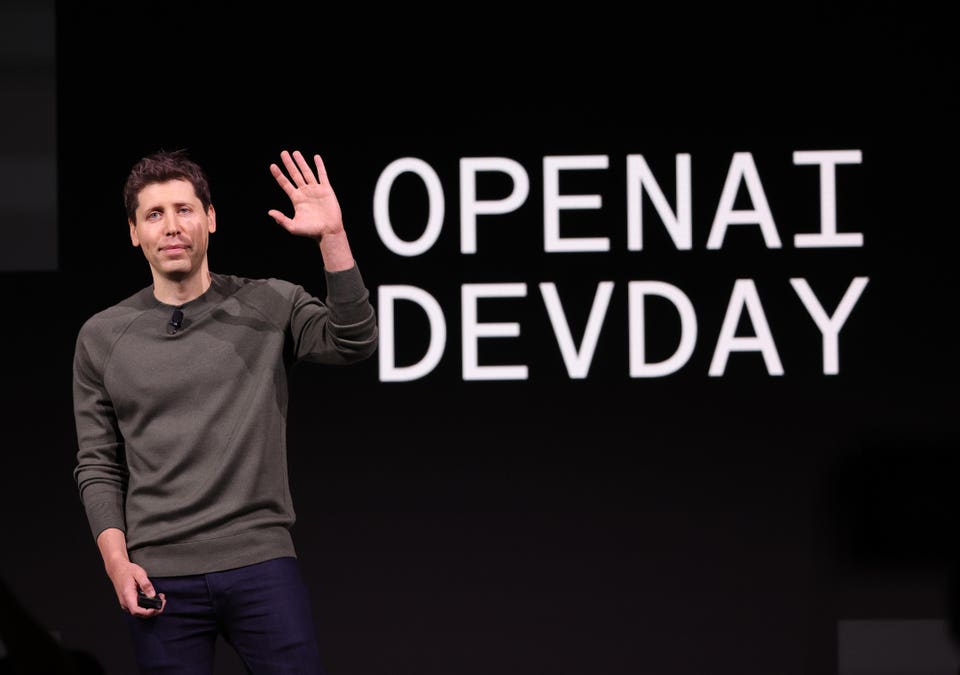
The digital landscape is once again bracing for a seismic shift, and the tremors began in earnest at OpenAI’s Dev Day 2025 in San Francisco.
What initially presented itself as a routine update of models and APIs quickly unveiled a far grander ambition: to transform ChatGPT from a mere chatbot into nothing less than the internet’s next primary interface.
This isn’t just about faster responses or cheaper access; it’s a bold declaration that OpenAI intends to redraw the very map of how we interact with the digital world, blurring the once-clear lines between browser, operating system, and personal assistant.
Sam Altman, OpenAI’s CEO, took to the stage, not just to showcase incremental improvements, but to unveil a vision where the internet doesn’t live in a fragmented universe of apps and tabs, but within a single, conversational thread.
At the heart of this audacious play are two pivotal announcements: the Apps SDK and AgentKit.
The Apps SDK allows developers to embed fully interactive software directly into the ChatGPT window.
Imagine designing a graphic in Canva, streaming music on Spotify, enrolling in a Coursera lecture, or browsing Zillow listings – all without ever leaving your chat with ChatGPT.
This is the promise, turning the AI into a universal container for digital life, where requests are typed or spoken, and applications respond contextually within the same continuous conversation.
This fundamentally challenges the visual, click-driven navigation that has defined the web for decades, proposing conversation itself as the new navigational paradigm.
Alongside this, AgentKit offers developers a drag-and-drop workflow builder to create intelligent agents capable of executing complex tasks, connecting with various APIs, or integrating with enterprise systems.
It’s a direct challenge to established workflow automation tools like Zapier or Lindy AI, but with the distinct advantage of being natively embedded within the ChatGPT ecosystem.
OpenAI, now a staggering $500 billion startup, articulated a future where developers can visually design intricate, goal-oriented agents with ease, sidestepping the “fragmented tools” and “weeks of frontend work” that have historically plagued agent development.
This includes embeddable chat components for websites and robust evaluation systems, ensuring accuracy and reliability.
These moves signal OpenAI’s intent to evolve from a developer ecosystem to a comprehensive consumer platform, a role traditionally dominated by giants like Apple’s iOS and Google’s Android.
From a user perspective, the vision is compelling: a streamlined existence where the digital clutter of toggling between Slack, Spotify, Chrome, and Figma is consolidated.
Brainstorm a logo, design it, check licensing, and share it – all within the same AI-powered conversation.
The convenience factor is undeniable, yet this enticing vision of digital consolidation simultaneously raises a host of profound questions that cannot be ignored.
Foremost among these is the issue of control.
If ChatGPT indeed becomes the environment where users “live” their digital lives, OpenAI inherently transforms into the primary intermediary for every online interaction.
This isn’t OpenAI’s first foray into app integration; a previous attempt with custom widgets or GPTs two years prior didn’t gain significant traction.
The success of this new iteration hinges on far more than just technological prowess; it requires a delicate balancing act of user trust, developer adoption, and regulatory navigation.
The competitive landscape is also heating up.
OpenAI is not merely vying for developer attention against rivals like Google, Anthropic, and Amazon; it’s also fending off the rise of capable open-source models from Meta and DeepSeek, which offer developers greater flexibility and cost savings.
Furthermore, this conversational OS directly confronts the established paradigms of Apple’s iOS, Google’s Android, and Microsoft’s Windows, all of which are built on graphical navigation and native app architectures.
OpenAI’s approach could either complement or fundamentally undercut this hierarchy, depending on its adoption.
Beyond the immediate competitive dynamics, the implications for privacy and data security are immense.
Embedding third-party apps and agents directly into ChatGPT introduces entirely new vectors for potential data risks.
Users will be asked to place immense trust not only in OpenAI’s own data handling practices but also in the security protocols of every integrated app and agent.
OpenAI’s review system for malicious agents will need to be unimpeachable.
The specter of “lock-in” also looms large for developers, who might find themselves beholden to OpenAI’s policies and monetization rules, much like mobile developers currently navigate the strictures of Apple’s App Store and Google Play.
Regulators, already wary of the immense power wielded by “gatekeeper platforms,” are likely to scrutinize OpenAI’s ambitious expansion with renewed intensity.
A platform that hosts apps, facilitates transactions, and intermediates user data could swiftly fall under new forms of antitrust and digital-market oversight, echoing the European Union’s Digital Markets Act (DMA).
Perhaps the most crucial, and often overlooked factor, is human choice.
Will users genuinely want to spend their entire digital day within a single conversational interface?
While efficiency is appealing, human interaction with technology is often social, visual, and emotional.
Nick Turley, OpenAI’s head of product for ChatGPT, offered a more tempered perspective after the keynote, admitting the company “never meant to build a chatbot; we meant to build a super assistant, and we got a little sidetracked.”
He acknowledged that while OpenAI is excited about natural language processing, they will continue to experiment with different UIs.
“Will people spend all of their time in ChatGPT? I don’t think so,” Turley stated, envisioning a scenario where ChatGPT might “start your day” before guiding users toward other apps and websites.
This suggests a more nuanced role, perhaps as a sophisticated orchestrator rather than a monopolistic digital home.
Dev Day 2025, in essence, was OpenAI’s unequivocal declaration that it aims to own the next user interface of the internet.
The shift from apps in tabs to apps in threads, from clicks to prompts, and from search to conversation, represents a profound re-imagining of our digital engagement.
If successful, ChatGPT could indeed become the new browser for a post-search era, where consumers talk, transact, and create within one single conversational window.
However, as history repeatedly demonstrates, every major technological transition, from the advent of the graphical user interface to the rise of the mobile app store, brings with it a fresh wave of questions regarding openness, privacy, interoperability, and the ultimate control of the platform.
For OpenAI and the digital world it seeks to reshape, these questions are only just beginning to surface.
-
Frank DiBernardo handles LNGFRM's Foodie and Miscellaneous writing tasks. He's always getting ideas from users, so don't be afraid to send an email to the editor.