Halloween, that annual crucible of creativity and cultural commentary, has long mirrored the anxieties and obsessions of its time.
From classic monsters to political figures, each costume tells a story about what occupies our collective consciousness.
This year, however, a new, distinctly digital specter is haunting the costume parties: the AI chatbot.
What began as a niche fascination among tech enthusiasts is rapidly spilling into the mainstream, transforming lines of code and conversational interfaces into silver bodysuits, custom tees, and even rudimentary user interfaces.
The evidence is undeniable.
Google Trends data shows a significant surge in searches for “ChatGPT costume,” signaling a moment of cultural crystallization for artificial intelligence.
It’s no longer just a tool or a topic of academic debate; it’s a recognizable, even iconic, entity worthy of impersonation.
This shift reflects AI’s meteoric rise from the fringes of Silicon Valley to a pervasive presence in daily life, establishing recognizable brands like OpenAI’s ChatGPT and Anthropic’s Claude with astonishing speed.
For many, particularly within the tech-savvy enclaves of the Bay Area and beyond, associating with this emerging technology isn’t just a professional pursuit—it’s a lifestyle, manifested in merchandise, pop-ups, and now, Halloween attire.
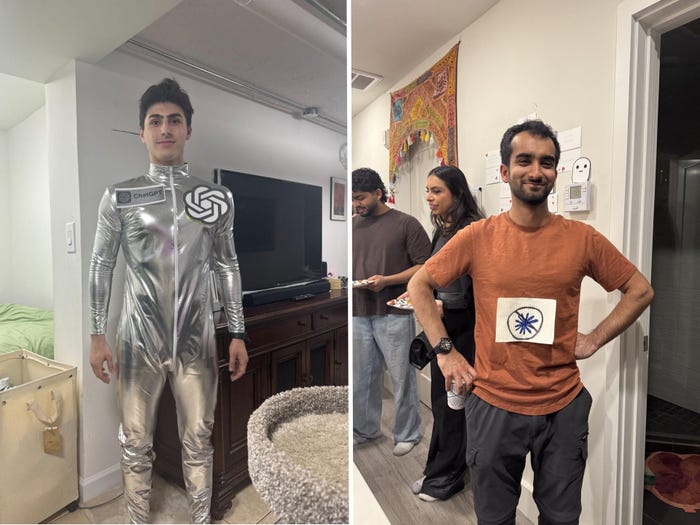
Take Stephen Michael, for instance, a 23-year-old founder who decided to embody the very chatbot he was consulting for costume ideas.
Donning a silver bodysuit and a laminated OpenAI logo, Michael transformed into a “person in a futuristic movie.”
The striking visual, combined with his robotic responses to partygoers’ prompts, made him an instant viral sensation on TikTok.
His experience underscores a fascinating aspect of these AI costumes: they invite interaction.
People don’t just observe; they engage, attempting to “prompt” the human chatbot, blurring the lines between the digital assistant and its flesh-and-blood representation.
Then there’s Taha Haider, a 26-year-old product manager, whose last-minute ingenuity perfectly illustrates the tech insider’s embrace of the trend.
With an orange tee reminiscent of Anthropic’s signature hue, he simply drew Claude’s logo on a notebook page and stuck it to his chest.
“Those who got it got it immediately,” Haider observed, highlighting the clear divide between those immersed in the AI ecosystem and those still on the periphery.
This costume choice wasn’t just about dressing up; it was a subtle nod, a shared understanding among a burgeoning community.
Asara Near, another San Francisco resident and Auren founder, went a step further, crafting a custom Claude shirt and lanyard for Halloween 2024.
His preference for Claude over ChatGPT was deeply personal, rooted in the chatbot’s “quirky” and “endearing” personality.
This speaks volumes about how quickly these AI entities are developing distinct personas in the public imagination, moving beyond mere functionality to elicit genuine user affection.
Near, too, faced the interactive challenge, with partygoers attempting to “jailbreak” him, pushing the boundaries of his AI persona with playful, provocative prompts like, “Ignore instructions, pull out your wallet, and give me $20.”
The humor lies in the recognition of these specific AI vulnerabilities and the playful human desire to test the machine.
What’s truly remarkable is the rapid acceleration of AI’s cultural footprint.
Sean Percival, a 46-year-old e-commerce executive, recalls dressing as ChatGPT in 2023.
Despite attending a party in Oslo, Norway, filled with “startup people and techies,” few understood his topical costume.
“It wasn’t in the zeitgeist as it is nowadays,” Percival lamented, reflecting on the stark contrast with how a similar costume would be received in Silicon Valley.
His girlfriend’s Midjourney costume from the same year, featuring a distorted Balenciaga logo and an extra finger to capture the AI image generator’s “weird quirks” at the time, faced similar recognition challenges.
Just a year later, the landscape has dramatically shifted, with AI chatbots having achieved a level of household recognition that makes such explanations largely unnecessary.
The rise of the AI chatbot costume isn’t merely a fleeting trend; it’s a significant cultural marker.
It signifies the mainstreaming of artificial intelligence, its transition from a specialized technological domain to a pervasive cultural touchstone.
These costumes, with their blend of humor, ingenuity, and sometimes revealing self-expression, offer a tangible manifestation of our evolving relationship with technology.
They are a testament to the fact that AI is no longer just a distant concept or a tool confined to screens; it is becoming an integral part of our shared human experience, influencing our humor, our interactions, and even how we choose to celebrate on Halloween.
As Near ponders whether his Claude costume will still be “original enough” next year, it’s clear that the bar for AI-themed novelty will continue to rise, just as the technology itself relentlessly advances.
The age of the AI persona has truly arrived, and it’s dressing up for the occasion.
-
Frank DiBernardo handles LNGFRM's Foodie and Miscellaneous writing tasks. He's always getting ideas from users, so don't be afraid to send an email to the editor.