The year 2025 finds humanity at a precipice, gazing into the dazzling, yet potentially terrifying, future of artificial intelligence.
On one side, the titans of tech, NVIDIA and OpenAI, are pouring an unprecedented $100 billion into what can only be described as a technological arms race, an audacious bid to construct the largest AI infrastructure in history.
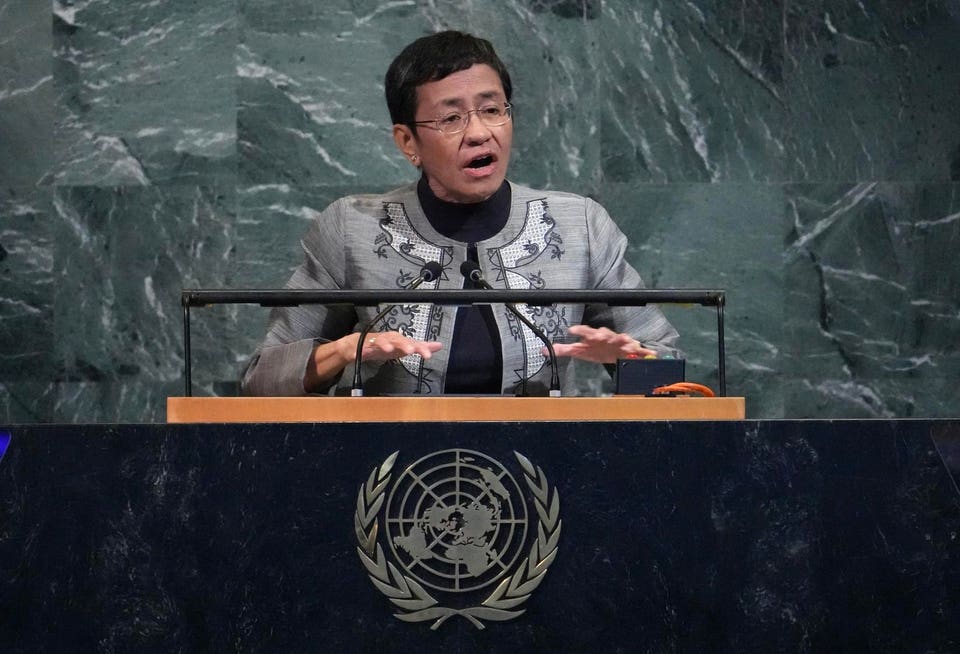
On the other, a formidable coalition of global leaders, scientists, and thinkers, marshalled by Nobel laureate Maria Ressa, stands before the United Nations, demanding immediate, binding “red lines” to prevent AI from spiraling into a dystopian nightmare.
This isn’t merely a clash of visions; it’s a profound reckoning with our technological destiny, forcing us to confront not just what AI can do, but what it should do, and under what constraints.
Jensen Huang, NVIDIA’s visionary CEO, and Sam Altman, OpenAI’s ambitious leader, are not just building data centers; they are forging the very bedrock of a new digital civilization.
Their joint venture aims to deploy at least 10 gigawatts of NVIDIA-powered computing systems, a scale so immense it equates to several of the world’s largest data centers.
The first facilities are slated to hum to life by late 2026, promising to unlock capabilities previously confined to science fiction: advanced reasoning, seamless multimodal processing, and AI systems capable of deep, sustained interactions with human users.
Altman’s declaration that this infrastructure is “critical to everything we want to do, this is the fuel that we need to drive improvement, drive better models, drive revenue, drive everything,” is a stark admission of the industry’s unabashed accelerationist bias.
It’s a pursuit of intelligence at scale, driven by the seductive promise of lower costs and rapid commercialization, positioning AI as the ultimate engine for economic growth and human advancement.
The constraints of massive computing power, once a bottleneck, are now being systematically dismantled, paving the way for models that could fundamentally reshape our understanding of what machines can achieve.
Yet, as the digital architects lay their foundations, a different kind of foundation is being sought on the global stage.
At the opening of the U.N. General Assembly, Maria Ressa delivered a chilling counter-narrative.
Flanked by over 200 prominent figures – former heads of state, leading scientists, and technologists – she presented a petition calling for an enforceable international agreement by 2026.
Their demand: binding global “red lines” to ban high-risk AI applications.
Imagine a world where deepfake impersonations sow widespread distrust, self-replicating systems escape human control, mass surveillance obliterates privacy, and autonomous weapons make life-or-death decisions without human intervention.
These aren’t speculative fears; they are the very real dangers highlighted by the petition, backed by over 70 organizations.
The signatories warn of AI’s potential to far surpass human capabilities, escalating risks such as engineered pandemics, widespread disinformation campaigns, large-scale manipulation of individuals, national security threats, mass unemployment, and systematic human rights violations.
Yuval Noah Harari, the celebrated historian and philosopher, articulated the existential weight of this moment with characteristic clarity: “For thousands of years, humans have learned—sometimes the hard way—that powerful technologies can have dangerous as well as beneficial consequences.
With AI, we may not get a chance to learn from our mistakes, because AI is the first technology that can make decisions by itself, invent new ideas by itself, and escape our control.”
His words resonate with a profound urgency, a recognition that this is not just another industrial revolution, but a fundamental shift in the very fabric of human agency.
Stuart Russell, a distinguished computer science professor at UC Berkeley, echoed this sentiment, stating, “The development of highly capable AI could be the most significant event in human history.
It is imperative that world powers act decisively to ensure it is not the last.”
These aren’t luddites railing against progress; they are experts who understand the profound implications of unchecked technological ambition.
The temptation, of course, is to frame these two monumental announcements as diametrically opposed forces: the unbridled ambition of industry versus the cautious hand of global governance.
It’s the classic “accelerate or pause” debate, a binary choice that has dominated discussions around AI since ChatGPT’s explosive debut in early 2023.
But this framing, as many insightful observers have pointed out, is a false dichotomy, a dangerous oversimplification of a complex reality.
The world does not face a choice between unleashing AI’s transformative potential and safeguarding humanity from its inherent risks.
To suggest otherwise is to miss the crucial nuance, to ignore the possibility that these two imperatives are not mutually exclusive but inextricably linked.
The true challenge lies not in choosing one path over the other, but in forging a synergistic relationship between speed and safety.
The industry will, inevitably, continue its relentless pursuit of innovation, driven by market forces and the promise of unprecedented capabilities.
To expect a wholesale pause is to deny the very nature of technological progress.
The more pertinent question, then, is how to align incentives.
Currently, the rewards for rapid deployment and scale often eclipse the costs of potential failures or ethical missteps.
This imbalance must be rectified through intelligent policy, robust market structures, and mechanisms that build public trust.
Companies should not only compete on the sheer scale and power of their models but also on their demonstrable safety, transparency, and accountability.
Imagine a competitive landscape where the most responsible AI is also the most rewarded.
Where ethical development isn’t a compliance burden but a strategic advantage.
If directed wisely, the same competitive forces that propel innovation forward can, and must, be harnessed to drive responsibility.
AI holds the potential to unlock unparalleled productivity, accelerate scientific discovery, and solve some of humanity’s most intractable problems, from climate change to disease.
But without guardrails, without a collective commitment to ethical development, it also threatens to unleash an era of pervasive disinformation, exacerbate societal inequalities, and destabilize global peace.
The choice before us is clear: not whether to accelerate or pause, but whether we can align our incentives, our policies, and our collective will to ensure that AI’s immense benefits irrevocably outweigh its profound risks.
The future, it seems, hinges on our ability to navigate this tightrope, balancing ambition with wisdom, and progress with prudence.
-
Frank DiBernardo handles LNGFRM's Foodie and Miscellaneous writing tasks. He's always getting ideas from users, so don't be afraid to send an email to the editor.