Florida’s Space Coast has long been synonymous with the pioneering spirit of human endeavor, a launchpad for dreams that stretched beyond the blue.
Now, a new kind of titan, more accustomed to delivering packages than payloads, is carving out its own formidable presence in this hallowed ground.
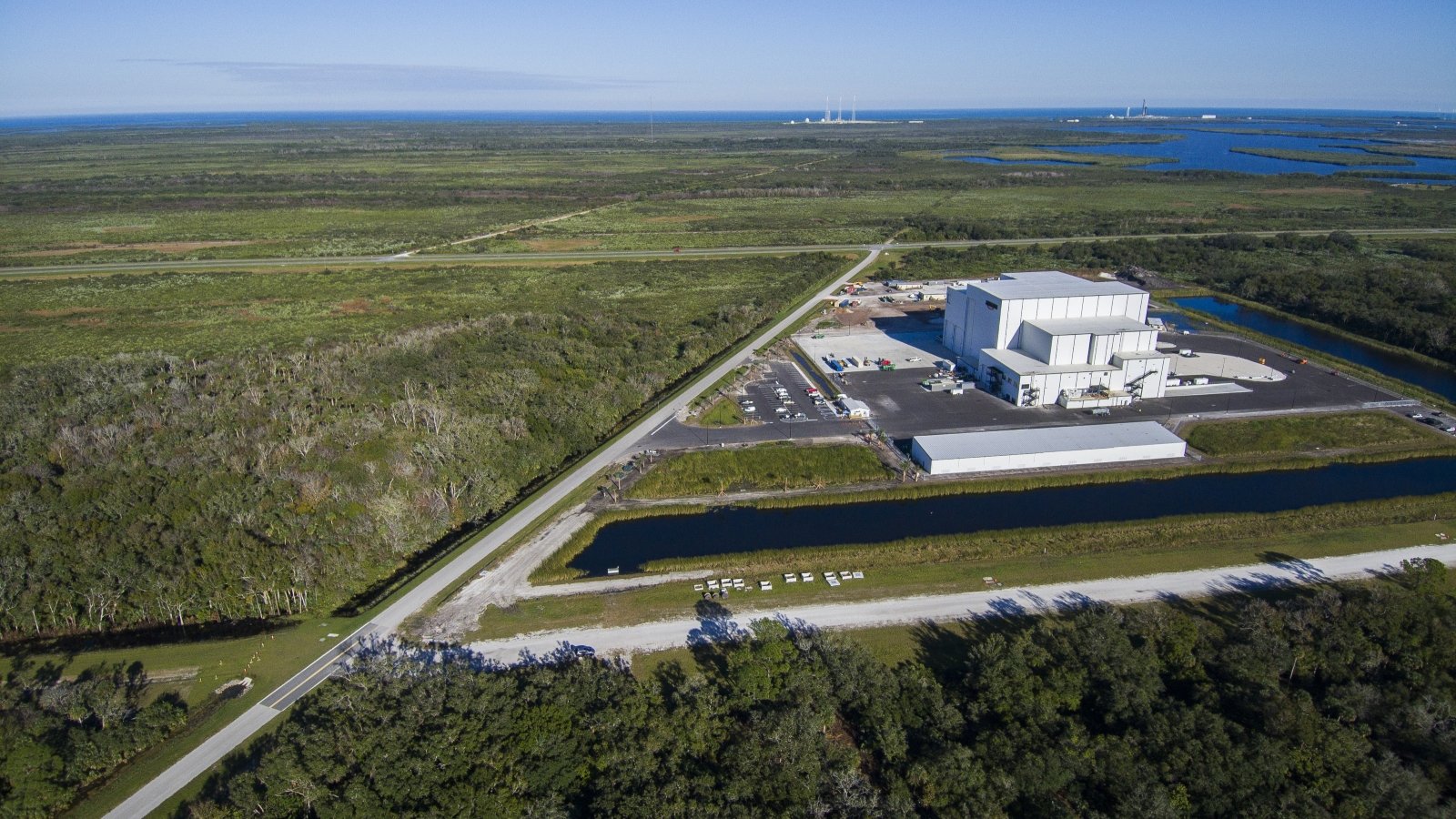
Amazon, the ubiquitous e-commerce giant, is not merely dabbling in space; it is industrializing it, transforming a $140 million facility at Kennedy Space Center into a hyper-efficient nerve center for its ambitious Project Kuiper.
This isn’t just another building on the Space Coast; it’s a statement.
Spanning a vast 100,000 square feet, Amazon’s payload processing facility is the critical nexus where the company’s vision for global satellite internet truly takes flight.
Imagine a meticulously choreographed dance of high-tech machinery and human precision, capable of simultaneously preparing satellites for three separate launch campaigns.
At its peak, this facility will churn out over 100 satellites a month, a testament to Amazon’s relentless pursuit of scale and efficiency, traits typically associated with its terrestrial logistics empire now applied to the cosmos.
The strategic placement of this hub near Cape Canaveral, where the majority of Kuiper’s 80-plus secured launches are slated to occur with partners like SpaceX, ULA, Arianespace, and Blue Origin, is no accident.
It’s a deliberate move to collapse the traditional timeline from factory floor to orbital deployment.
Satellites, fresh from their production lines in Kirkland, Washington, where Amazon’s factory can assemble up to five spacecraft a day, are swiftly transported across the country.
Upon arrival in Florida, they enter a meticulously controlled environment.
Each satellite undergoes a rigorous electrical checkout, its battery charged, and its vital signs verified.
Then, a crucial step: the loading of krypton propellant, a design choice that underscores Kuiper’s commitment to safe and controlled operations throughout a mission’s lifecycle.
The process culminates in the integration of dozens of satellites onto a multi-level dispenser system, a kind of orbital carrying case, before they are carefully encapsulated within the rocket fairing – the protective shell that will shield them during the violent ascent through Earth’s atmosphere.
This entire intricate dance is designed for speed and precision, a hallmark of Amazon’s operational philosophy.
Once sealed, the fairing, laden with its precious cargo, makes its final journey through a towering 100-foot-high bay door, destined for the partner launch facilities where it will be mated with its rocket.
Steve Metayer, vice president of production operations at Project Kuiper, encapsulates the unprecedented nature of this operation.
“We’ve completed three missions in less than three months, and we’re continuing to pick up the pace as we prepare to begin delivering service to customers,” he noted, adding with a touch of pride, “There’s nothing else like it on the Space Coast.”
This facility, soon to be complemented by a $19.5 million secondary support site, is a bespoke marvel, designed to handle the diverse fairings of rockets like Atlas V, Vulcan, New Glenn, and Falcon 9, all stacked high with Kuiper satellites.
Beyond the technological marvel, Amazon’s investment in Florida carries significant economic weight. The $140 million committed to the primary processing site and its ancillary facilities has already generated over 130 jobs on the Space Coast since 2024.
But the ripple effect extends far wider.
Amazon’s substantial launch contracts underpin thousands of jobs and support a vast network of suppliers across the United States.
Furthermore, joint investments with United Launch Alliance (ULA) are actively upgrading critical infrastructure and services at Cape Canaveral, benefiting not only Kuiper but also a spectrum of other commercial and government customers operating from the historic launch complex.
Brian Huseman, Amazon’s vice president for public policy and community engagement, articulated the company’s commitment.
“There is no better place than Florida’s Space Coast to fulfill Kuiper’s promise to bring broadband to unserved and underserved across the nation and world,” he stated, emphasizing the pride in their local investments and the anticipation of a long-term partnership with key stakeholders like Space Florida, NASA, Space Force, and state and local officials.
Perhaps one of the most compelling narratives embedded within this ambitious space venture is the story of human transformation.
Amazon’s “career launchpad” program is enabling warehouse employees, individuals who once packed boxes, to transition into high-tech roles building satellites.
It’s a powerful testament to the company’s internal mobility and the potential for upskilling, offering a tangible pathway from the mundane to the extraordinary, from the ground floor to the final frontier.
Amazon, once primarily a digital marketplace and logistics powerhouse, is now firmly entrenched in the orbital race, a race to connect the unconnected and redefine global broadband access.
Project Kuiper’s Florida hub isn’t just a facility; it’s a tangible manifestation of Amazon’s boundless ambition, a symbol of the Space Coast’s evolving identity, and a critical piece in the puzzle of a truly interconnected world, all launched from the same storied shores that once sent humanity to the moon.
-
Frank DiBernardo handles LNGFRM's Foodie and Miscellaneous writing tasks. He's always getting ideas from users, so don't be afraid to send an email to the editor.