Anna May Wong, who moved to Europe at the end of the silent era to reinvigorate her career. Photograph: Ronald Grant
Soon, the actor will appear on quarter-dollar coins, an honor that honors a significant but challenging career at the height of Hollywood
Your pocket’s contents are about to become a bit sexier. The first Asian American to appear on US money is renowned film actress and style icon Anna May Wong. Wong’s image will start to appear on quarters in circulation on Monday as part of the Women Quarters initiative, which was established earlier this year with a tribute to Maya Angelou.
Wong’s career spanned the silent era, the talkies, the height of Hollywood, and television. She debuted in a leading part in the Technicolor 1922 picture The Toll of the Sea, and later starred with Marlene Dietrich and Douglas Fairbanks. She portrayed the first Asian American lead on a US television program in her role on the small screen. In her greatest parts, she is deadly serious and exudes a seductive aura of jazz-age sophistication. She was always intriguing on camera.
The gesture recognizes Wong’s widespread success in the film industry and her groundbreaking role as the first Chinese American celebrity in Hollywood. It could also serve as a reminder that the bigotry she experienced in the entertainment business is still very much present. Hollywood, a new Netflix original series from Ryan Murphy, dramatizes the infamous episode in which Wong was passed over for the main role in the 1937 Chinese epic The Good Earth in favor of white actress Luise Rainer. Hollywood’s preference for “yellowface” over Asian actresses is the cause of Wong’s US career’s failure to realize its potential; but, it’s also the reason why she did so many movies in Europe, where she had a far higher chance of landing the main role. She portrays an East End potwasher who becomes a West End dance phenomenon in the 1929 British silent picture Piccadilly, which may be her greatest performance, but even then she was not given top billing.
On her Archetypes podcast earlier this month, Meghan Markle spoke with the writer Lisa Ling and the comedian Margaret Cho about the “toxic stereotyping of women of Asian descent” in the media. Wong’s legacy was marred by the numerous stereotypical roles she took on, but recently, as fans and academics have focused on her talent, her stock has increased. Examples include her moving performance in The Toll of the Sea, her multifaceted lead performance in Piccadilly, and her smoldering chemistry with Dietrich in Shanghai Express. Although Wong makes too many fleeting appearances on screen, she has a noticeable presence and has a big influence in every scene.
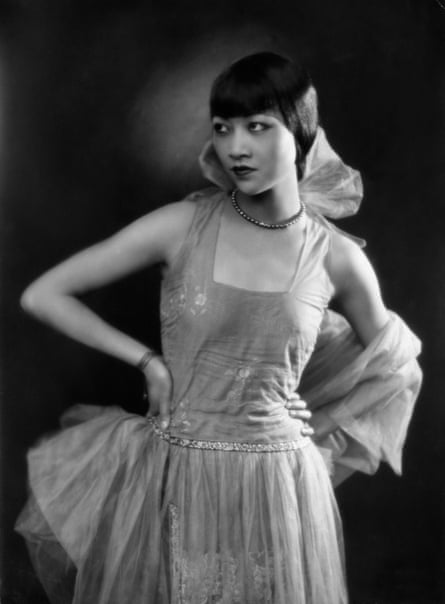
Anna May Wong in this 1928 picture. Photograph: Ullstein Bild/Getty Images
Wong’s straightforward analysis of the nature of Hollywood’s racial issue has stood the test of time. She was honest about her dissatisfaction with Hollywood when given the opportunity, stating: “I was so tired of the parts I had to play.” After she relocated to Europe, she presented the case succinctly to a reporter. She questioned, “Why is it that the screen Chinese is almost always the bad guy?” And such a vulgar villain. He was murderous, cunning, and a snake in the grass. That is not how we are. How should we act in the presence of a civilization that is so much older than the western world’s?
Wong was born Wong Liu-tsong in Los Angeles in 1905 to Chinese American parents who were of the second generation. Young Wong’s father ran a laundry, but the town’s burgeoning film industry naturally captured her attention much more than the family company. Wong began acting as an extra in Hollywood movies in 1919. Two years later, she left school to pursue her acting career. Only a year later, she featured in The Toll of the Sea, a gory two-strip Technicolor adaptation of the Madame Butterfly narrative. She should be seen again and often on the screen, according to the New York Times, who gave the film raving reviews. However, she wouldn’t get another main part for many years. Her finest chance was to portray the cunning Mongol slave in Douglas Fairbanks’s legendary Dragon Lady movie The Thief of Baghdad from 1924. Wong tried to establish her own production business in order to create movies about China, but this endeavor resulted in legal trouble. She proceeded to portray exoticized supporting parts in Hollywood, such as Tiger Lily in Peter Pan, and a string of stereotyped vamps.
Wong relocated to Europe towards the conclusion of the silent period, much like Josephine Baker before her, which rekindled her career. She starred in movies filmed in Berlin and London, such as Piccadilly. Early in the 1930s, Paramount tried to entice her back to Hollywood, but following 1931’s Daughter of the Dragon, she declined to reprise her role as the Dragon Lady. The 1932 film Shanghai Express was a high point in Wong’s career; although having a small and sacrificed part, he looks stunning and consistently holds the audience’s attention, even when Dietrich is there. After that, she was passed over for a number of parts that should have been hers because one executive said she was “too Chinese to play a Chinese,” such as the lead in The Good Earth and roles in The Bitter Tea of General Yen in 1933. Wong set off on a well publicized trip of China, despite the fact that the Chinese authorities had long criticized her for her film work. She was referred to as “the stooge that disgraces China” by one jeerer.
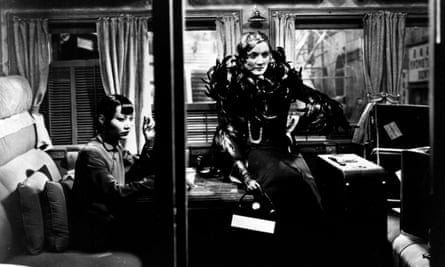
Wong with Marlene Dietrich in Shanghai Express. Photograph: Ronald Grant
Wong started to experience the effects of stress in the late 1930s when she started drinking excessively and experiencing awful mood swings. She did, however, complete her Paramount contract with a number of B pictures, which provided her a wider range of roles to portray. She gushed to a magazine while describing 1937’s Daughter of Shanghai: “This picture gives Chinese a break — we have sympathetic parts for a change!”
Wong almost stopped acting throughout the war. She produced a few anti-Japanese propaganda movies for the “Poverty Row” company Producers Releasing Corporation while also working for Chinese NGOs. Her appearance in the 1951 primetime television series The Gallery of Madame Liu-Tsong was what reintroduced her to the public. Her part as an art dealer and investigator, which utilizes her own name, was specifically created for her. The episodes are currently regarded as lost since the program was canceled after one season. Following its filming, Wong’s health started to deteriorate. The studio press attempted to explain away her disappearance from the limelight by using an erroneous Chinese proverb: “Don’t be photographed too much or you’ll lose your soul.” She had one more significant film appearance, Lana Turner’s 1960 drama Portrait in Black. Wong passed just a year later, having received little exposure to her work, leaving a legacy of movies that merely scraped the surface of her potential.
Wong has never quite vanished from memory. She has a star on the Hollywood Walk of Fame, and Gemma Chan and Li Jun Li will portray her in an upcoming biography and Damien Chazelle’s Babylon, respectively. Her legacy is more nuanced than most Hollywood legends’, however. Her graceful image on the quarter conjures a bygone period of glitz; it may also cause us to consider the anti-Asian American bigotry that derailed her career and that cruelly exists today.
Thanks to Pamela Hutchinson at The Guardian whose reporting provided the original basis for this story.
-
Frank DiBernardo handles LNGFRM's Foodie and Miscellaneous writing tasks. He's always getting ideas from users, so don't be afraid to send an email to the editor.


