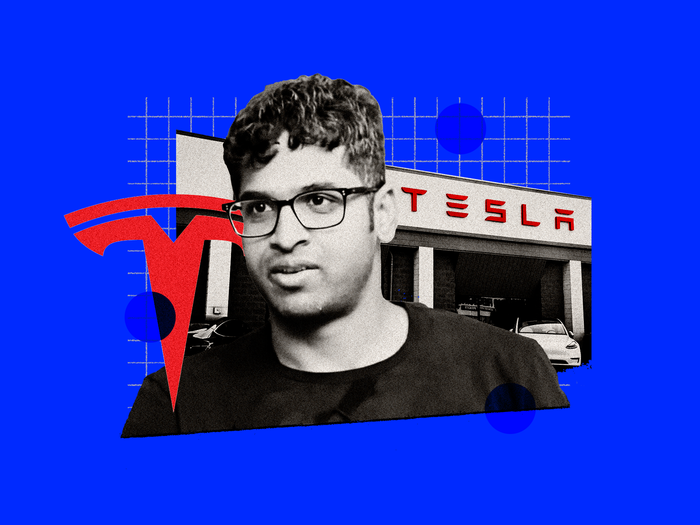
In the high-octane world of Tesla, where ambition often outpaces reality, one figure stands quietly at the nexus of Elon Musk’s grandest gambles: Ashok Elluswamy.
As Vice President for AI Software and a founding architect of the Autopilot team, Elluswamy is not merely a lieutenant; he is the indispensable engineer tasked with translating Musk’s audacious visions into tangible, albeit sometimes controversial, technology.
His story is one of relentless drive, an uncanny ability to navigate the capricious currents of innovation at Tesla, and an unwavering commitment to pushing the boundaries of what’s possible, even when it means venturing into uncharted territory.
Elluswamy found himself thrust into the spotlight of one of Tesla’s most radical experiments in 2022.
Amidst the departure of Tesla’s then-director of AI, Andrej Karpathy, Musk made a decision that sent ripples of apprehension through his engineering ranks: scrap the ultrasonic sensors that augmented Tesla’s self-driving capabilities and rely entirely on cameras. No other autonomous vehicle company had dared such a singular, camera-centric approach.
It was a bold, almost reckless, maneuver, and it fell squarely on Elluswamy’s shoulders to make it work.
Former Autopilot engineer Lewey Geselowitz vividly recalls Elluswamy and his team huddling in a Tesla, intentionally risking collisions in a parking lot to train the software.
“It took courage to know that we would be able to figure that out,” Geselowitz later reflected, a testament to Elluswamy’s resolve.
A year later, the sensors were gone from new builds, a silent affirmation of Elluswamy’s team’s success.
Musk has famously declared that achieving full autonomy is the difference between Tesla being “worth a lot of money or worth basically zero.”
More recently, he’s championed Optimus, the humanoid robot program, as a future value driver, potentially accounting for 80% of Tesla’s worth.
Elluswamy, who joined Autopilot in 2014, is now front and center in both these epoch-making initiatives, a quiet engineer pulling the levers of a technological revolution that could redefine human-machine interaction.
His influence, though largely unpublicized, is undeniable, extending from the public rollout of Full Self-Driving in 2022 to the launch of Tesla’s robotaxi services and his recent leadership role in the Optimus program.
Despite his pivotal position, Elluswamy remains a largely enigmatic figure.
Public appearances are rare, interviews almost nonexistent, and detailed reporting on his rise is scant.
Yet, those who know him — former colleagues, friends, and classmates — paint a consistent picture: a hands-on, hard-working engineer with a high tolerance for risk and an almost telepathic understanding of Musk’s often-unconventional directives.
They also highlight striking similarities between the two men, from their sense of humor to their decisive, sometimes cutthroat, approach to problem-solving.
Elluswamy’s journey began far from the gleaming laboratories of Silicon Valley.
Raised in a middle-class family in southern India, he admits to being more interested in being “cool” and engaging in robotics competitions than traditional academic pursuits.
He “did the bare minimum” at the College of Engineering, Guindy, preferring hands-on work over textbooks.
His ambition was evident early on; he left a slow-paced government job, finding its predictable trajectory “depressing.”
His path led him to Carnegie Mellon University, where he honed his robotics skills, earning him the nickname “the captain” among his peers.
This rigorous training proved invaluable when he answered Musk’s 2013 Twitter call for autonomous driving engineers, joining a nascent Autopilot team that worked out of a “least sexy” back room, pulling all-nighters amidst active construction.
Navigating the volatile genius of Elon Musk is an art form in itself, and Elluswamy has clearly mastered it.
He caught Musk’s eye early on with a path prediction model, a critical step towards Tesla’s in-house AI development.
Colleagues describe his ability to “talk Musk off the ledge,” setting aside his ego to embrace even the most seemingly unachievable ideas.
This blend of technical acumen and emotional intelligence has allowed him to thrive where others might have burned out.
Yet, this proximity to Musk’s vision has also placed Elluswamy at the heart of controversies.
His 2022 testimony in a lawsuit revealed that a much-touted 2016 Autopilot demo video, presented by Musk as evidence of a self-driving Tesla with “no human input at all,” was, in fact, staged.
Elluswamy confirmed the route was pre-mapped, drivers intervened, and the car even crashed into a fence during testing.
Furthermore, reports indicate Elluswamy’s team prioritized “VIP drivers’ data,” including Musk’s personal routes, in training the software, potentially creating an “overly optimistic impression” of its capabilities.
His leadership style is as decisive as it is hands-on.
Like Musk, Elluswamy is known to drive prototype self-driving software daily, offering direct critiques.
He prefers real-world testing over simulations, a philosophy that has reportedly led to “critical intervention drivers” being trained to allow the software to approach an accident before taking over.
This high-risk approach, while lauded by Musk, has drawn scrutiny and criticism, landing Elluswamy in depositions for multiple lawsuits involving fatal crashes and marketing claims, and placing Tesla under federal probes.
Despite the controversies and the immense pressure, Elluswamy’s contributions have been handsomely rewarded.
An internal paysheet from 2021 showed him earning $300,000 annually with a $10 million stock grant.
He and his wife now own multiple properties, a testament to his financial success.
Musk himself has publicly acknowledged Elluswamy’s indispensability, stating last year, “Without him and our awesome team, we would just be another car company looking for an autonomy supplier that doesn’t exist.”
At a 2022 celebration marking the public release of Full Self-Driving, standing before a T. rex fossil with Musk nearby, Elluswamy delivered an emotional speech, thanking his team for achieving a milestone that had often seemed out of reach.
It was a rare moment of public vulnerability for a man who embodies the silent, relentless force driving Tesla’s future.
Ashok Elluswamy is more than an engineer; he is the embodiment of Tesla’s daring, its innovation, and its ongoing, high-stakes gamble on a future powered by AI.
His journey reflects not just the ascent of a talented individual, but the inherent complexities and profound implications of building a world where machines truly drive themselves.
-
Frank DiBernardo handles LNGFRM's Foodie and Miscellaneous writing tasks. He's always getting ideas from users, so don't be afraid to send an email to the editor.