‘He was afraid of the dark’: Barbara Chase-Riboud at Giacometti Foundation. Photograph: Michel Ginies/SIPA/Rex/Shutterstock
The artist sculpted Malcolm X, danced with James Baldwin, and received assistance from Jacqueline Kennedy Onassis. She has just been given the one honor she has ever desired
The only three Black American women to ever receive France’s highest honor, the Légion d’honneur, are listed by Barbara Chase-Riboud as follows: There’s myself, Dr. Ruth Simmons, the former president of Brown University, and Josephine Baker.
Chase-Riboud, a sculptor, author, poet, and sporadic model, had, in a dreamy sense, had her eye on the prize since she was a little girl growing up in Philadelphia. “When I was a little child, I learnt that Josephine Baker was a Légion d’honneur recipient and a war hero. That, I determined, was the only ornament I really want in life. And this year, just when Josephine was inducted into the French Pantheon, I finally received it!
Before two retrospectives, one at the Serpentine North Gallery in London and the other at the Pulitzer Arts Foundation in St. Louis, Missouri, we’re having this conversation. It is also the day of release for Chase-book Riboud’s I Always Knew, which is based on 30 years of letters she sent to her mother Vivian Mae Chase. The pages throb with fame, high fashion, and romance. There are stories of daring journeys. There are encounters with people like Jacqueline Kennedy Onassis, who made it possible for the publication of Chase-best-selling Riboud’s 1979 book Sally Hemings, James Baldwin (“does a wild twist”), Alberto Giacometti (“who slept with the lights on because he was afraid of the dark”), and dozens of other famous people.
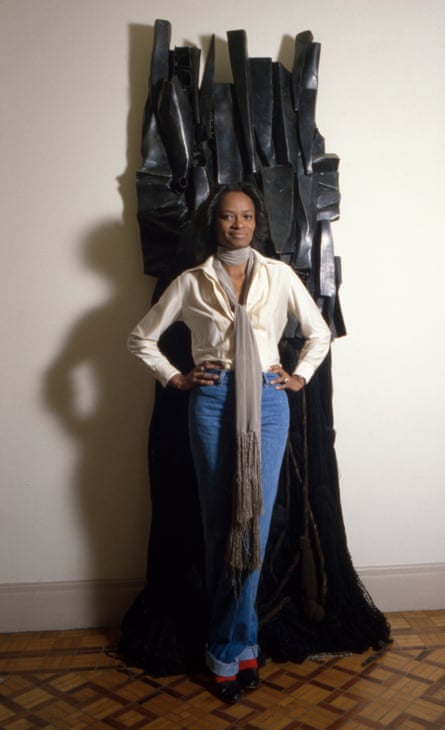
Chase-Riboud in 1981 with one of her sculptures. Photograph: Louis Monier/Gamma-Rapho/Getty Images
The letters are private and full of rumors. The mother and daughter had an open, sibling-like connection and were of similar ages. I’d want to learn more about her mother and how the smart, brave young lady who emerges from the letters came to be, but Chase-Riboud won’t cooperate. It was crucial to put the reader in the middle of the Atlantic Ocean because she doesn’t want the reader to know the book’s past.
As a result, we are at sea. This young sculptor, who was not yet 20 years old, boarded the liner Le Flandre in 1957 on her way to Rome for a fellowship at the American Academy. She wrote to Vivian Mae during the trip, “All the French waiters think I’m very pretty and that I don’t look American.” They keep speaking to me in French, which I have no idea how to grasp, so I simply grin adoringly.
The wait staff had foresight. Chase-Riboud will soon wed French photojournalist Marc Riboud, establish a family in Europe, and move there. She now divides her time between a residence in Paris and a foundry in Rome, where she casts sculptures constructed using a lost-wax technique that originated with the great Edo bronze work of the kingdom of Benin. She is a multilingual person. “I’m not the same person in French as I am in English. And in French, I’m a different mother than I am in English. I curse in Italian, and I dream in French,” she says after a knowing pause.
We go with Chase-Riboud via the letters as she experiences the US civil rights movement and the subsequent violence on the other side of the Atlantic. “People think I was removed from it, but I wasn’t; the Europeans were very aware of what was happening. In comparison to media in Europe, American media gave the movement significantly less publicity overall. Only after I learned of Malcolm X’s murder did I feel cut off. It hit me like a bombshell when it came.
Since then, Malcolm X has emerged as a major topic, which Chase-Riboud has explored in monumental sculptures made of cast bronze and braided fiber. “As the notion that Malcolm was beyond memory expanded, so did the notion of creating a monument of him. He served as a symbol. He had greater significance than he realized. He was also more significant than we realized. Chase-Riboud refers to her imposing abstract shapes as “steles,” which are reminiscent of the carved stones found at Karnak or Luxor in ancient Egypt.
These modern monuments make us consider who is remembered and whose histories are kept. She asserts that history is “written by the victors, not the oppressed.” The idea that this is a “culture war” is hilarious to me since culture has nothing to do with it. The suppression of half of the people in the United States of America has to do with power, history, and oppression. Chase-interest Riboud’s in monuments was decades ahead of its time, much like her investigation of historical characters such as Sally Hemings, an enslaved woman who was the mother of six children by President Thomas Jefferson.
She claims to have found her old letters in a blue metal box hidden amid Vivian Mae’s clothing in 1991. But it had been too soon after her mother’s passing. Instead, she put off reading them until 2008. “I was taken aback. I had no idea who that stupid chick was. Who did she believe herself to be? She didn’t know what she was doing. Reliving her adventurous past, she wonders, “How did she have the courage. I flipped through the pages like I had no idea what I had done.
Barbara Chase-Riboud’s Infinite Folds is at Serpentine North Gallery, London, 11 October-29 January. I Always Knew: A Memoir is published by Princeton University Press.
Thanks to Hettie Judah at The Guardian whose reporting provided the original basis for this story.
-
Frank DiBernardo handles LNGFRM's Foodie and Miscellaneous writing tasks. He's always getting ideas from users, so don't be afraid to send an email to the editor.


