SACRAMENTO, Calif. — In a bold move that simultaneously asserts its technological dominance and its commitment to public safety, California Governor Gavin Newsom has signed into law a pioneering bill designed to rein in the most powerful artificial intelligence models.
This isn’t merely a legislative tweak; it’s a foundational statement from the epicenter of global innovation, a clear signal that the golden state intends to lead not just in creating the future, but in safeguarding it too.
The new legislation takes direct aim at the potentially catastrophic capabilities of advanced AI.
Imagine a world where algorithms could be weaponized to construct bioweapons, dismantle financial systems, or cripple critical infrastructure like a power grid.
This bill, Newsom asserts, is designed to prevent precisely those scenarios.
It mandates that companies developing “frontier” AI models – those operating with immense computational power – implement and publicly disclose rigorous safety protocols. For more information, see this intriguing analysis of AI safety protocols in California.
A “catastrophic risk” is starkly defined: anything causing over $1 billion in damage or more than 50 injuries or deaths.
These companies will now be compelled to report any critical safety incidents to the state within 15 days, under threat of a $1 million fine per violation.
Newsom’s signing arrives amidst a palpable tension between the breakneck pace of AI development and the glacial speed of governance.
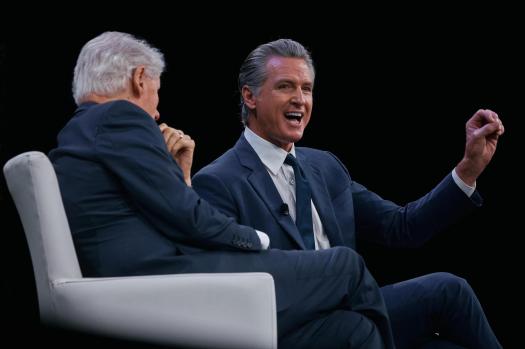
The governor, who recently engaged in a public dialogue with former President Bill Clinton, has been vocal in his criticism of federal inaction on AI regulation. For more on federal AI regulation, check this report on U.S. approaches to AI regulation.
He positions California as the vanguard, demonstrating that stringent safeguards can coexist with a thriving, homegrown industry.
“California has proven that we can establish regulations to protect our communities while also ensuring that the growing AI industry continues to thrive,” Newsom declared, articulating a delicate balance that many believe is essential for the future of technology.
Indeed, many of the world’s leading AI firms – Google, Meta Platforms, Anthropic, OpenAI – call California home.
Their cutting-edge models are the very systems the new law seeks to govern.
This proximity creates a unique dynamic, forcing a dialogue between innovators and regulators that is often absent in other jurisdictions.
While some tech companies have voiced a preference for federal oversight to avoid a “patchwork” of state-by-state rules, others, like Anthropic, have offered cautious support. Find out more about industry perspectives here.
Jack Clark, co-founder and head of policy at Anthropic, described the regulations as “practical safeguards” that formalize practices many companies are already voluntarily undertaking.
This suggests a pragmatic acceptance within parts of the industry, even as the call for a unified national standard persists.
The path to this landmark legislation wasn’t without its detours.
Newsom himself last year vetoed an earlier, broader version of the bill, siding with industry concerns that its requirements were too rigid and threatened to stifle innovation.
His subsequent move to convene a group of AI experts, including the renowned AI pioneer Fei-Fei Li, proved pivotal.
The current law is a product of those recommendations, a testament to a more collaborative, nuanced approach to regulation.
Significantly, it also features lighter reporting requirements for startups, a deliberate strategy to prevent undue burden on nascent companies that are often the engine of future innovation.
State Sen. Scott Wiener of San Francisco, the bill’s author, lauded the outcome, stating, “With this law, California is stepping up, once again, as a global leader on both technology innovation and safety.” For more on California’s innovative policies, see here.
This legislative act is not just a state affair; it resonates with national and international implications.
While California forges ahead, the federal government remains largely gridlocked. Explore the implications of this divide in this overview of AI regulations in the U.S..
This vacuum has left individual states to grapple with AI’s multifaceted challenges, from deepfakes in elections to AI-powered “therapy” and workplace applications.
This fragmented approach underscores the urgent need for a cohesive national strategy, lest the United States finds itself navigating a chaotic regulatory landscape.
The contrast with former President Donald Trump’s recent announcement – a plan to eliminate “onerous” regulations to accelerate AI innovation – further highlights the ideological chasm defining the debate.
Republicans in Congress have even attempted to ban state and local AI regulation for a decade, a move that starkly opposes California’s proactive stance. For insights into legislative efforts, see this resource.
California’s commitment to AI is dual-faceted.
It’s not just a regulator; it’s an early adopter, leveraging generative AI tools to detect wildfires, manage highway congestion, and enhance road safety.
This firsthand experience likely imbues its regulatory efforts with a dose of practical understanding, a recognition that while AI offers profound benefits, its unchecked power carries equally profound risks.
In the grand narrative of technological progress, California has often been cast as the restless inventor.
With this new law, it adds another crucial role to its identity: the thoughtful steward.
The world will be watching to see if this pioneering framework can indeed strike the elusive balance between fostering innovation and safeguarding humanity from the very intelligence it creates.
-
Frank DiBernardo handles LNGFRM's Foodie and Miscellaneous writing tasks. He's always getting ideas from users, so don't be afraid to send an email to the editor.