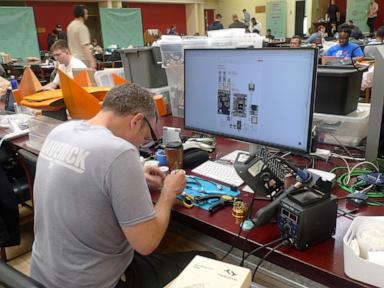
The hum of servers, the click of keyboards, and the low murmur of intense concentration filled the cavernous hall at Britain’s Sandhurst Military Academy.
Here, amidst the hallowed grounds of tradition, a new kind of battle was being waged – not with rifles and strategy maps, but with lines of code and ingenious hardware.
Teams of engineers, tech industry veterans, and even curious hobbyists, many of them strangers just hours before, hunched over laptops, fueled by caffeine and an urgent sense of purpose.
Their mission: to solve some of the most pressing challenges facing modern defense, all within the crucible of a 24-hour “hackathon.”
One team wrestled with a particularly thorny problem: how to guide a swarm of drones through enemy territory when GPS and other vital signals are jammed.
It’s a scenario pulled straight from the headlines, a chilling reality in an age of sophisticated electronic warfare.
This wasn’t merely an academic exercise; it was a visceral response to the unsettling geopolitical climate, a reflection of Europe’s scramble to fortify its military capabilities in the shadow of Russia’s war in Ukraine and the persistent, destabilizing rhetoric from across the Atlantic.
“Given the geopolitical climate, defense tech is relevant now more than ever,” observed Aniketh Ramesh, a startup founder with a Ph.D. in robotics, one of the drone team members.
For Ramesh, the hackathon offered a direct conduit for contribution, a chance to channel expertise into tangible solutions.
He articulated a profound shift in the technological landscape, noting that “robotics and drones are having their iPhone moment.”
The cost of hardware has plummeted, and accessibility has soared, transforming complex technical hurdles into challenges of ingenuity and strategic thinking.
Building new drone functionalities, he posited, is now more a “thinking challenge” than a purely technical one.
This grassroots innovation, born from the urgency of conflict, is not confined to Sandhurst.
It’s a phenomenon sweeping across Europe, inspired by the remarkable on-the-fly innovations of the Ukrainian military in their tenacious defense against a numerically superior Russian force.
These informal gatherings are rapidly coalescing into a robust, continent-wide network of defense innovation.
From Lviv to London, Sheffield to Gothenburg, a series of European Defense Tech Hackathons are sprouting, championed by organizers like Benjamin Wolba, whose group has hosted tournaments in roughly ten cities over the past year alone.
Beyond these independent initiatives, institutional heavyweights are also stepping in, with the EU-backed EUDIS Defence Hackathon holding simultaneous competitions at eight universities and NATO launching DIANA, an accelerator program designed to fast-track defense innovations.
The underlying philosophy is elegantly simple yet powerfully disruptive: “go build a prototype, take your prototype to become a product, and go build a company” to “deliver stuff to the frontline and hopefully save someone’s life,” as Wolba passionately put it.
This isn’t just about winning a prize; it’s about fostering an ecosystem where ideas rapidly evolve into deployable solutions.
The results are already proving transformative.
A team of Bulgarian high school students, winners of a previous European Defense Tech Hackathon, developed a de-mining solution so promising they founded a startup.
At last year’s London event, the winning team’s anti-drone system concept led to further testing in Ukraine and subsequent acquisition by a startup that went on to raise millions in venture capital.
This year, some teams at the London event bypassed trophies entirely, signing term sheets with investors directly.
This burgeoning scene represents a significant cultural and strategic pivot for Europe’s defense industry, traditionally dominated by a handful of colossal “prime” contractors like BAE, Rheinmetall, and Thales, known for their focus on “exquisite, high-cost capabilities” such as fighter jets, submarines, and tanks.
Richard Pass, a co-founder of the London hackathon, highlighted a crucial shift: “There’s definitely been a shift in the industry from the purchase of more exquisite, high-cost capabilities… towards more low-cost systems that can give you scale advantages.”
The urgency of this shift is underscored by recent geopolitical realities.
Pass cited the aerial confrontation between Pakistan and India, where Chinese-made fighter jets and missiles reportedly downed French-made Rafales.
This incident, he argued, not only revealed unexpected “technological parity between the Chinese and leading Western industrial nations like France” but also highlighted China’s formidable advantage in mass-producing military hardware, a capability that could potentially overwhelm Western forces.
Fostering a dynamic European defense tech startup ecosystem, Pass asserted, is paramount to “regain that technological advantage.”
The financial winds are certainly favorable.
NATO, comprising 30 European nations, is pushing for a 5% GDP target for defense spending.
The European Union has earmarked a staggering 800 billion euros ($927 billion) to bolster the bloc’s defense, prioritizing areas like drones, AI, autonomous systems, and quantum computing.
Even post-Brexit Britain has pledged 10% of its defense budget to new technologies.
While a recent McKinsey report suggests Europe’s defense tech startup ecosystem is still nascent, perhaps five years behind the United States, it is undeniably growing at an exponential pace, with venture capital investment more than quadrupling in the last three years.
The hackathon environment itself is a microcosm of this cultural revolution.
As Wolba noted, “The beauty of the hackathon is you get a mixture of people who never normally meet.”
Engineers are paired not just with fellow tech enthusiasts, but with investors who grasp the commercial viability and, crucially, with military end-users who understand the frontline realities.
This cross-pollination of ideas and expertise is forging a new, agile paradigm in an industry historically steeped in formality and rigidity.
Andrii Solonskyi, a CEO observing the scene, acknowledged that defense hackathons are “a bit of a novelty” in a sector traditionally characterized by structured processes and caution.
Yet, he concluded with a sentiment that encapsulates the spirit of this transformation: “What we definitely feel is that you can be very agile in defense right now.”
In an era of escalating global instability, where technological supremacy and rapid deployment are increasingly decisive, Europe is betting on the collective ingenuity of its brightest minds, hoping to hack its way to a more secure future.
-
Frank DiBernardo handles LNGFRM's Foodie and Miscellaneous writing tasks. He's always getting ideas from users, so don't be afraid to send an email to the editor.