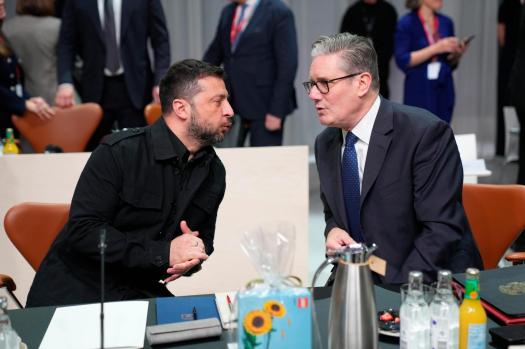
The air in Copenhagen this week felt charged, not just with the crisp autumn chill but with a palpable shift in European resolve.
What began as a series of hushed anxieties over drone incursions, insidious cyber-attacks, and acts of sabotage has erupted into a forceful declaration: Europe’s patience with Russia is wearing thin, and a new, more confrontational era is dawning.
At the European Political Community summit, hosted by Danish Prime Minister Mette Frederiksen, the usual diplomatic niceties gave way to an unvarnished assessment of a widening hybrid war.
French President Emmanuel Macron, often seen as a proponent of dialogue, emerged as a leading voice for a dramatically hardened stance, urging his counterparts to shed their predictability and embrace a strategic ambiguity that would leave Moscow guessing.
Macron’s message was stark, cutting through the carefully worded communiqués of past gatherings.
“Drones which would violate our territories are just taking a big risk. They can be destroyed, full stop,” he declared, eschewing any pretense of providing advance notice.
This isn’t merely a rhetorical flourish; it signals a fundamental re-evaluation of engagement rules.
For too long, the implicit rules of engagement in this shadowy conflict have favored the aggressor, allowing for probing attacks and minor provocations without immediate, decisive retaliation.
Macron is advocating for a break from this pattern, a return to the principle that sovereignty has teeth, and trespassers will face consequences, not just diplomatic condemnations.
Beyond the airspace, Macron also turned his attention to the murky waters of illicit oil transport, pinpointing Russia’s “shadow fleet” as a critical financial artery for its war machine. He estimates that these clandestine shipping operations fund a staggering 30 to 40 percent of Moscow’s military efforts.
His proposed solution is direct and disruptive: seize these vessels.
Citing a recent French intervention that saw an oil tanker on the EU’s sanction list stopped and two crew members detained – a ship naval experts suspect may have been involved in drone flights over Denmark – Macron illustrated a blueprint for action.
“By seizing the ships, for a week or two, we completely break the efficiency of the organization,” he explained.
It’s a pragmatic, almost mercantile approach to warfare, targeting the enemy’s revenue stream with surgical precision, turning the high seas into an economic battleground.
The urgency echoing through the summit was amplified by the host, Danish Prime Minister Mette Frederiksen, whose nation had recently endured its own spate of drone incidents near airports and military bases. Her words were a clarion call, devoid of any vestige of naivety.
“It must be clear to everyone now, Russia will not stop until they are forced to do so,” Frederiksen asserted, framing the conflict not just as Ukraine’s struggle but as a direct assault on “all our nations, all our citizens, our values and our freedom.” This is the core of the new European consensus: the war in Ukraine is merely the most visible front in a broader existential contest.
Indeed, the two days of closed-door talks in Copenhagen, free from the distractions of phones and advisors, appear to have forged a unity born of shared apprehension.
German Chancellor Friedrich Merz articulated this renewed solidarity, warning that “Putin should not underestimate our determination.” The message from the continent’s economic powerhouse was clear: the era of cautious diplomacy is yielding to a firm, collective resolve.
Perhaps the most potent commentary came from Polish Prime Minister Donald Tusk, whose country, bordering both Ukraine and Belarus, has long been acutely aware of Russia’s aggressive posture. Tusk implored leaders to abandon any “illusions” about Russia’s intentions, dismissing euphemisms and stating unequivocally: “It’s war. A new type of war. Very complex, but it’s war.”
He dismantled the notion that victory for Ukraine – and by extension, Europe – is impossible, pointing to the collective economic and demographic might of the European bloc. Russia’s only advantage, he posited, is “mentality.” This is a profound insight, suggesting that the psychological barrier to assertive action has been Europe’s greatest weakness, now being systematically dismantled.
Tusk’s chilling warning that a Russian victory in Ukraine would inevitably lead to the “end of my country and of Europe” underscored the high stakes. Poland, having endured a significant drone intrusion last month, has already vowed to shoot down any Russian drones entering its airspace, demonstrating a practical application of the very strategic ambiguity Macron now advocates.
Even from across the channel, UK Prime Minister Keir Starmer, forced to depart early due to an attack outside a synagogue in Manchester, weighed in with a call to intensify economic pressure through further sanctions, bearing down on energy in particular, and on the shadow fleet.
He also reiterated the vital need to arm Ukraine with advanced air defenses, long-range missiles, and anti-drone capabilities – a recognition that military support for Kyiv remains a cornerstone of Europe’s self-defense.
What emerged from Copenhagen is not just a collection of policy proposals, but a paradigm shift. The continent, once hesitant to directly confront the implications of Russian aggression on its own soil, is now signaling a readiness to engage in a more robust, unpredictable defense of its borders and its values.
The days of absorbing blows and responding with measured statements are giving way to a more assertive posture, where the message to Moscow is no longer one of cautious diplomacy, but of firm, unambiguous deterrence. Europe, it seems, has decided to stop being a passive observer and start dictating the terms of engagement in a war that has, for too long, felt abstract to many.
-
Frank DiBernardo handles LNGFRM's Foodie and Miscellaneous writing tasks. He's always getting ideas from users, so don't be afraid to send an email to the editor.