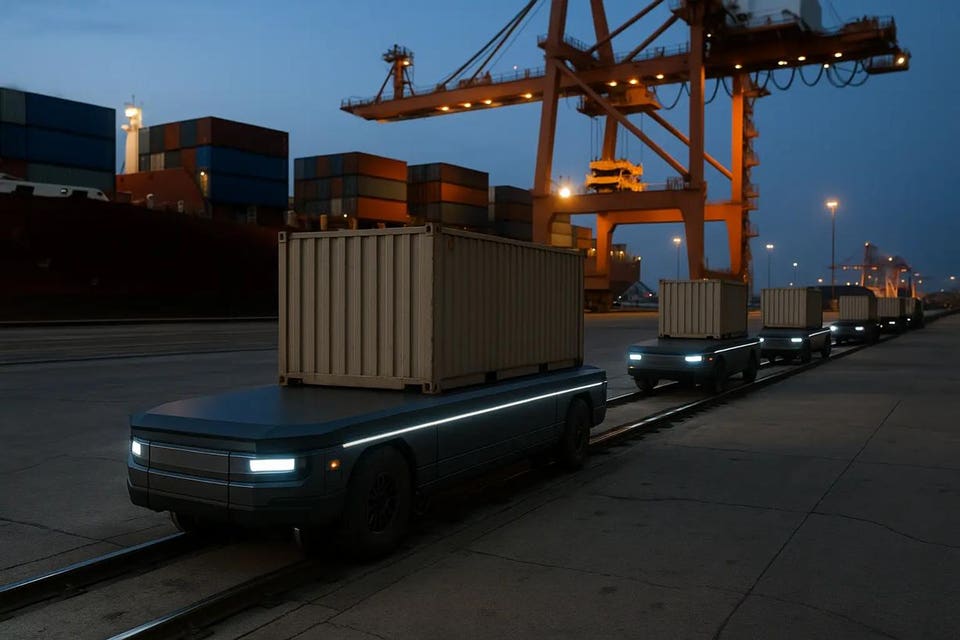
In the intricate ballet of global commerce, where goods traverse continents and oceans, the seemingly mundane act of moving cargo from a train track to a truck bed often becomes a jarring stumble.
This “short mile” logistics, the final, crucial leg of a journey or the initial, often overlooked, transfer, represents a persistent choke point in the ambitious vision of America’s manufacturing resurgence. Importance of Logistics in International Trade
It’s a realm traditionally dominated by expensive machinery, skilled human labor, and a frustrating inefficiency that has long shackled the agility of small and medium-sized businesses.
Enter Glīd Tech, a California-based innovator, pronounced “Glide,” that is poised to transform this cumbersome transition into a frictionless dance.
Born from the diverse experiences of CEO Kevin Damoa, a U.S. Army veteran whose career spanned logistics roles at SpaceX, Northrop Grumman, and Harley-Davidson, Glīd is not merely introducing new vehicles.
It’s orchestrating a symphony of hardware, software, and physical artificial intelligence to redefine how goods flow across our nation’s arteries.The Rise of Intermodal Transportation
Damoa’s journey, one that saw him grappling with the complexities of shipping massive F-35 components or navigating the nuances of industrial design, revealed a glaring inefficiency: the inherent complexity and latency in intermodal transfers.
Cranes, forklifts, and a patchwork of processes meant that goods, especially small batches, faced significant delays and cost burdens when moving between rail and road.
This reality runs counter to the needs of a manufacturing landscape increasingly reliant on speed, precision, and localized production.
Glīd’s answer is the Rāden, a hybrid-electric, autonomous vehicle that is as revolutionary in concept as it is practical in design.
Approximately 8 feet wide and 22 feet long, the Rāden boasts a patented mechanism enabling seamless transition between rail and road.
Imagine a vehicle that can glide off a train track, rotate its wheels at coordinated angles for sideway or diagonal movement at low speeds, and then effortlessly navigate a warehouse floor.Hybrid Electric Vehicle Technology News
This omni-directional capability, where all wheels are independently actuated, marks a fundamental departure from conventional steering, offering unparalleled precision for autonomous rail engagement and significant operational efficiency.
The hardware prowess of Rāden is complemented by EZRA-1SIX, Glīd’s AI-powered software, which integrates perception and control architecture with mechanical systems.
This technological marriage enables safe and efficient operation across diverse environments, from bustling rail yards to challenging, unpaved industrial parks or even disaster-affected regions.How Artificial Intelligence is Transforming Logistics
The company’s vision is eloquently captured by Damoa himself: “We’re not just building vehicles, we’re synchronizing road and rail with atoms and bits.
The next generation of logistics is not man versus machine, but man and machine operating as one – unmanned systems guided by human values.”
This blend of human ingenuity and machine capability is what Glīd terms “Blue Collar Autonomy,” or as Brad Reams, Director of the Great Plains Industrial Park, more aptly puts it, “Purple Collar Autonomy.”Self-Driving Trucks Threaten America’s Top Blue-Collar Job
It’s about empowering logistics workers—truck drivers, crane operators, rail engineers—by providing advanced tools that enhance safety, efficiency, and ultimately, job satisfaction in an industry currently plagued by labor shortages and bottlenecks.
The impact of Glīd’s innovation is already being demonstrated through critical pilot programs.
In the American heartland, at the Great Plains Industrial Park in Parsons, Kansas, Glīd is proving its worth.
This sprawling former Army base, with its 26 miles of rail track, houses both large defense contractors like Days Zimmerman and a vibrant ecosystem of some 50 small businesses.
Union Pacific trains frequent the area, but the challenge for tenants has always been efficiently moving products to appropriate load and unload points for long-distance transport.Gl̄id Closes Oversubscribed $3.1M Pre-Seed Round
Glīd’s platform offers a solution, capable of moving any commodity on rail or road within the park, and even transporting loaded rail cars to a Union Pacific siding for pickup.
For Reams and the Great Plains Development Authority, Glīd is an instrumental enabler for a “purple collar job economy,” sustaining economic success in a previously underserved region.
Further west, in rural Northern California, Glīd is collaborating with Mendocino Railway, a Class III common carrier railroad that manages vital short-distance lines, including the historic Skunk Train.Barriers to Transportation Programs in Rural Areas
CEO Robert Pinnoli, a passionate advocate for rail as the lifeblood of rural communities, sees Glīd’s technology as crucial for maintaining the affordability, profitability, and relevance of these lines.
The GlīderM, a variant built on the Rāden platform, is under development for a pilot aimed at demonstrating safe operation on both road and rail.
The long-term vision includes using the technology to deliver goods containers by rail and then seamlessly transition to road for the last mile to a distribution center, or to efficiently move containers to load points for long-distance railway lines.The Complexities Of Last-Mile Logistics
Pinnoli’s sentiment echoes a broader truth: “This partnership captures the spirit of the Skunk Train—timeless in its roots, bold in its future.
We’re excited to work alongside Glīd to chart a path forward where innovation and tradition not only coexist but thrive.”
This ambitious endeavor is not operating in a vacuum.
Glīd Tech recently secured $3.1 million in pre-seed funding from notable investors like Draper U Ventures and The Veteran Fund, a testament to the market’s recognition of its disruptive potential.Innovative Trends in the Electric and Hybrid Car Industry
The company is also being nurtured by Newlab Detroit and its Centropolis Accelerator, a venture platform dedicated to fostering hard-tech innovation.
Colleen Hau, an Advisor-in-Residence, sees Michigan’s rich industrial heritage and talent pool as the ideal environment for Glīd to prototype and scale its hardware platforms.
“Glīd is at the forefront of hard tech and reindustrialization in Michigan,” Hau states, “seamlessly merging autonomous, electrified transport with logistics innovation.”
The implications extend far beyond mere efficiency gains.
By delivering over 50% operating cost reductions compared to conventional diesel trucks and enabling access to remote rail infrastructure, Glīd is poised to accelerate the re-industrialization of America.How the Logistics Industry Impacts Global Trade
This is not just for high-tech components, but for the “heavier physical stuff” that forms the backbone of our economy.
In a world increasingly demanding speed, sustainability, and resilience, Glīd Tech’s vision of frictionless rail-to-road logistics isn’t just about moving goods; it’s about moving an entire nation forward.
-
Frank DiBernardo handles LNGFRM's Foodie and Miscellaneous writing tasks. He's always getting ideas from users, so don't be afraid to send an email to the editor.