A quiet storm is brewing on Capitol Hill, one that threatens to reshape the landscape of American tech and beyond.
In an era marked by widespread corporate layoffs and a persistent undercurrent of economic anxiety, two influential US senators have cast a skeptical eye on the hiring practices of the nation’s most powerful companies.
They are demanding answers about their continued reliance on H-1B visas.
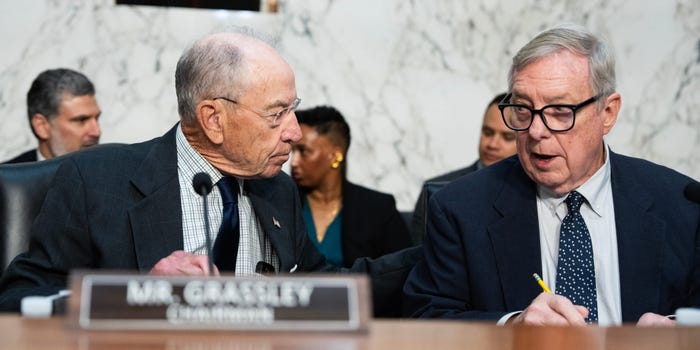
Senate Judiciary Committee Chairman Chuck Grassley and ranking member Sen. Dick Durbin have dispatched stern letters to a formidable roster of ten corporate giants.
These include Amazon, Apple, Google, Meta, Microsoft, and JPMorgan Chase, probing their use of the H-1B program.
Their core concern is stark: how can these companies justify bringing in tens of thousands of foreign workers on H-1B visas when American tech workers are being laid off in droves?
The senators’ inquiry arrives at a particularly sensitive moment.
It coincides with the Trump administration’s intensified efforts to curb foreign worker hiring.
Just days before these letters landed on corporate desks, President Donald Trump signed an executive order.
This order imposed a hefty $100,000 fee for each new H-1B application as highlighted by American Immigration Council.
This move was initially unveiled with a confusing haste that sent companies scrambling to recall foreign employees.
It was later clarified to apply only to new visas.
However, the message was clear: the era of seemingly unfettered H-1B access may be drawing to a close.
Grassley and Durbin didn’t mince words.
In their letter to Amazon CEO Andy Jassy, they highlighted a stark contradiction.
“Tens of thousands of employees in recent years” were laid off by the e-commerce titan.
Yet, Amazon was approved to hire “at least 10,033 H-1B employees” for the upcoming fiscal year.
Their incredulity was palpable.
“With all of the homegrown American talent relegated to the sidelines, we find it hard to believe that Amazon cannot find qualified American tech workers to fill these positions,” the letter declared.
This sentiment cuts to the heart of a long-standing debate.
Is the H-1B program genuinely filling critical skills gaps, or is it being exploited to secure cheaper labor?
This exploitation potentially comes at the expense of the American workforce.
The letters, each containing eight pointed questions, seek to unravel the intricate web of foreign hiring practices.
Crucially, they ask whether any American employees have been “displaced” by H-1B workers.
This question strikes at the very legitimacy of the program in the eyes of many critics.
The silence from the targeted companies speaks volumes.
Their spokespeople have yet to respond to requests for comment.
This silence perhaps reflects the delicate tightrope they now walk between business necessity and public scrutiny.
This congressional scrutiny is not merely a bureaucratic exercise.
It’s a direct challenge to the often-repeated narrative from Big Tech.
That narrative suggests a chronic shortage of domestic talent necessitates the importation of foreign workers.
Some industry leaders, like Netflix co-founder Reed Hastings and OpenAI CEO Sam Altman, have publicly supported the new $100,000 fee as a necessary corrective to the existing system.
However, others warn of dire consequences.
Smaller companies, in particular, may find the prohibitive cost insurmountable.
This could potentially hinder innovation and growth in sectors that rely on specialized skills.
A recent JPMorgan Chase report underscored these concerns.
It projected that the new fee could reduce US work authorizations by a staggering 5,500 per month.
The H-1B visa program, designed to bring highly skilled foreign professionals to the US, has long been a lightning rod for controversy.
Proponents argue it’s vital for maintaining America’s competitive edge in a globalized economy.
They believe it attracts the best and brightest to fuel innovation.
Critics, however, contend it has been co-opted by large corporations and outsourcing firms.
They state it is used to depress wages and replace American workers, particularly in the tech sector.
The current confluence of mass layoffs, an aggressive immigration policy shift, and a direct congressional inquiry suggests that the program’s future is more uncertain than ever.
As lawmakers delve deeper, companies will be forced to confront uncomfortable truths about their hiring strategies.
The questions posed by Grassley and Durbin aren’t just about numbers.
They’re about ethics, economic fairness, and the social contract between corporations and the nation that hosts them.
The answers, or lack thereof, will undoubtedly shape the future of the H-1B program.
They will also shape the broader narrative surrounding corporate responsibility in a rapidly evolving global economy.
The spotlight is on, and the implications for both American workers and the tech industry could be profound.
-
Frank DiBernardo handles LNGFRM's Foodie and Miscellaneous writing tasks. He's always getting ideas from users, so don't be afraid to send an email to the editor.