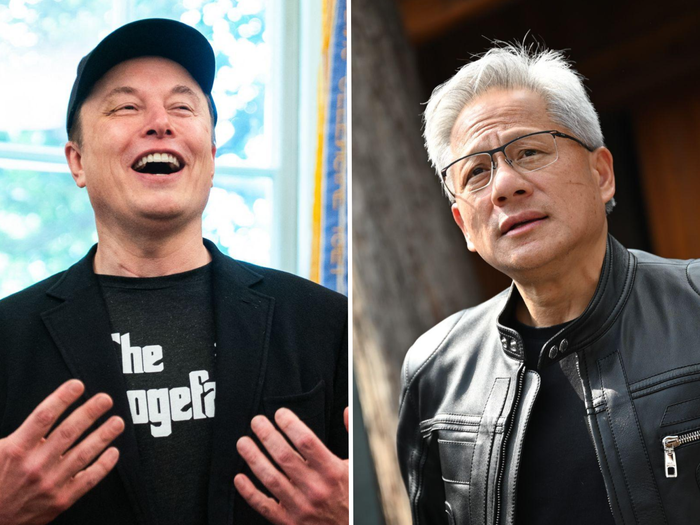
In the rarefied air of Silicon Valley’s power players, where strategic foresight is currency and public admissions of missed opportunities are rare, Nvidia CEO Jensen Huang has offered a surprisingly candid reflection on his investment choices.
Speaking with an almost wistful tone, Huang expressed his singular regret regarding Elon Musk’s artificial intelligence startup, xAI: he wished he had poured more capital into the venture.
It’s a sentiment that speaks volumes, not just about xAI’s perceived potential, but about Huang’s profound respect for Musk’s disruptive vision.
“The only regret I have about xAI — we’re an investor already — is that I didn’t give him more money,” Huang stated during a recent CNBC interview.
This wasn’t merely a casual remark; it was an emphatic endorsement, positioning xAI as a bet on a “really great future company.” Such a declaration from the head of the company at the epicenter of the AI revolution carries significant weight, underscoring a belief in xAI that transcends mere financial calculation.
Huang’s admiration for Musk is palpable, bordering on reverence for a fellow titan of industry.
He characterized Musk’s various enterprises as the kind of endeavors one “always want to be part of.”
This isn’t just a nod to Musk’s Midas touch, but an acknowledgment of his consistent ability to identify and build companies that fundamentally reshape industries, whether it’s electric vehicles with Tesla, space exploration with SpaceX, or now, artificial intelligence with xAI.
For Huang, investing in Musk’s ventures isn’t just about the immediate returns; it’s about aligning with a force that consistently pushes the boundaries of innovation.
The context of Huang’s comments is equally telling.
He was asked about the nature of Nvidia’s investments in AI startups like xAI, probing whether such deals constituted “circular financing” – a scenario where Nvidia lends money to companies that then use it to purchase Nvidia’s coveted chips.
Huang’s response, however, sidestepped any defensive posture, instead pivoting to an enthusiastic affirmation of xAI’s promise.
His excitement over the “financing opportunity” underscores a conviction that these investments are not merely transactional, but strategic alliances in a rapidly evolving technological landscape.
Beyond the specific investment in xAI, Huang offered a broader, insightful commentary on the current state of artificial intelligence, drawing a stark contrast with the infamous dot-com bubble of the late 1990s.
He dismissed comparisons between AI’s explosive growth and that speculative era as “misguided,” arguing that the current wave is fueled by genuine, “trillion-dollar demand” and tangible utility.
“Back then, all the internet companies combined were maybe $30 or $40 billion in size,” Huang observed, highlighting the vastly different scale of today’s tech giants.
He pointed to the “hyperscalers” – the colossal cloud computing providers – already representing a staggering $2.5 trillion business.
This foundational infrastructure, already in place and generating immense revenue, provides a stable bedrock for the AI revolution, unlike the nascent and often unprofitable internet ventures of two decades ago.
Huang elaborated on the profound shift occurring in the very nature of AI models.
He noted that for years, these models were “generating tokens at a loss,” implying that their output, while technologically impressive, lacked immediate commercial viability.
However, he stressed a recent, critical turning point: “in the last several months, it’s become clear the technology is now reasoning, doing research, using tools — it’s actually useful.
The tokens are profitable now.”
This transformation from a cost center to a profit generator is the fundamental differentiator, signifying AI’s maturation from a theoretical marvel to a practical, indispensable tool.
This burgeoning utility is driving what Huang termed a “multi-trillion-dollar buildout” – a monumental global effort to transition from CPU-based computing to GPU-powered generative AI.
Nvidia, as the leading provider of these essential GPUs, finds itself at the very heart of this tectonic shift, racing to meet an insatiable demand.
The CEO’s perspective is not just one of a hardware vendor, but of an architect witnessing the construction of an entirely new computational paradigm.
The impact of this shift isn’t theoretical for Huang; it’s deeply integrated into Nvidia’s own operations.
He cited Cursor, an AI coding assistant, as his “favorite enterprise AI service,” revealing that “Every one of our engineers, 100%, is now assisted by AI coders, and our productivity has gone up incredibly.”
This internal adoption serves as a powerful testament to the immediate, tangible benefits of AI, reinforcing his conviction that this is not a passing fad but a fundamental recalibration of how work is done.
Jensen Huang’s regret over not investing more in xAI isn’t just about a missed financial opportunity; it’s a window into the strategic thinking of a visionary leader.
It underscores a deep belief in Elon Musk’s ability to forge the future, a clear differentiation between the AI boom and past tech bubbles, and an unwavering conviction in the multi-trillion-dollar transformation that artificial intelligence is already enacting across the global economy.
For Huang, the future of computing isn’t just arriving; it’s being built, brick by digital brick, and he intends for Nvidia to be at its foundation.
-
Frank DiBernardo handles LNGFRM's Foodie and Miscellaneous writing tasks. He's always getting ideas from users, so don't be afraid to send an email to the editor.