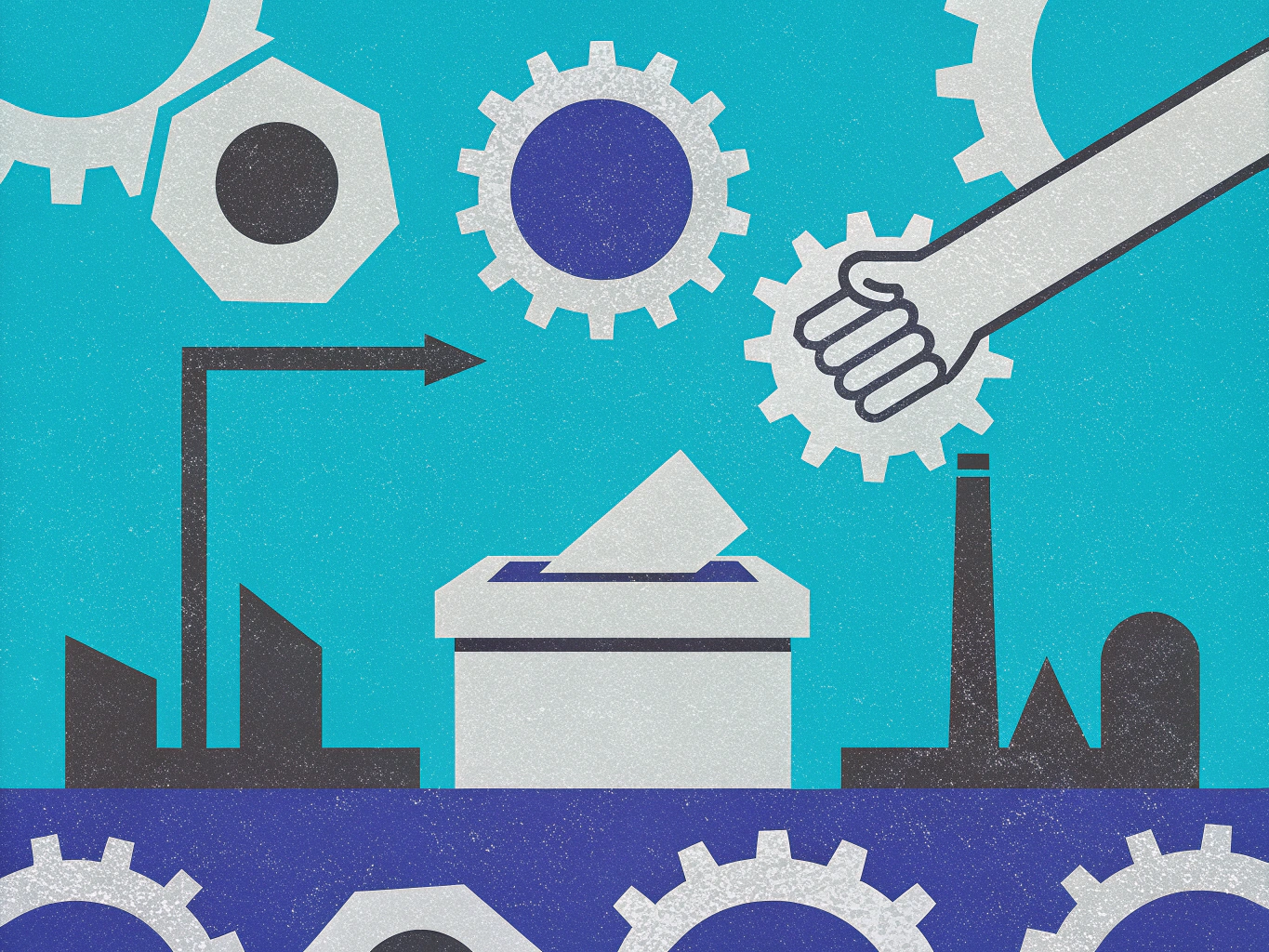
In a quiet Kentucky town, where the sprawling BlueOval SK battery park now looms large against the rural landscape, a crucial decision is unfolding, one that could ripple through the future of American manufacturing and the very fabric of organized labor.
Workers at this nearly $6 billion joint venture between Ford Motor Co. and South Korean partner SK On are casting their ballots.
They are deciding whether to join the United Auto Workers (UAW) and, in doing so, potentially extend a surprising streak of union victories across the historically anti-union South.
The two-day vote, which concludes this Wednesday, comes just a week after the plant in Glendale began churning out advanced batteries.
Glendale is a community of only about 2,000 residents an hour south of Louisville.
These batteries are destined to power Ford’s all-electric F-150 Lightning pickup and its E-Transit cargo van.
This isn’t just about a factory; it’s about the nerve center of America’s electric vehicle ambitions.
Kentucky Governor Andy Beshear proudly hails this project as the single largest economic investment in the Bluegrass State’s history.
For employees like Kumari Logan, the stakes are deeply personal.
Speaking through comments provided by the union, Logan articulated a fundamental desire for stability in an era of rapid industrial transformation.
“My bills are guaranteed, so my pay and benefits should be guaranteed, too,” she stated, her words echoing the anxieties of countless workers navigating the precariousness of modern employment.
“Right now they can just change things whenever they feel like it, and that’s stressful.
With a contract, you’ve got it in writing. You know where you stand.”
Beyond the paychecks, the spectre of on-the-job safety also looms large for pro-union workers, a perennial concern in heavy manufacturing, even as the company insists workplace safety is its “top priority.”
BlueOval SK, for its part, has articulated a desire to maintain a “direct relationship” with its employees.
This is a common corporate euphemism often used to signal a preference against unionization.
CEO Michael Adams, at the commencement of battery production, lauded the plant for “creating good-paying, American jobs,” and “strengthening the domestic supply chain and driving the transition to zero-emissions transportation.”
These are noble goals, certainly, but for many workers, a “direct relationship” often lacks the leverage and codified protections that a union contract provides.
The fundamental tension here is between the employer’s vision of a flexible, direct workforce and the employees’ yearning for contractual certainty and collective bargaining power.
The vote in Glendale is more than an isolated incident; it’s a significant front in organized labor’s broader campaign to regain a foothold in the South.
This region, long a bastion of resistance to unionization, has recently seen cracks in its anti-union armor.
Workers at a General Motors joint venture EV battery plant in Spring Hill, Tennessee, successfully unionized, as did those at a Volkswagen assembly plant in Chattanooga.
Even another GM joint venture EV battery factory in Ohio voted to join the UAW.
These victories, however, are tempered by recent setbacks, such as the UAW’s loss at two Mercedes factories in Alabama last year, illustrating that the path to widespread unionization remains fraught with challenges.
Politically, the outcome holds particular weight for Governor Beshear, a potential White House contender in 2028, who has consistently championed his pro-union credentials.
He has framed the BlueOval SK project as a catalyst, “sparking a surge of new investment and job announcements that placed Kentucky at the center of EV-related innovation.”
A union victory would undoubtedly bolster his narrative of bringing both jobs and worker protections to the state, aligning perfectly with a progressive national platform.
Conversely, a defeat could be seen as a blow to the very workers he claims to champion.
This local battle is also playing out against a tumultuous global backdrop.
Domestic EV battery production is rapidly scaling up, a critical necessity as the push toward electrification of the auto industry reaches a pivotal crossroads.
While American automakers, particularly Detroit’s Big Three, are committed to the transition from internal combustion engines to electric, they face fierce competition.
Chinese automakers are expanding aggressively across the globe, offering increasingly affordable electric vehicles and a rapidly growing network of superfast charging stations, putting immense pressure on Western manufacturers.
Complicating matters further are the shifting sands of federal policy.
The Trump administration, despite its rhetoric of American manufacturing, had unwound incentives designed to boost EV sales.
This included the imminent removal of a credit that could save buyers up to $7,500 on a new electric car.
This creates an uneven playing field, forcing domestic manufacturers to innovate not just in technology, but in cost-efficiency.
Ford, recognizing this challenge, recently announced a nearly $2 billion investment to retool a Louisville, Kentucky, plant to produce electric vehicles that it promises will be “more affordable, more profitable to build and will outcompete rival models.”
The first of these, a midsize, four-door electric pickup truck, is slated for 2027, powered by lower-cost batteries made at a separate $3 billion factory in Michigan.
The vote in Glendale, Kentucky, therefore, is far more than an internal labor dispute.
It’s a barometer for the health of American manufacturing, a test of organized labor’s enduring power, and a critical indicator of how the nation will navigate the complex, rapidly evolving landscape of the electric vehicle revolution.
While the immediate outcome of the unionization vote may not be known until late Wednesday, its repercussions will undoubtedly echo for years to come, shaping not just the lives of the workers in Glendale, but the very trajectory of an industry at the cusp of profound change.
-
Frank DiBernardo handles LNGFRM's Foodie and Miscellaneous writing tasks. He's always getting ideas from users, so don't be afraid to send an email to the editor.