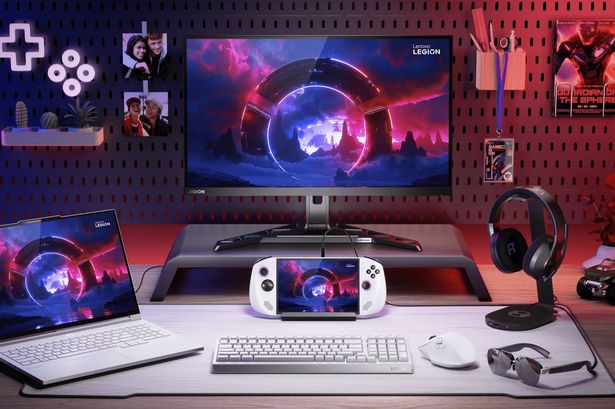
The summer air hums with the promise of adventure, and for a growing legion of gamers, that adventure increasingly includes the ability to carry their entire PC library in the palm of their hand.
The handheld PC market, once a niche curiosity, has exploded into a battleground of innovation, price points, and performance benchmarks.
And right now, a quiet contender from Lenovo is making a compelling, almost sneaky, move to capture a significant slice of that pie, offering a tantalizing proposition for those eyeing portable power without breaking the bank.
Enter the Lenovo Legion Go S, a device currently gracing Amazon’s virtual shelves with a price tag that demands a second look: a mere £349, a significant drop from its original £409.
This isn’t just another gadget; it’s Lenovo’s direct challenge to the reigning champions of portable gaming, most notably Valve’s Steam Deck.
While the “S” in its name denotes a slightly less potent iteration of the original Lenovo Go, it arrives armed with an 8-inch WUXGA display, an AMD Ryzen Z1 Go chip, a 120Hz refresh rate, VRR, and a native 16:10 aspect ratio.
It also boasts a larger battery than its predecessor and the welcome option for additional RAM, promising endurance for those long journeys or intense gaming sessions away from a power outlet.
But the real story here isn’t just the price; it’s the carefully calculated balance of features against cost, and the inherent compromises that define this segment of the market.
Our tech experts, who put the Legion Go S through its paces, found themselves genuinely impressed by what Lenovo has managed to pack into this budget-friendly package.
Nathan Bliss, a seasoned reviewer, lauded its ergonomics, going so far as to suggest it might even surpass the Steam Deck in comfort.
“Honestly, and I don’t say this lightly, it’s fantastic,” Bliss remarked, highlighting its more compact, controller-like size and asymmetrical joystick layout as key advantages.
This focus on tactile comfort is often overlooked but proves critical for extended play, transforming a mere device into a natural extension of the gamer’s hands.
The visual experience, too, received high marks.
The 1920 x 1200 LCD display, capable of reaching 500 nits of peak brightness, was described as “pretty gorgeous.” While acknowledging it doesn’t quite match the brightness of an OLED, Bliss praised its vibrancy, particularly when enjoying multimedia content or visually rich games.
This combination of ergonomic excellence and a stunning display paints a picture of a device designed for immersive engagement, promising to pull players deep into their digital worlds.
However, the path to portable gaming nirvana is rarely without its bumps.
The Achilles’ heel of the Legion Go S, as identified by our experts, lies in its raw gaming performance, particularly when it comes to demanding AAA titles.
“The performance is a huge shame,” Bliss noted, “especially considering just how strong the screen is.”
For gaming, it really is a struggle to use it to its full potential when it comes to AAA titles.
This creates a curious dichotomy: a beautiful screen and comfortable controls, but a processor that sometimes struggles to push the pixels needed to truly leverage them.
It’s the age-old dilemma of hardware capability versus software demand, forcing potential buyers to weigh their priorities: is a fantastic visual and tactile experience worth a compromise on the most graphically intensive games?
Adding another layer to this decision is the operating system.
Unlike the Steam Deck, which runs Valve’s Linux-based SteamOS, the Legion Go S is a Windows device.
This brings both blessings and curses.
On one hand, it offers unparalleled compatibility with a vast library of PC games and applications, further sweetened by a three-month Xbox Game Pass trial included with the purchase.
This means immediate access to hundreds of titles, a significant value add.
On the other hand, Windows on a small, portable form factor can sometimes be less optimized for gaming than a purpose-built OS, potentially contributing to the performance struggles noted with AAA titles.
It’s a trade-off that speaks to the broader ambitions of the device: to be a portable PC, not just a gaming handheld.
In the grand arena of portable gaming, the Legion Go S finds itself positioned strategically.
At £349, it significantly undercuts the SteamOS-powered Steam Deck, which can be found for around £499.
It also presents a stark contrast to the premium ROG Ally X, a powerhouse handheld commanding a hefty £799.99. Even Nintendo’s new Switch 2, while a different beast entirely in terms of ecosystem and power, sits at a higher price point of £429.99.
This makes the Legion Go S a compelling proposition for the budget-conscious gamer, or perhaps the casual PC gamer looking for a versatile secondary device rather than a primary AAA powerhouse.
The Lenovo Legion Go S isn’t a Steam Deck killer, nor does it aim to be the most powerful handheld on the market.
Instead, it carves out a vital niche: a highly ergonomic, visually impressive, and remarkably affordable Windows-based portable PC.
For those willing to accept some performance limitations with the most demanding games, or for players primarily interested in indie titles, older classics, or the vast library offered by Game Pass, it represents an outstanding value.
It’s a testament to the rapid evolution of this sector, where innovation isn’t just about raw power, but about intelligent design, strategic pricing, and understanding the nuanced demands of a diverse gaming populace.
The battle for the ultimate handheld continues, and with devices like the Legion Go S entering the fray, gamers are the ultimate winners.
-
Frank DiBernardo handles LNGFRM's Foodie and Miscellaneous writing tasks. He's always getting ideas from users, so don't be afraid to send an email to the editor.