Park Chan-wook: “We must accept our society’s illness”
Sideways look … Park Hae-il as Hae-jun and Kim Shin-Young as Yeon-Soo in Decision to Leave. Photograph: youngukjeon/- The director’s most recent picture obviously lacks the sex and violence that have been his trademarks, but he is nevertheless unafraid to face some uncomfortable facts about our age of intolerance. The character is a subservient police officer […]
By
LNGFRM Team
Published October 12, 2022
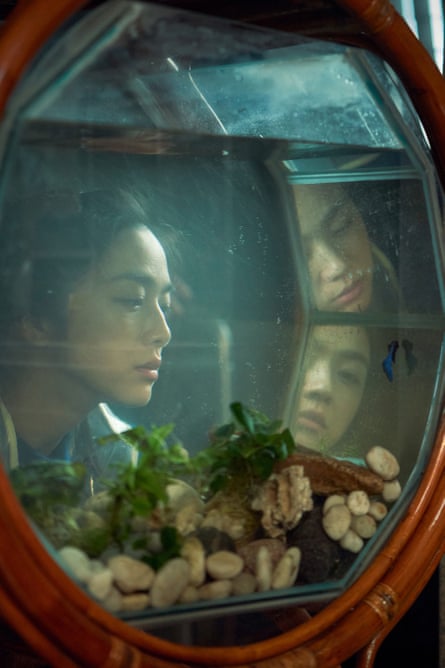
Sideways look … Park Hae-il as Hae-jun and Kim Shin-Young as Yeon-Soo in Decision to Leave. Photograph: youngukjeon/-
The director’s most recent picture obviously lacks the sex and violence that have been his trademarks, but he is nevertheless unafraid to face some uncomfortable facts about our age of intolerance.
The character is a subservient police officer who “doesn’t carry a gun, but he carries wet wipes,” according to Park Chan-wook, who was asked to define his position in the director’s most recent noir romance Decision to Leave by his starring man.
With a cheeky smirk, Park remembers this over Zoom; his interpreter chuckles. The Handmaiden and Oldboy filmmaker is in Toronto to promote his new movie, Decision to Leave, which is about a mild-mannered investigator (Park Hae-il) who becomes uncomfortably close to the prime suspect in a murder investigation. He comments on the reintroduction of live events by saying, “It’s really nice to be able to go back to cinemas” (he’ll be present at the London Film Festival this month). Before the epidemic, I believe I underestimated the value of being able to exhibit my films in front of a larger audience. But I am aware now.
His latest movie was inspired by police mystery books. They were “quite violent, very macho, and some of their signatures are swearing or chain smoking,” Park observed of the characters. He developed a fascination with the Martin Beck series of Swedish detective books from the 1960s because they offered a kinder detective role model: Beck “has a very strong sense of calling, he has his own principles.” Because of this, Hae-jun from Decision to Leave is nearly “too courteous and too kind: he is out of the category of the macho detective.” Hae-jun is also attempting to stop smoking at his wife’s request.
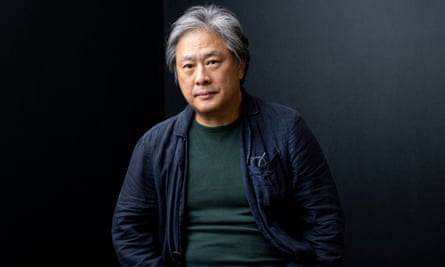
Park Chan-Wook, photographed at Toronto International Film Festival. Photograph: Jeff Vespa/Rex/Shutterstock
Fans of Park’s previous work may be surprised by this focus on restraint. With three sleek and vicious pictures about retribution that mix cruel psychological tests with maximalist violence, the filmmaker is credited with bringing Korean cinema to the attention of the world in the 2000s. Sympathy for Mr. Vengeance features a guy who is tied up and abandoned to drown in a riverbank. In the movie Oldboy, a prisoner battles through a mob while carrying just a hammer and dripping blood down his neck. In the movie Lady Vengeance, a group of parents confronts the serial murderer who killed their children with knives and axes.
Park has also never shied away from depicting sex in her films. A secluded Japanese heiress and a con artist serving as her maid in 1930s colonial Korea is the subject of the 2016 film The Handmaiden. The plot is rich with sexual detail, from the material splendor of the Japanese-style home to the blossoming relationship between the two women.
Decision to Leave garnered Park a prize for outstanding director at its Cannes debut this year, but it also raised concerns about why the movie didn’t have any sex or violence. In Decision to Leave, Park’s two characters “are quite bad at being honest with their true emotions.” “They occasionally hold back from saying what’s going on inside of them or occasionally say something different, something the complete opposite of how they really feel.” The audience will thus have to pay attention to “all the little nuances and the little changes happening to their faces and their gestures” and enjoy them.
“I have to make sure there aren’t too many stimulants surrounding what we saw in order to achieve that. I made an effort to ensure that nothing was too powerful to overwhelm or obscure what I was attempting to say. He gives some instances that I observed, such as a close-up of two handcuffed hands closing in on one another, and others that I missed, such as the two protagonists’ breathing flowing in unison.
Decision to Leave is a twist-filled slow-burner; patient – and even many – viewings are rewarded by Park’s subtle touches. Seo-rae (played by Tang Wei), the wife of the murder victim and an immigrant with a murky history, is at the center of the mystery.
Seo-rae, who is neither a blameless Madonna nor a femme fatale, is described as “the biggest objective for me and my co-writer [Jeong Seo-kyeong] was to really go beyond that stereotype of film noir women,” he claims. The movie plays with various genre clichés that it embraces. Seo-apartment rae’s is watched by Hae-jun at night, who notices Seo-propensity rae’s for eating ice cream for supper. The voyeuristic guy watches his beautiful, unaware prey from a distance. Then Seo-rae begins to observe him in return, starting an intriguing game.
Park also explores the concept of failure. He asserts that the conclusion of a riddle does not necessarily result in the end of a dispute. Despite the variations, both Park’s latest film and his Vengeance trilogy from the 2000s take a genre that often teases some kind of fulfillment, whether it be via the uncovering of a crime or the delivery of a long-awaited strike of justice, and then disappoint that delivering. His characters are left with more unanswered questions after learning the truth; seeking retribution does not feel satisfying but rather leaves one feeling empty and guilty.
Tang Wei as Seo-rae in Decision to Leave.
In interviews, Park, who originally aspired to be an art critic and studied philosophy in college, is kind and reflective. Throughout his career, he has been questioned over the brutality he has shown. What does he think of the present political climate, in which fury has shown itself once again in social movements aimed at retaliating against perceived outsiders like feminists, refugees, and immigrants?
It has historically been extremely typical for politicians to capitalize on people’s animosity against others, he claims. “All of my films that deal with vengeance fundamentally discuss how pointless it is to take revenge on someone and how there is nothing to be gained from doing so. While none of my films address the issue of wrath or hate against women, which does exist in our culture, it is crucial for us to acknowledge that we suffer from this condition. Sympathy for Mr. Vengeance deals with the battle between the classes. There is only one way to find a solution, and that is to look at it head-on. He claims that producing films may help us face our demons and that the power of art lies in how tales on screen can ignite conversations in real life.
The global rollout of Decision to Leave is still ongoing, but Park is already hard at work on a number of new projects, including an HBO adaptation of Viet Thanh Nguyen’s Vietnam War novel The Sympathiser as well as a western and a science fiction movie. Decision to Leave will be South Korea’s entry for best international feature film at the Oscars next year. He attributes the current surge in interest in Korean culture on streaming sites, saying that “resistance to subtitles has decreased quite a bit.” Leading filmmakers from today, including Bong Joon-ho of Parasite and Hwang Dong-hyuk of Squid Game, were in their undergraduate years while South Korea was fighting for democracy in the 1980s. This, according to Park, is one of the reasons why the country has a reputation for generating works that are particularly sensitive to concerns of social class and political conflict.
“My two protagonists are quite bad at being honest with their true emotions”
Park is still interested in retribution, despite how alluring it is to portray his work as one that evolved from a fixation with violence in his adolescence to one that now embraces romanticism and moderation. In line with a story about a middle-aged guy who loses his office job and turns into a serial murderer, he intends to recreate the 2005 French film The Axe. He chuckles when I ask him what further he wants to research on the issue. Since I haven’t worked on the projects you’re mentioning, it’s too early for me to comment. I haven’t even given it any attention.
He is far less meticulous in his creative approach. Even when I’m writing the screenplay for a movie, I have no idea what kind of movie I’m doing. I’m just giving the tale I think the audience will find amusing and enjoyable. He doesn’t realize, “Oh, this is what I’m trying to say,” until he begins editing. He claims that everything seems to come together in the end “as if I planned everything from the beginning,” including camera angles, shots, and screenplay lines. How the subconscious of the creator works is truly remarkable.
Decision to Leave has national previews starting on October 15 and will open in theaters on October 21.
Thanks to Rebecca Liu at The Guardian whose reporting provided the original basis for this story.
Frank DiBernardo handles LNGFRM's Foodie and Miscellaneous writing tasks. He's always getting ideas from users, so don't be afraid to send an email to the editor.
Jodey (Zhihan) Yang’s approach to choreography begins with a discipline most artists skip: she arrives at a site before the movement does, listening to its soundscape, light, textures, and rhythms until the environment reveals what kind of work it can hold—and only then does she begin to choreograph with it rather than in it. Across site-specific performances, award-winning dance films, and public commissions at institutions like LACMA and New York Fashion Week, her practice offers a precise model for how movement, camera, and place can collaborate to make audiences see familiar environments as though for the first time.
Pushpika Fernando has built a career on a premise most large enterprises quietly accept as impossible: that the entrenched pricing power of dominant HR vendors isn’t a market reality to be managed, but a structural imbalance to be dismantled through analytical rigor, leverage creation, and disciplined commercial architecture. As a Global HR Services Category Manager, his work moves well beyond cost-cutting—redirecting the savings captured from renegotiated supplier economics into the employee benefits, learning platforms, and service accountability frameworks that define the workforce experience.