The cacophony, the seemingly disorganized sprawl of innovation that defines America, might just be its secret weapon in the global scramble for artificial intelligence supremacy.
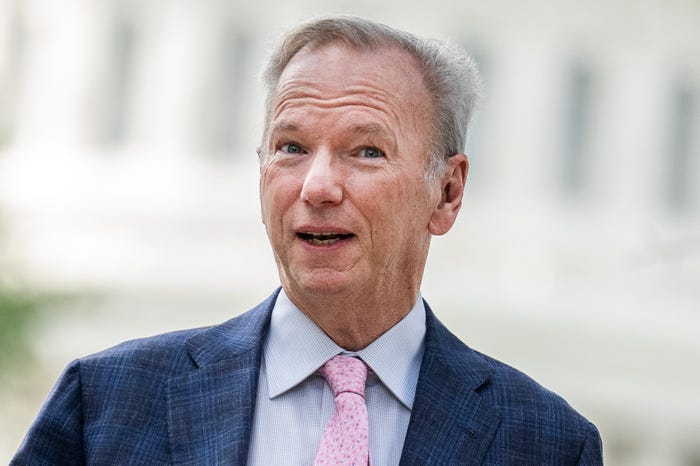
This isn’t the musing of an academic, but the conviction of Eric Schmidt, the former Google CEO who steered the tech giant through its formative years.
His message is both a challenge and a rallying cry: don’t fear the chaos; lean into it.
Schmidt, speaking at the recent All-In Summit, painted a vivid picture of America’s innovation ecosystem – a vibrant, often messy tapestry woven from venture capital, pioneering universities, and a relentless spirit of entrepreneurship.
“We’re chaotic, confusing, loud, you know, but we’re clever,” he remarked, a statement that at once acknowledges the perceived flaws and champions the underlying genius.
It’s a system, he argues, that allocates capital smartly, boasts deep financial markets, and possesses an enormous industrial base that constantly churns out new ideas and applications.
This isn’t just a matter of national pride; it’s a strategic advantage.
Schmidt contends that Europe and Asia look upon this distinctly American model with envy.
Far from being a weakness to be ironed out, this “chaotic” approach is, in his view, a wellspring of dynamism that should be celebrated, stoked, and accelerated.
It’s a testament to the idea that true innovation often thrives not in sterile, centralized planning, but in the unpredictable collisions of diverse minds and ambitious projects.
The very disarray, perhaps, forces a greater degree of resilience, adaptability, and ultimately, breakthrough.
Yet, this celebration of American ingenuity is tempered by the looming shadow of the US-China AI race.
The stakes couldn’t be higher: control over the future of technology, global economic leadership, and the very values embedded within the AI systems that will shape our world.
China, with its formidable work ethic and a keen focus on consumer applications, presents a formidable challenger.
Schmidt specifically highlighted Beijing’s embrace of open-weight AI models, a strategy he ominously likened to a new “Belt and Road” initiative for technology.
This isn’t merely about market share; it’s about the proliferation of foundational models that could embed specific cultural and ethical frameworks globally.
“I’d much rather have the proliferation of large language models and that learning be done based on Western values,” Schmidt articulated, underscoring the ideological dimension of the technological contest.
The former Google chief’s warning resonates deeply within Washington and Silicon Valley.
The Trump administration, in its AI Action Plan, emphasized the critical need for the US to ensure its leading open models are “founded on American values.”
The concern is palpable: if the US falters in this open AI race, the standards by which AI is developed and deployed could very well become Chinese.
The recent announcement by OpenAI CEO Sam Altman of GPT-oss, a family of large language models with “open weights,” is seen by analysts as a crucial step towards closing this potential gap and ensuring Western participation in the foundational layers of AI.
The call to action isn’t confined to Schmidt.
Other titans of industry and political figures are echoing the sentiment, each adding their unique perspective to the multifaceted challenge.
“Shark Tank” investor Mark Cuban, ever the pragmatist, believes America’s path to victory lies in sustained, broad-based investment in research.
“The quality and depth of the research we do in this country can help us stay ahead of China and other countries in the AI race,” Cuban stated, highlighting the foundational role of scientific inquiry.
Jensen Huang, CEO of Nvidia, a company at the very heart of AI’s hardware revolution, offers a more granular perspective.
He sees the US and China in a dead heat for AI chip dominance, emphasizing that America’s energy policies must adapt to accelerate emerging tech industries.
This points to a recognition that the AI race isn’t just about software and algorithms; it’s about the underlying infrastructure, the energy to power massive data centers, and the strategic foresight to ensure a stable, supportive environment for growth.
Even former President Donald Trump weighed in on the competitive landscape, viewing the impressive, yet relatively cheap, AI models from Chinese startup DeepSeek not as a threat to be feared, but as a “wake-up call.”
“The release of DeepSeek, AI from a Chinese company, should be a wake-up call for our industries that we need to be laser-focused on competing to win,” Trump told GOP lawmakers.
It’s a reminder that global innovation waits for no one, and complacency is a luxury America cannot afford.
Schmidt’s provocative thesis, therefore, isn’t an excuse for inaction but a blueprint for leveraging an inherent strength.
It’s a recognition that America’s unique blend of entrepreneurial zeal, academic excellence, and robust financial markets, for all its perceived disarray, is a powerful engine.
The challenge lies in harnessing this inherent “chaos” with purpose, directing its formidable energy towards not only pushing the boundaries of artificial general intelligence but also dominating the “day-to-day stuff” that forms the backbone of the AI economy.
In a world increasingly defined by technological prowess, America’s greatest asset might just be its enduring ability to innovate brilliantly, even if a little loudly and a little messily.
The future of AI, and perhaps global influence, depends on whether it can embrace this distinctive style and make it go “faster and faster.”
-
Frank DiBernardo handles LNGFRM's Foodie and Miscellaneous writing tasks. He's always getting ideas from users, so don't be afraid to send an email to the editor.