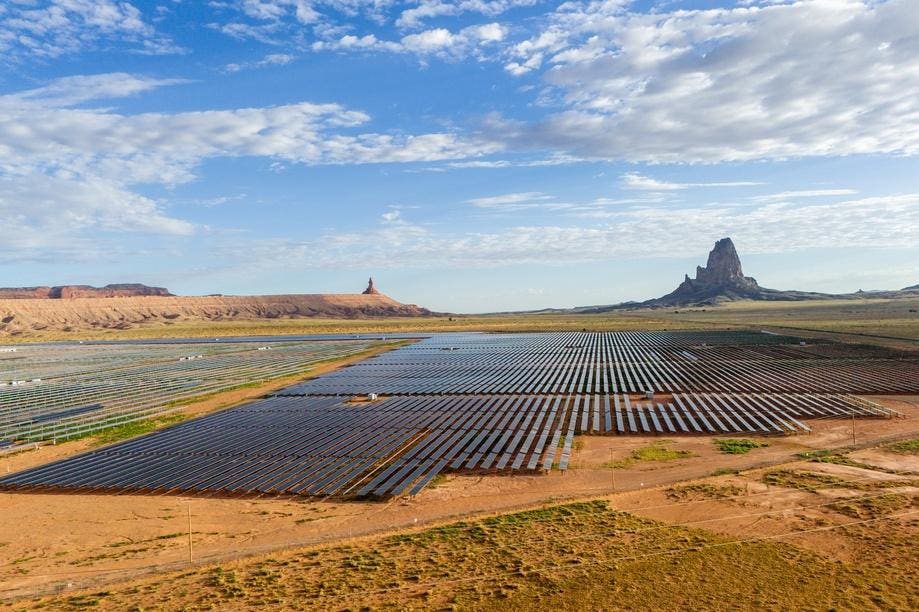
Fifty years ago, when the oil giant Exxon ventured into solar energy, it wasn’t a grand vision for a clean energy future that drove their investment.
Instead, their sights were set on powering offshore oil platforms, a pragmatic need for their core business.
Yet, from those unassuming beginnings blossomed a technological revolution, one that today sees solar energy emerging as the cheapest power source on Earth, poised to supply half of global electricity demand by 2030.
This remarkable trajectory offers a profound lesson: that seemingly minor investments, coupled with relentless innovation and supportive policy, can unlock breakthroughs capable of reshaping our world in ways we scarcely imagine.
Today, as the imperative to decarbonize our planet grows ever more urgent, a new compass has emerged to guide us through the uncharted waters of climate innovation.
The Climate Tech Atlas, a collaborative effort by leading organizations including Breakthrough Energy, Elemental Impact, Energy Innovation, McKinsey Sustainability, Speed & Scale, and the Stanford Doerr School of Sustainability, aims to map out the frontiers of climate technology.
It’s a strategic response to a critical challenge: while existing clean energy solutions like renewables and electric vehicles are being deployed at an unprecedented pace, they alone won’t get us to net zero emissions by 2050.
Nearly half of the necessary reductions, experts suggest, must come from technologies still in their nascent stages – demonstration or prototype phases.
This is where the Atlas steps in, identifying nearly 70 “innovation imperatives” and almost 40 “moonshots” across 24 “opportunity areas” spanning six vital sectors: buildings, manufacturing, transportation, electricity, greenhouse gas removal, and food, agriculture, and nature.
Ryan Panchadsaram, co-author of Speed & Scale, aptly describes the Atlas as “a compass pointing to the frontiers of tomorrow.”
The distinction between its two core concepts is crucial: “innovation imperatives” represent critical near-term needs that demand accelerated development, such as truly clean cement or eliminating livestock emissions.
These are the immediate hurdles requiring focused problem-solving.
“Moonshots,” on the other hand, are the high-risk, high-reward innovations that could take longer to commercialize but hold the potential to radically transform our path to net zero, offering solutions as audacious as space-based solar power or the development of geologic hydrogen.
Just as solar power in the 1970s or electric vehicles in the 2000s were once considered niche or futuristic, these potential breakthrough technologies could compress decades of decarbonization efforts into mere years once proven and scaled.
The implications are staggering.
Imagine a world where industrial manufacturing, currently the largest emitter with 26.7 gigatons forecast for 2050, is revolutionized not just by industrial heat pumps, but by entirely new, carbon-neutral processes.
Or an electricity sector, projected to emit 13.3 Gt in 2050, that goes beyond wind and solar to harness previously unimaginable energy sources.
The transportation sector, with its 9.4 Gt potential emissions, could see not only widespread vehicle electrification but also breakthroughs in materials and aerodynamics that fundamentally alter shipping and aviation.
Yet, this isn’t merely an environmental crusade; it’s an economic gold rush.
The flip side of securing a safe climate future is the immense opportunity to build new markets, create millions of jobs, and drive unprecedented investment.
Global clean energy investment surged past the $2 trillion mark in 2024, a six-fold increase over the past decade, and created 1.5 million new jobs in 2023 alone, particularly in manufacturing.
Goldman Sachs projects the global investment opportunity to reach net zero at a staggering $75 trillion, with clean energy potentially representing 7-10% of global market capitalization by 2030.
This isn’t just a bet on the future; it’s a strategic investment in the next global economy.
History, too, offers a compelling argument for embracing innovation even amidst uncertainty.
Startups founded during the 2008 financial crisis demonstrated superior long-term survival and growth despite capital constraints.
More recently, despite the shadow of the COVID-19 pandemic and lingering recession fears, over 600 new tech “unicorn” companies emerged worldwide in 2021.
As Panchadsaram observes, “Innovation has always thrived in uncertain times, and this moment is no different.”
It’s a testament to human ingenuity’s ability to not only adapt but to flourish under pressure.
Decades of relentless innovation have already rendered many clean energy technologies the most affordable options for grid generation and personal transportation, simultaneously cutting consumer costs and bolstering domestic energy security.
However, as Sonia Aggarwal, CEO of Energy Innovation, reminds us, “Yesterday’s innovation has delivered cheap, clean technologies we must continue to deploy at scale today – but many more technological breakthroughs are on the horizon.”
The Climate Tech Atlas serves as a vital tool, a shared map for students seeking impactful careers, governments allocating R&D funding, and investors searching for the next transformative idea.
It’s an acknowledgment that while we don’t know precisely which technologies will define the industries of tomorrow, we absolutely need a systematic approach to find them.
By illuminating these frontiers, the Atlas hopes to accelerate the breakthroughs that will secure a net zero future, making our children’s lives not just safer, but better.
-
Frank DiBernardo handles LNGFRM's Foodie and Miscellaneous writing tasks. He's always getting ideas from users, so don't be afraid to send an email to the editor.