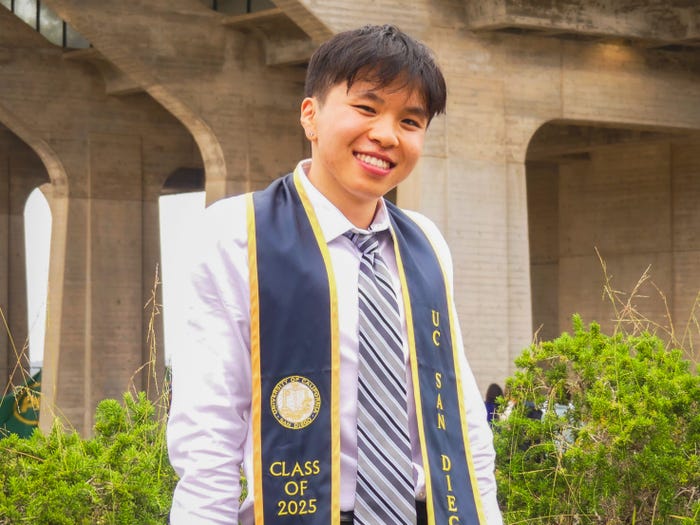
It was the ticking clock that Andrew Chen couldn’t ignore.
Weeks away from clutching his computer science degree from the prestigious University of California San Diego, the 22-year-old faced a daunting void where a job offer should have been.
The dream of a software engineering career, once a clear path, had dissolved into a year-long odyssey of applications, rejections, and growing despair.
Then, a digital lifeline: an email from Amazon, an invitation to interview in just ten days.
For many, it would be a golden ticket.
For Chen, it was a crucible, an eleventh-hour chance he couldn’t afford to squander.
But how does one conjure career-defining preparation in such a condensed timeframe, especially after months of nearly giving up?
Chen found his answer not in a traditional study group or a career counsellor’s office, but in the most unlikely of places: TikTok.
He transformed his intense, self-imposed isolation into a public spectacle, a digital confessional where the pressure of millions of views would become his ultimate accountability partner.
He locked himself away, canceling all social engagements, his only companions LeetCode problems, Amazon’s opaque leadership principles, and the relentless hum of a camera documenting his every anxious step.
“If I don’t get this job,” he recalled thinking, “this is all for nothing.”
Chen’s dramatic sprint to employment isn’t just a personal triumph; it’s a stark reflection of a brutal, unforgiving job market that has swallowed up countless recent graduates, particularly those in the tech sector.
As of June, nearly 5% of Americans aged 22 to 27 with a bachelor’s degree found themselves unemployed—a figure that shockingly surpasses the general working-age population’s jobless rate.
This reversal of fortunes signals a broader hiring slowdown, exacerbated by tariff uncertainties and the creeping influence of AI, pushing US company hiring to its slowest pace since 2014.
For computer science graduates like Chen, the landscape is particularly bleak, scarred by widespread layoffs at industry giants like Amazon, Google, and Microsoft, and a staggering 70% decline in US software development job postings on Indeed since their 2022 peak. State of the software engineering job market in 2025
Andrew Chen had experienced this harsh reality firsthand.
His initial optimism after graduating with a computer science major quickly faded into a sea of rejections.
Over 400 applications yielded little traction, forcing him to broaden his search into product management and design roles, a reluctant detour from his true passion.
He had even applied to Amazon multiple times between September 2024 and February 2025, completing an online assessment he thought went well, only to hear nothing for months.
His parents, understandably fixated on the “name brand” employer, kept asking for updates.
“I eventually told them I got rejected,” he admitted, “I thought if I hadn’t heard from them after months, it’s probably not going to happen.”
By May, when Amazon’s unexpected interview invitation finally arrived, Chen was deep in interviews for those alternative roles, his software engineering dream all but a ghost.
The timing was both a blessing and a curse.
Ten days to prepare for a FAANG interview, while juggling final exams, projects, and other company interviews, felt like an impossible feat.
He meticulously structured his days: blocks for coding practice on LeetCode, dedicated time for behavioral prep, and deep dives into Amazon’s infamous leadership principles.
He scoured Reddit and Blind for insights, memorizing STAR-format stories to illustrate his embodiment of Amazon’s values.
But the sheer magnitude of the task demanded more than just discipline; it required a unique form of external pressure.
Enter TikTok.
Chen, a casual user, saw an opportunity to leverage the platform’s public gaze for personal gain.
On May 19, he posted his first “10 days until FAANG final interview” update, detailing his skipped classes, caffeine consumption, and shower count.
The subsequent videos, some garnering millions of views, became a live chronicle of his frantic preparation.
While skepticism from some viewers was inevitable, the platform also provided a crucial stream of advice and encouragement, transforming a solitary struggle into a shared journey.
When interview day arrived in late May, Chen was a cocktail of anxiety and exhaustion.
Amazon’s “loop” interview process—three back-to-back virtual sessions with short breaks—tested everything.
Technical prowess in the first round, behavioral scenarios rooted in leadership principles in the second, and a blend of both in the third.
“I was thinking that these few hours will determine if I am employed,” he recalled, the weight of his year-long struggle pressing down.
Yet, he settled into a rhythm, feeling he had given his best.
The payoff arrived on June 3, an email notification after another day of non-Amazon interviews: a six-figure offer from Amazon.
The news, shared in a TikTok viewed nearly a million times, marked the end of his 298-day unemployment saga.
His biggest takeaway from the Amazon experience was not just technical skill, but the profound importance of behavioral questions and the company’s leadership principles.
“They care a lot about your success stories outside your technical expertise,” Chen noted, acknowledging that his strength as a “talker” rather than solely a “coder” played to his advantage.
His hard-won advice for fellow job seekers in this challenging climate is refreshingly pragmatic: while quality matters, volume is paramount.
“Many times I did feel hopeless,” he confessed, “but I think it truly is a numbers game.
You just need to apply to everything you’re qualified for.”
Andrew Chen’s story is a compelling narrative for the modern job seeker.
It’s a testament to resilience, the power of unconventional strategies, and the evolving role of social media in personal and professional development.
In a world where the traditional pathways to employment are increasingly fraught, Chen’s journey offers a glimmer of hope, demonstrating that sometimes, the most effective way to secure your future is to broadcast your struggle to the world.
It’s a new blueprint for navigating the turbulent waters of the entry-level job market, one TikTok post at a time.
-
Frank DiBernardo handles LNGFRM's Foodie and Miscellaneous writing tasks. He's always getting ideas from users, so don't be afraid to send an email to the editor.