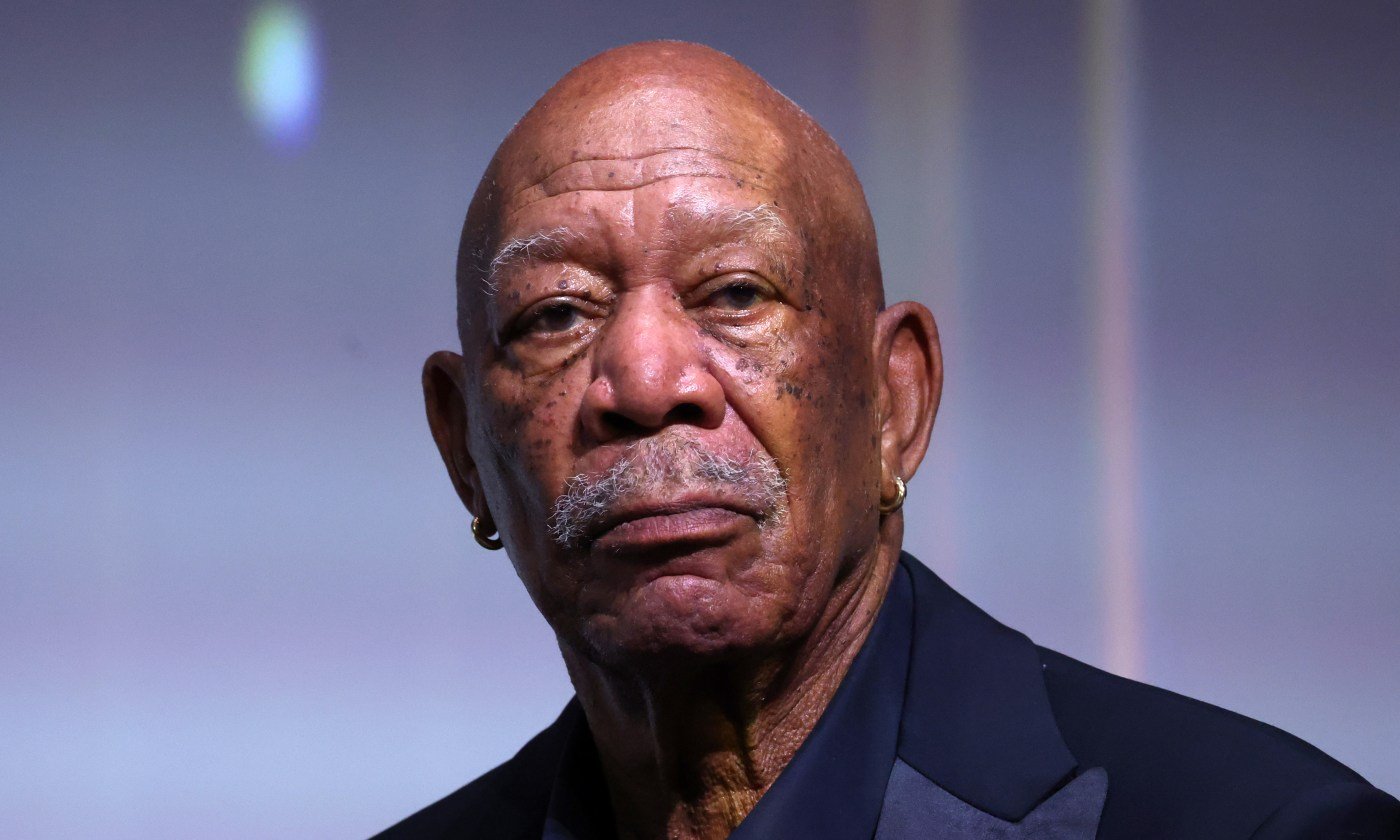
The voice, deep and resonant, has long been synonymous with authority, wisdom, and even the divine.
It is the voice that guided millions through the solemnity of “The Shawshank Redemption,” delivered the pronouncements of God himself in “Bruce Almighty,” and lent gravitas to countless documentaries, from the sweeping historical narrative of “The Civil War” to the poignant journey of “March of the Penguins.”
It is, in essence, the very signature of Morgan Freeman, an inimitable instrument that has shaped cinematic and documentary landscapes for decades.
Now, that iconic voice finds itself at the heart of a modern-day battle, not against a villain on screen, but against an insidious, unseen adversary: artificial intelligence.
Freeman, at 88, is not merely perturbed; he is, in his own words, “a little PO’d.”
The Oscar winner is taking decisive legal action, his legal team “very, very busy” in the face of a burgeoning tide of AI replicas of his voice, generated without a whisper of permission or a penny of payment.
His sentiment is stark, cutting to the core of an artist’s livelihood: “I’m like any other actor: Don’t mimic me with falseness.
I don’t appreciate it and I get paid for doing stuff like that, so if you’re gonna do it without me, you’re robbing me.”
This isn’t just the lament of a celebrity guarding his brand; it’s a clarion call from the front lines of an evolving war over intellectual property and artistic integrity. Intellectual property rights in entertainment are becoming a central issue.
Freeman’s lawyers have already unearthed “many” instances of unauthorized use, and “quite a few” legal battles are now underway.
It speaks to the sheer scale of the problem, a digital Wild West where algorithms roam free, pilfering the unique attributes of human talent for commercial gain.
The financial implications are clear: every unauthorized AI replication represents a potential job lost, a payment withheld, a piece of an artist’s craft devalued and exploited.
But beyond the economics, there’s a deeper wound—the erosion of authenticity, the blurring of lines between genuine human performance and synthetic mimicry.
The veteran actor’s frustration extends beyond his own voice to the broader existential threat AI poses to the acting profession. When pressed on the controversial AI actress Tilly Norwood, Freeman didn’t equivocate.
His response was blunt and unequivocal: “Nobody likes her because she’s not real, and that takes the part of a real person, so it’s not going to work out very well in the movies or in television.”
This statement cuts to the heart of the matter for many in Hollywood: the inherent value of human experience, emotion, and presence that an algorithm, however sophisticated, simply cannot replicate.
Tilly Norwood is not a phantom; she is the brainchild of Dutch actress Eline Van der Velden, founder of the AI production studio Particle 6.
Van der Velden’s creation, while technically impressive, has been met with fierce condemnation from industry bodies like the SAG-AFTRA union.
They have rightly decried Norwood as a “dangerous creation,” a harbinger of a future where real-life actors could be sidelined, their roles usurped by digital phantoms.
The union’s mandate, as Freeman pointedly notes, is “to keep actors acting,” setting the stage for an inevitable and escalating conflict between human labor and artificial intelligence.
This isn’t merely a technological advancement; it’s a profound ethical dilemma dressed in code. The ability to perfectly clone a voice, a face, or an entire persona raises uncomfortable questions about consent, ownership, and the very definition of performance.
If a studio can generate an infinite number of Morgan Freeman narrations without ever needing Morgan Freeman, what becomes of the human artist?
What happens to the nuance, the lived experience, the soul that a human brings to a role, elements that even the most advanced AI struggles to synthesize?
Morgan Freeman’s stand is a pivotal moment, not just for him, but for every artist whose unique contribution to the world is now vulnerable to algorithmic appropriation.
His legal battle is more than a personal grievance; it’s a fight for the future of human creativity in an increasingly automated world.
It’s a defense of the irreplaceable value of a genuine voice, a real presence, and the fundamental right of artists to control and profit from their own work.
In the grand narrative of technological progress, it’s a crucial reminder that some things, like the voice of God, should remain sacred and untampered, belonging solely to their human origin.
The conflict, as Freeman and SAG-AFTRA rightly observe, has only just begun.
-
Frank DiBernardo handles LNGFRM's Foodie and Miscellaneous writing tasks. He's always getting ideas from users, so don't be afraid to send an email to the editor.