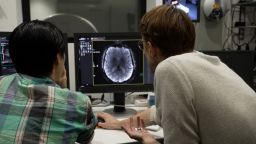
In a world increasingly defined by the fusion of human intellect and artificial intelligence, a quiet revolution is unfolding in Japan.
This revolution promises to unlock the very theatre of our minds.
Tomoyasu Horikawa, a researcher at NTT’s Communication Science Laboratories, has unveiled a groundbreaking technique, aptly named “mind-captioning.”
This technique translates the fleeting, complex tapestry of our mental images directly into descriptive text.
This isn’t merely about deciphering the words we think; it’s about giving voice to the visual narratives that play out in our heads.
This is a feat previously confined to the realm of science fiction.
For years, scientists have grappled with the formidable challenge of extracting language from brain activity.
However, translating the intricate dance of visual thought – the objects, scenes, actions, and the nuanced relationships between them – has remained elusive.
Horikawa’s method leverages the formidable power of AI to bridge this gap.
His team meticulously analyzed the brain activity of six Japanese participants as they watched thousands of silent video clips.
This raw neural data was then fed into a sophisticated system where large language models converted video captions into numerical sequences.
Subsequently, simpler AI models, or “decoders,” were trained to match these sequences with the corresponding brain activity.
The result is a system capable of interpreting brain signals from unseen or even recalled videos, progressively generating descriptive text that mirrors the mind’s eye.
The implications are nothing short of profound.
Imagine a future where those silenced by circumstance can finally articulate their inner worlds.
The technology holds immense promise for individuals suffering from aphasia, a condition that impairs language expression due to brain damage.
It also offers hope for those battling amyotrophic lateral sclerosis (ALS), a debilitating neurodegenerative disease that robs individuals of their ability to speak.
Beyond these, psychologists like Scott Barry Kaufman, a lecturer at Barnard College, envision “profound interventions” for non-verbal autistic individuals.
This would offer them an unprecedented pathway to communication.
Remarkably, the AI generated text in English, even from non-native English speakers.
Crucially, it functions independently of the brain’s traditional language networks.
This particular aspect suggests its utility even when those language centers are compromised, opening doors that were once thought permanently closed.
Yet, as with any technology that pierces the veil of human consciousness, mind-captioning casts a long shadow of ethical concern.
Marcello Ienca, a professor of the ethics of AI and neuroscience, aptly describes it as “the ultimate privacy challenge.”
The ability to decode an individual’s private thoughts before they are even verbalized raises a chilling specter.
This includes potentially accessing the content of dreams, the nascent thoughts of infants, or even animal cognition.
What happens when our inner sanctum, the last bastion of true individuality, becomes legible to machines, and potentially, to others?
This concern is amplified by the rapid advancements in neural interface technologies.
Companies like Neuralink publicly declare ambitions to develop brain implants for the general population.
Ienca stresses the urgent need for “very, very strict rules” governing access to people’s minds.
He highlights that our brains harbor “sensitive information” like “signatures of early dementia and psychiatric disorders and depression.”
The potential for misuse, for involuntary disclosure of deeply personal or even pathological information, is a future we must proactively guard against.
The ethical dilemma has already spurred discussions around “neurorights.“
Social scientist Łukasz Szoszkiewicz advocates for treating neural data as sensitive by default.
He demands explicit, purpose-limited consent, and prioritizing on-device processing with user-controlled “unlock” mechanisms.
He warns that reliance on AI introduces further regulatory and cybersecurity challenges.
This underscores the necessity for a complementary, AI-specific legal framework.
The speed of neuroscientific advancement, Szoszkiewicz argues, dictates that “mental privacy and freedom of thought protections can’t wait.”
One proposed safeguard, a “keyword unlock” mechanism, suggests a future where individuals could consciously grant or deny access to their inner thoughts.
This would offer a modicum of control in this brave new world.
However, even as these grand ethical debates unfold, Horikawa himself offers a dose of reality.
He acknowledges that his method currently demands extensive data collection and the active cooperation of participants.
This makes it “not so accurate for practical use” in its present form.
Furthermore, the AI was trained on relatively “typical” video scenes.
This raises questions about its ability to interpret less predictable or more abstract mental images.
Therefore, while the concerns about mental privacy are legitimate and forward-looking, Horikawa assures us that, for now, “the current approach cannot easily read a person’s private thoughts.”
This cutting-edge research stands as a powerful testament to human ingenuity, a beacon of hope for those yearning for a voice.
Yet, it simultaneously serves as a stark reminder of the accelerating pace of technological progress and the profound ethical quandaries it invariably brings.
As we stand on the precipice of deciphering the human mind, the conversation must shift from merely “can we?” to “should we?” and, most importantly, “how do we do so responsibly?”
The future of mental privacy, and perhaps the very essence of what it means to be an individual, hangs in the balance.
-
Frank DiBernardo handles LNGFRM's Foodie and Miscellaneous writing tasks. He's always getting ideas from users, so don't be afraid to send an email to the editor.