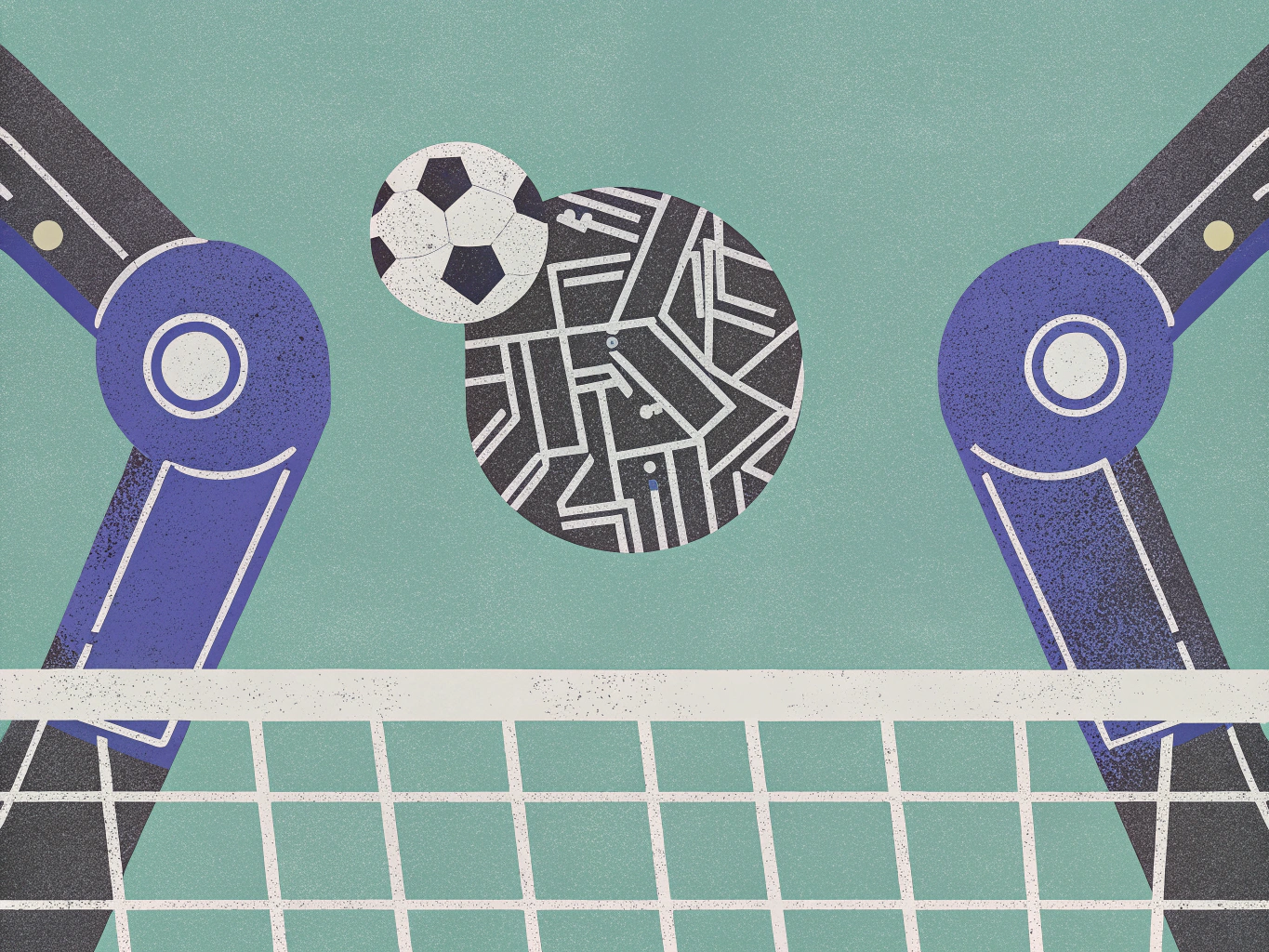
Beijing, a city often mesmerized by the delicate dance of ancient traditions and hyper-modern ambition, recently witnessed a new kind of spectacle unfold on its sporting grounds.
It wasn’t the roar of a human crowd celebrating a hard-fought goal by the national team – a sound increasingly rare for China’s beleaguered men’s soccer squad – but rather the whirring hum and precise, if occasionally clumsy, movements of humanoid robots.
These metallic players, powered by the invisible alchemy of artificial intelligence, have managed to generate more genuine excitement than their flesh-and-blood counterparts ever could, hinting at a fascinating, and perhaps unsettling, future for sports and technology.
On a recent Saturday night, four teams of these autonomous androids took to the field for a 3-on-3 soccer match, a contest touted as a national first and a prelude to the eagerly anticipated World Humanoid Robot Games.
The key differentiator, and indeed the most captivating aspect, was the complete absence of human puppeteers.
Every decision, every pass, every attempt at a goal was orchestrated by AI-driven strategies, allowing the robots to operate with an eerie independence.
Equipped with sophisticated visual sensors, these mechanical athletes could identify the ball, navigate the pitch with surprising agility, and were even designed to right themselves after a tumble.
Yet, in a darkly humorous echo of human athletic frailties, several still required the assistance of staff, carried off the field on stretchers – a touch of realism that inadvertently added to the surreal charm of the silicon-and-steel spectacle.
This robotic soccer showcase, however, was far more than mere entertainment.
It was a calculated maneuver in China’s grand strategy to accelerate its dominance in AI-powered humanoid robotics.
Sports competitions, from marathons to boxing and now football, are being repurposed as dynamic, real-world proving grounds.
Cheng Hao, the visionary founder and CEO of Booster Robotics, the company behind these metallic marvels, articulated this perfectly.
He sees these contests as the ideal crucible, forging the rapid development of both intricate algorithms and integrated hardware-software systems.
It’s a pragmatic approach to innovation, leveraging the inherent challenges and immediate feedback loops of competitive sport to push technological boundaries.
The intricacies of this development are fascinating.
While Booster Robotics supplied the robust hardware for all four university teams, the true intelligence resided within the algorithms painstakingly developed and embedded by each school’s research team.
This meant each robot was imbued with its own unique brain, dictating perception, decision-making, player formations, and even the nuances of passing strategies – variables such as speed, force, and direction.
The final match, a testament to this collaborative ingenuity, saw Tsinghua University’s THU Robotics emerge victorious with a 5-3 win over China Agricultural University’s Mountain Sea team.
A supporter of Tsinghua, Mr. Wu, captured the sentiment perfectly, celebrating his team’s prowess while also acknowledging the impressive and surprising performance of their opponents.
But beyond the immediate thrill of victory and the mesmerising display of nascent AI, a deeper, more profound discussion emerged: the future integration of robots into human society, particularly in shared activities.
Cheng Hao himself broached the intriguing possibility of robots eventually playing football alongside humans.
This isn’t merely about avoiding a mechanical foul; it’s about engineering public acceptance and dismantling the pervasive anxieties that often shadow advanced AI.
“That means we must ensure the robots are completely safe,” Cheng emphasized, highlighting safety as a core concern.
He envisions a future where robots and humans can engage in interactions where winning isn’t the primary objective, but genuine offensive and defensive plays occur, fostering trust and understanding that these advanced machines are not a threat.
What unfolded on that pitch was more than a mere exhibition; it was a potent symbol of China’s relentless drive to dominate the frontier of artificial intelligence and robotics.
While the nation’s human men’s soccer team has only ever graced one World Cup and has already been unceremoniously knocked out of contention for next year’s tournament in Canada, Mexico, and the United States, its robotic counterparts are already playing on a global stage, albeit a nascent one.
The contrast is stark and telling: a traditional sport struggles to find its footing, while a futuristic one, born of algorithms and ambition, captivates audiences and pushes the boundaries of what is possible.
It begs the question: as AI continues its exponential ascent, will the most thrilling athletic contests of tomorrow be those played by human ingenuity, or by its artificial progeny?
For now, in Beijing, the robots are undeniably winning the popularity contest.
-
Frank DiBernardo handles LNGFRM's Foodie and Miscellaneous writing tasks. He's always getting ideas from users, so don't be afraid to send an email to the editor.