The quiet hum of commercial aviation, a symbol of global interconnectedness and prosperity, has been replaced by an unsettling buzz over Denmark this week.
What began as a series of unexplained drone sightings near major airports has escalated into a declaration of a “hybrid attack” by the Danish government.
This declaration points a finger of suspicion squarely at professional, albeit currently unknown, actors.
This isn’t just about disrupted flight schedules; it’s about a nation, a continent, grappling with a new, insidious form of aggression.
This aggression blurs the very definition of war and peace, eroding the sense of security from within.
The incidents themselves paint a stark picture of vulnerability and precision.
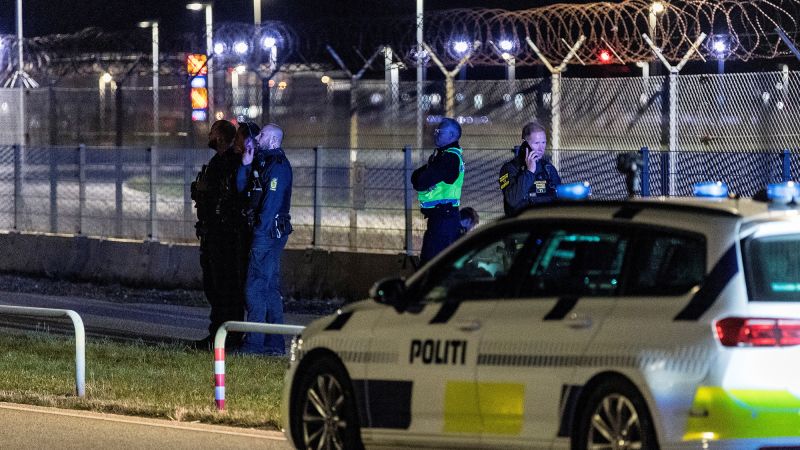
On Monday, Copenhagen Airport, the nation’s busiest hub, was brought to a standstill for nearly four hours.
This was due to two or three large drones loitering menacingly in its vicinity.
Just two days later, the scene repeated itself at Aalborg, forcing a three-hour closure.
The pattern continued with reports of similar activity overnight into Thursday near airports in Esbjerg, Sonderborg, Skrydstrup, and Billund.
This underscores the coordinated nature of the incursions.
The ripple effect even extended to neighboring Norway, where Oslo Airport’s airspace was closed for around three hours due to a separate drone sighting.
This is not random mischief; this is a calculated campaign designed to sew chaos and fear.
Danish officials are not shy about connecting these increasingly alarming dots.
Prime Minister Mette Frederiksen has described the Copenhagen incident as the most serious “attack” on Denmark’s critical infrastructure to date.
She explicitly linked it to recent alleged Russian drone breaches in the airspace of Poland and Romania.
Defense Minister Troels Lund Poulsen acknowledged no direct, irrefutable evidence yet.
However, he stated unequivocally that these were the work of a “professional actor” engaged in a “systematic operation,” with drones launched locally.
The implication is clear: a sophisticated, state-sponsored hand is at play, operating just beneath the threshold of open conflict.
The shadow of Moscow looms large over these events, deepening the chill across Europe.
The continent is already on edge, reeling from a succession of airspace violations by Kremlin drones and aircraft.
These incidents have already prompted Poland and Estonia to invoke NATO’s Article 4, a mechanism for consultations when a member’s security is threatened.
Now, Denmark is considering following suit, a move that would mark a historic first for the nation.
Russia’s Embassy in Denmark has, predictably, dismissed the “absurd speculation.”
However, their denials ring hollow against a backdrop of escalating tensions and a well-documented history of destabilizing tactics.
This is the essence of hybrid warfare: an adversary operating in the grey zone, employing non-military tactics to achieve strategic objectives.
This occurs without crossing the threshold of conventional armed conflict.
As NATO defines it, hybrid attacks aim to “blur the lines between war and peace” through propaganda, deception, sabotage, and other covert means.
Justice Minister Peter Hummelgaard put it succinctly: “The goal with this kind of hybrid attack is to create fear and divisions, and make us scared.”
And in that, the perpetrators are, for now, succeeding, disrupting daily life and injecting a pervasive sense of insecurity.
The choice of Denmark, if Russia is indeed the orchestrator, is far from arbitrary.
Edward Arnold, a senior research fellow for European security at the UK defense and security think tank RUSI, points out Denmark’s robust and unwavering support for Ukraine.
“Their rhetoric is very anti-Russian at the moment due to the war in Ukraine,” Arnold noted, emphasizing Denmark’s significant contributions relative to its GDP.
This suggests a potent “signaling” element – Moscow attempting to warn Copenhagen off its steadfast allegiance to Kyiv.
Alternatively, it could simply be to cause widespread disruption, a baseline tactic for the Kremlin in its ongoing psychological warfare.
The unsettling truth is that the “who” behind the drones might be deliberately obscured.
The possibility that Russian security services are recruiting criminal elements on European soil to carry out these hostile acts is not new.
Ken McCallum, director-general of British intelligence service MI5, warned just last year about state actors increasingly using petty criminals for such purposes.
This outsourcing of aggression adds another layer of deniability and complexity, making definitive attribution a painstaking process.
The widespread availability of sophisticated drone technology, as Arnold highlights, further muddies the waters.
This makes it difficult to distinguish between state-level operations and those of highly skilled individuals.
The very nature of the threat is designed to be elusive.
Perhaps the most chilling aspect of these incursions is the long-term prognosis.
Arnold warns that these relatively minor disruptions could be a “practice run,” a “perfection of the technique” for something far more sinister down the line.
This could potentially involve armed drones.
“What do the Russians, and Iranians for that matter, do when they are successful at certain operations? They replicate them,” he stated.
This suggests that similar incidents could spread to other European nations, perhaps timed for maximum impact during peak travel seasons like Christmas or summer holidays.
The psychological toll of such constant, low-level harassment, creating a pervasive sense of vulnerability, cannot be underestimated.
Defending against such elusive threats presents a formidable challenge.
While closing affected airports is an immediate response, more proactive measures are complex and fraught with risk.
Shooting down drones, for instance, was considered and rejected in Denmark due to the inherent danger posed to civilian populations by stray bullets or falling debris.
Imagine the chaos and potential tragedy if a defensive shot missed its target.
Drone jamming, which uses electronic signals to sever a drone’s link to its operator, offers a less kinetic alternative.
Other innovative solutions include counter-drones equipped with nets or even, as Dutch police demonstrated in 2016, training eagles to pluck rogue devices from the sky.
Yet, even with these ingenious countermeasures, the sheer scale of potential targets and the ease of deployment for these aerial nuisances make comprehensive defense a Herculean task.
This week’s events in Denmark serve as a stark reminder that the battlefields of the 21st century are not always defined by front lines and conventional weaponry.
They are increasingly found in the skies above our airports, in the digital networks that underpin our lives, and in the very fabric of our collective peace of mind.
The drones may be small, but the implications of their presence are anything but, heralding a new, unsettling era of strategic ambiguity.
-
Frank DiBernardo handles LNGFRM's Foodie and Miscellaneous writing tasks. He's always getting ideas from users, so don't be afraid to send an email to the editor.