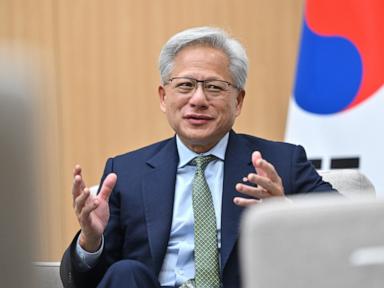
Gyeongju, South Korea – In a whirlwind of technological ambition and geopolitical maneuvering, Nvidia CEO Jensen Huang has descended upon South Korea, cementing a partnership that underscores the nation’s fervent embrace of artificial intelligence, even as he navigates the treacherous waters of U.S.-China trade relations.
His visit, marked by a rockstar reception reminiscent of Apple’s Steve Jobs, culminated in a massive deal set to inject hundreds of thousands of Nvidia’s coveted graphics processing units (GPUs) into the heart of South Korea’s burgeoning AI ecosystem.
The scale of this collaboration is breathtaking. Approximately 260,000 GPUs are earmarked for South Korean projects, a powerful testament to the country’s resolve to become a global AI powerhouse.
The South Korean government will receive 50,000 GPUs to construct a national cloud computing center, a foundational step in democratizing AI access. Simultaneously, tech giants Samsung Electronics and SK Hynix, stalwarts of the semiconductor industry, will each be supplied with 50,000 units to refine their manufacturing processes and accelerate the development of next-generation chips.
Not to be outdone, automotive titan Hyundai Motor, in partnership with Nvidia, will leverage another 50,000 advanced Blackwell GPUs for groundbreaking work in self-driving cars, smart factories, and robotics – areas Huang himself champions as the future of AI, especially when combined with South Korea’s strengths in software and manufacturing.
Huang’s presence in South Korea, coinciding with the Asia-Pacific Economic Cooperation (APEC) forum, has been nothing short of a spectacle.
From sharing fried chicken and beer with Samsung and Hyundai chairmen to engaging with cheering fans at a gaming festival, his casual demeanor in a black T-shirt belied the immense gravity of the deals he was forging and the complex political landscape he was traversing.
His acknowledgment of Korea’s gaming scene as instrumental to Nvidia’s early success resonated deeply, forging a connection beyond mere business transactions. It’s a masterclass in soft diplomacy, demonstrating how personal engagement can amplify corporate strategy on a global stage.
Yet, beneath the surface of this enthusiastic collaboration lies a stark reminder of the global AI race’s complexities: the ongoing saga of U.S. chip export restrictions to China.
In a remarkable turn of events, President Donald Trump, fresh from discussions with Chinese President Xi Jinping in Busan, indicated a willingness to ease some trade tensions, including potentially allowing certain computer chip sales to China.
Huang, ever the pragmatist, expressed his fervent hope to eventually sell Nvidia’s most advanced Blackwell chips to China, arguing that it serves the best interests of both nations. He acknowledged U.S. security concerns but countered that China already possesses substantial AI capabilities, rendering the military application of Nvidia’s chips largely redundant.
This delicate dance between commercial ambition and national security highlights the tightrope Nvidia, and indeed the entire tech sector, must walk.
While an August deal under Trump reportedly allowed some advanced chip sales to China in exchange for a revenue cut, the current administration, like its predecessor, has largely maintained a firm stance on restricting access to cutting-edge AI technology, particularly the advanced Blackwell series.
Huang’s public statements reflect a company caught between immense market opportunity and the geopolitical realities dictated by Washington. His sentiment – “We’re always hoping to return to China… but that’s a decision for the president to make” – underscores the limits of corporate agency in an era of heightened economic nationalism.
Nvidia’s journey to becoming the first $5 trillion company, achieved in a mere three months after crossing the $4 trillion mark, speaks volumes about the insatiable demand for its technology, which powers much of the global AI industry.
This meteoric rise is widely hailed as the most significant technological shift since the iPhone’s debut 18 years ago, transforming industries and redefining human-computer interaction.
However, this exhilarating ascent is not without its shadows. Financial watchdogs, including officials at the Bank of England and the head of the International Monetary Fund, have sounded alarms about a potential AI bubble, warning that the current tech stock frenzy could lead to a sharp correction.
As South Korea positions itself at the vanguard of AI development with Nvidia’s formidable support, the narrative unfolds as a complex tapestry of innovation, aspiration, and caution.
Jensen Huang, the unlikely rockstar CEO, stands at the nexus of technological revolution and geopolitical tension, embodying both the immense promise of AI and the profound challenges that accompany its global proliferation.
The future of AI, it seems, will be shaped not just by silicon and software, but by diplomacy, policy, and the delicate balance of international power.
-
Frank DiBernardo handles LNGFRM's Foodie and Miscellaneous writing tasks. He's always getting ideas from users, so don't be afraid to send an email to the editor.