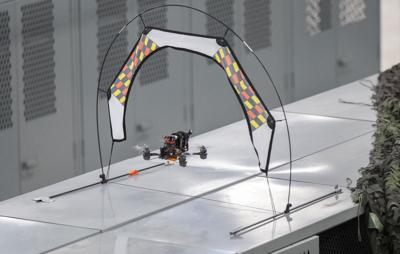
The landscape of modern warfare is shifting, not with the roar of jets or the thundering of tanks, but with the silent, insidious hum of drones.
For a nation that prides itself on military innovation and overwhelming technological superiority, the recent revelation that the United States lags significantly behind countries like China and even war-torn Ukraine in drone production comes as a sobering wake-up call.
It’s a reality underscored by President Donald Trump’s recently signed “megabill,” a legislative behemoth that funnels billions into the Department of Defense’s drone programs, a stark admission of a critical deficit.
This massive financial injection, part of a staggering $150 billion set aside for defense spending within the bill, aims to bridge a chasm that has widened almost unnoticed.
While the U.S. was projected to acquire a mere 4,000 drones this year, Ukraine, battling a full-scale invasion, is reportedly churning out an astonishing 4,000 to 5,000 drones daily.
Their ingenuity, born of necessity, sees engineers and troops collaborating to 3D print drones in makeshift basement workshops (source).
Meanwhile, China has quietly cornered 70% of the global drone market, a dominance that should send shivers down the spines of national security strategists (source).
Doug Beck, director of the Defense Innovation Unit, did not mince words before a congressional hearing, stating, “We have got a long way to go to get to the level of meeting the threat and the level of pacing change that’s necessary.”
It’s a sentiment echoed by Maj. Gen. David Stewart, director of the Joint Counter-Small Unmanned Aircraft Systems Office, who painted a grim picture of the evolving threat.
He warned lawmakers that small unmanned aerial systems are proving more dangerous than the improvised explosive devices that plagued U.S. troops in the war on terrorism, possessing the chilling capability to actively target personnel from the air (source).
This isn’t just about surveillance anymore; it’s about precision lethality delivered from above, changing the calculus of ground combat.
The “Big Beautiful Bill” attempts to address this gaping hole with targeted investments.
It allocates $1 billion to bolster the industrial base for one-way attack drones and another $1.4 billion for the production of small unmanned aerial systems (source).
The maritime domain, too, is seeing a significant influx, with over $5.5 billion earmarked for naval drones, including a curious $250 million for wave-powered unmanned underwater vehicles.
Counter-drone systems, the defensive shield against this new aerial menace, will also receive a crucial $1.3 billion.
These figures, while substantial, are just a fraction of Trump’s proposed $1 trillion defense budget for the coming year, indicating a long-term commitment to a rapid pivot.
Michael O’Hanlon, director of research in the Foreign Policy Program at the Brookings Institution, acknowledges the significance of these investments, deeming them necessary across all categories: short and long range, maritime and land-based, offensive and defensive.
His highest priority for drone development rests on medium-range systems, specifically to counter China’s growing influence.
Yet, O’Hanlon injects a dose of pragmatic skepticism, noting that one-time financial injections, no matter how large, rarely revolutionize the defense landscape overnight (source).
“DoD rarely remakes the world or rebuilds its weaponry within just one year,” he cautioned, hinting at the deep-seated bureaucratic inertia that often plagues major defense overhauls.
Indeed, the challenge extends far beyond mere dollars.
Beck highlighted the critical need for a fundamental shift in the Pentagon’s procurement philosophy.
The traditional “programs of record,” rigid and slow-moving, are ill-suited for an era where technology evolves at breakneck speed.
He advocates for “portfolios of record,” a more flexible approach that acknowledges the rapid obsolescence of specific technologies and allows for continuous adaptation.
“It makes no sense to identify exactly what you are going to buy in two years, when the thing doesn’t exist yet,” Beck rightly pointed out, encapsulating the dilemma.
Furthermore, he stressed the importance of seamlessly linking America’s burgeoning hardware and software development capabilities within emerging companies to advanced manufacturing processes, enabling the mass production of drones at scale—a feat Ukraine has achieved out of sheer necessity.
While the DoD grapples with this overarching strategic recalibration, some parts of the military are already adapting.
At the Joint Counter-Small Unmanned Aircraft Systems University at Fort Sill, Oklahoma, the Army has embraced 3D printing to produce drones for training purposes, saving an estimated $3.6 million by spending just $360,000.
Similarly, Fort Carson has been proactively preparing soldiers to detect and survive drone attacks, a testament to the growing realization that drones will soon be an integrated component of every squadron.
This forward-thinking approach stands in stark contrast to past missteps, such as the Army’s abandonment of the 11-foot Shadow drones, which proved ill-suited for the modern battlefield.
The megabill’s billions are a powerful statement, an acknowledgment that the U.S. cannot afford to be outmaneuvered in the silent skies.
But as the experts suggest, money alone won’t secure victory in this new domain.
It requires a radical reimagining of how the military innovates, procures, and deploys technology, shedding the rigidities of the past to embrace the agile, adaptable future of warfare.
The hum of the drone is not just a sound; it’s a call to action, demanding a fundamental transformation if America is to reclaim its technological edge.
-
Frank DiBernardo handles LNGFRM's Foodie and Miscellaneous writing tasks. He's always getting ideas from users, so don't be afraid to send an email to the editor.