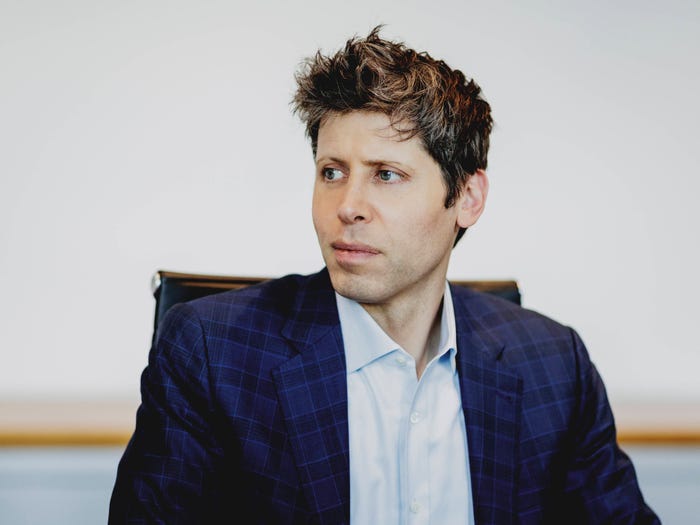
In a world increasingly shaped by algorithms and machine learning, the architect of our AI future, OpenAI CEO Sam Altman, has revealed a surprisingly grounded vision for his own post-technological existence: he wants to become a farmer.
It’s a startlingly humble ambition for a man who stands at the very frontier of artificial intelligence, a pastoral counterpoint to the gleaming silicon valleys he currently inhabits.
Yet, this isn’t merely a whimsical fantasy; it’s a deeply telling glimpse into the mind of someone who believes the era of human intellectual supremacy is already waning, if not entirely past.
Altman, the figurehead of the company behind ChatGPT, articulates not just a resignation but an outright enthusiasm for the day an AI can run OpenAI better than he can.
“I will be nothing but enthusiastic the day that happens,” he told Axel Springer CEO Mathias Döpfner.
This isn’t the reluctant surrender of a CEO facing obsolescence; it’s the confident pronouncement of a visionary who sees his own creations as the logical next step in executive evolution.
He posits that the age where machines are smarter than humans is not a distant sci-fi trope but a present reality, at least in certain sectors.
His chosen alternative, a life tilling the soil, offers a stark contrast to the high-octane world of tech innovation.
Altman speaks fondly of his farm, where he spends “some of the time,” recalling days when he used to “drive tractors and pick stuff” before ChatGPT’s meteoric rise consumed his schedule.
While his extensive real estate portfolio, including multimillion-dollar residences in San Francisco, Napa, and a $43 million estate in Hawaii, suggests a certain comfort level, the yearning for the farm speaks to a profound pivot.
It’s a return to the elemental, a rejection of the abstract for the tangible, perhaps a human anchor in a world set adrift by artificial intellect.
This isn’t just a personal preference; it’s steeped in Altman’s profound understanding of AI’s trajectory.
He predicts that by the end of this decade, specifically by 2030, the world will witness “extraordinarily capable models that do things that we ourselves cannot do.” (source)
The pace of progress is so rapid, he suggests, that even by 2026, the capabilities of AI models will be “quite surprising” if we were to encounter them today.
These aren’t the musings of a pundit, but the projections of a man steering the ship.
Such rapid advancement, Altman readily admits, will be a disruptive force.
“In the short term, AI will destroy a lot of jobs,” he concedes, echoing widespread anxieties about automation. (source)
However, he holds a long-term optimism, believing that, like every other technological revolution, humanity will “figure out completely new things to do.” (source)
These new vocations, he speculates, will likely revolve around helping one another.
This is where Altman’s commentary takes a truly insightful turn, challenging our conventional understanding of human exceptionalism.
He argues that what makes humans unique isn’t our “intellectual capacity”—because, frankly, “they already are” smarter than us—but rather “the way we care for one another.” (source)
He attributes to humanity a kind of “main character energy,” an inherent self-importance that allows us to overlook or perhaps even embrace the superior intellect of machines.
This perspective offers a fascinating, if somewhat unsettling, redefinition of human value in the age of superintelligence.
If our intellectual prowess is no longer our distinguishing feature, and if machines can perform complex tasks, including leadership, with greater efficiency, then our capacity for empathy, compassion, and interpersonal connection becomes our most precious commodity.
It suggests a future where the essence of being human shifts from conquering the world with our minds to nurturing it with our hearts.
Altman’s vision of a farming retreat, then, isn’t merely a personal escape; it could be seen as a metaphor for humanity’s future role.
If AI handles the complex, intellectual heavy lifting of running companies and systems, perhaps our collective purpose will indeed return to more fundamental, interpersonal, and nurturing endeavors.
The irony is palpable: the man who is propelling us toward a future where machines manage our most complex enterprises envisions his own highest calling in the simplest, most ancient act of creation—cultivating life from the earth.
It prompts us to consider: if the architect of AI is ready to step aside for his creations, what does that mean for the rest of us, and what will our fields of endeavor look like when the machines truly take the reins?
The answer, according to Altman, lies not in outsmarting them, but in simply being human.
-
Frank DiBernardo handles LNGFRM's Foodie and Miscellaneous writing tasks. He's always getting ideas from users, so don't be afraid to send an email to the editor.